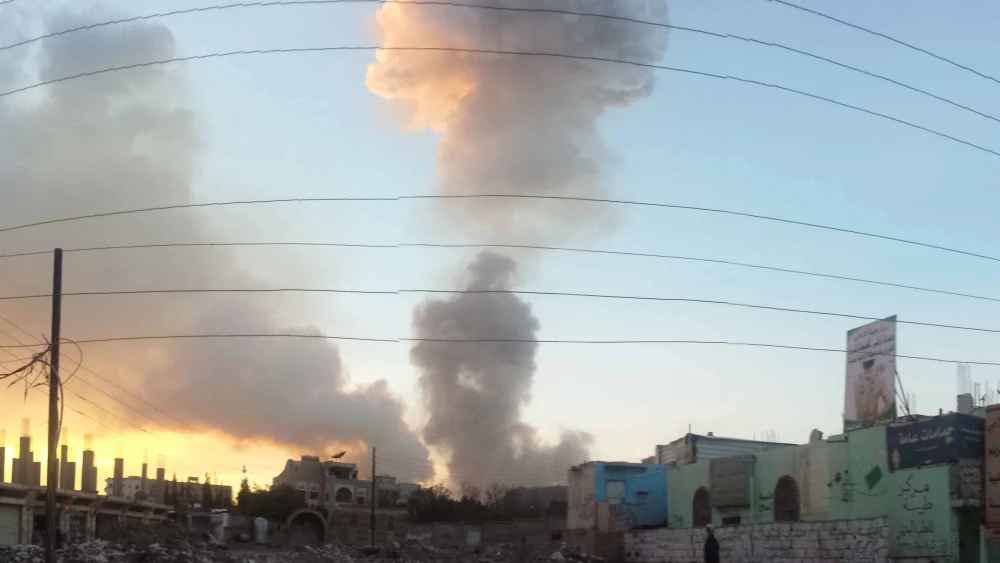
U.S. military strikes in Yemen in recent weeks have killed at least 500 Houthi fighters, including senior commanders, a Saudi newspaper reported on Tuesday, based on interviews with U.S. officials and Yemen’s information minister.
Speaking to Al Arabiya, Yemen’s Information Minister Moammar al-Eryani confirmed that American strikes had “targeted significant elements of Houthi military infrastructure, including command and control centers, training camps, weapons depots, and communication facilities.” He described the results as “a clear indicator of the campaign’s effectiveness,” noting that among the dead were high-ranking leaders responsible for maritime attacks and arms smuggling.
“This is not just Yemen’s war. It is a battle for the international order, for freedom of navigation, and to protect the region from the expansion of the Iranian regime and its terrorist militias,” said al-Eryani, stressing the broader regional implications of the ongoing conflict.
Yemen’s internationally recognized government has verified the deaths of senior Houthi figures in what it described as a strategic shift in dealing with the Houthi terrorists. Al-Eryani praised the Trump administration’s handling of the conflict, characterizing the airstrikes as “precise” and “justified” in the face of continued Houthi aggression.
U.S. President Donald Trump launched the operation against the Houthi militia, a proxy of Iran, as a response to Houthi attacks on international shipping and Israel. U.S. Central Command (CENTCOM) recently confirmed the destruction of a fuel facility in western Yemen, part of an effort to cut off the group’s funding and logistics.
U.S. strikes have devastated multiple Houthi training camps, severely weakened the group’s air defense systems, and reduced their capacity to launch drone and missile attacks, particularly in the Red Sea and Bab al-Mandab, according to Al Arabiya.
The Houthis have not publicly acknowledged the scale of their losses. According to Yemeni officials, the group has pressured families to stay silent and launched disinformation campaigns to counter leaked casualty figures, hoping to avoid unrest within their support base.
“The current instability in the Middle East is a result of years of international negligence toward Iran and its behavior in the region. Continued American resolve is essential to reversing that trend,” said al-Eryani.