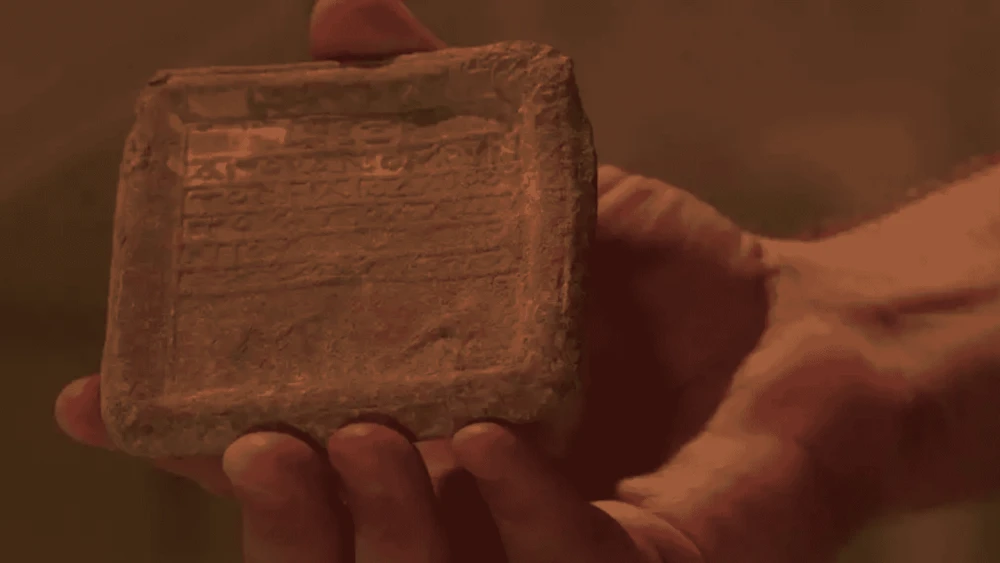
A rare lead weight in excellent condition, bearing an ancient Greek inscription from the Hellenistic period, was seized this week in Jerusalem during a special operation by the Israel Antiquities Authority (IAA).
The weight, dated to 147–148 BCE, was discovered during an intelligence-based operation by the IAA’s Unit for the Prevention of Antiquities Theft in a Jerusalem shop. IAA inspectors questioned the store owner to trace the intermediaries and thieves who removed the weight from its original site.
The archaeological find is inscribed with the text “Heliodorus, son of Apollonius, agoranomos"—the name and title of a government official responsible for overseeing the accuracy of measurements and weights in markets to prevent commercial fraud. The date indicated on the weight—the year 165 of the Seleucid era—corresponds to the Hellenistic period in the Land of Israel, when the Seleucid Empire controlled vast regions of the Middle East.
Ido Zangen, a researcher at the Israel Antiquities Authority, explained, “The Greek names Heliodorus and his father, Apollonius, indicate a Hellenized population. Both names are linked to the sun gods in Greek mythology, Helios and Apollo, suggesting a cultural-religious connection to the Hellenistic culture that dominated the Land of Israel at that time.”
Zangen added that such names were common in the region of Idumea (modern-day southern Judea).
One of the surprising discoveries about the weight is its remarkable precision, corresponding exactly to one mina, the standard unit of weight for the period, equivalent to one hundred Greek drachmas. Researchers identified a mark resembling the Greek letter M on the weight as an abbreviation for the word “mina.”
Alongside the inscription, there is also an illustration of a dolphin, the significance of which is still under investigation. Researchers hope that deciphering the symbol will help identify the specific city from which the weight originated.
The weight will be transferred for further in-depth study to expand understanding of the economic and social life during the Hellenistic period in the Land of Israel.
This article was originally published in Israel Hayom.