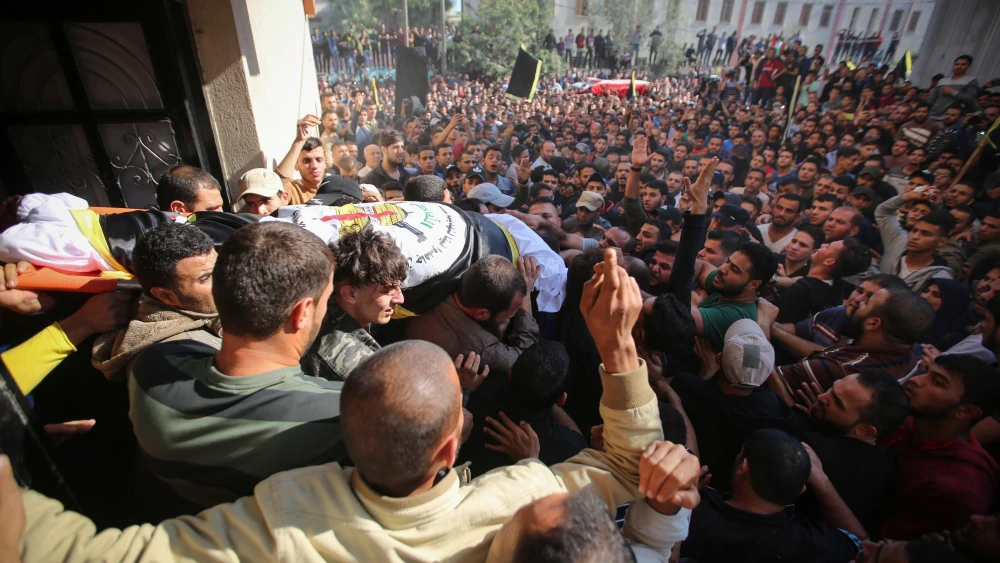
The Israeli assassination of a senior Palestinian Islamic Jihad commander in the Gaza Strip removed what Israeli officials have called a “ticking time bomb” from the Gazan arena—a terrorist leader who was in the final stages of preparing imminent attacks on Israel.
The Iranian-backed terror organization sustained a painful surprise blow. Hamas sat on the sidelines and did not get involved in the first hours of the battle that erupted between Israel and Palestinian Islamic Jihad on Tuesday following the early-morning strike.
Hamas’s inaction in the first stage of this escalation is highly revealing of its desire to avoid war at this time. The question of whether Hamas continues to remain so (as was the case at the time of this writing) or chooses to join the escalation will be crucial in determining where the current escalation is headed. As time goes by, pressure will grow on Hamas to become involved or risk being branded by PIJ as a “traitor” to the jihadist cause.
Hamas’s initial attempt to stay out of the new fight does not stem from any ideological softening up of its jihadist ideology, but rather from the fact that it is also a regime responsible for governing 2 million people—a heavy consideration that PIJ, the second-largest terror faction in Gaza with no governing responsibilities, is free to ignore.
As a result, while Hamas has been engaged in talks with Egypt for months to look for a long-term truce with Israel and generate some economic relief to avoid a popular revolt, PIJ has been playing the role of a pyromaniac at a gas station.
Specifically, it was Baha Abu al-Ata, a senior PIJ terror chief, who kept trying to ignite the region, launching repeated attacks on Israelis, and in doing so, challenging Hamas’s sovereignty legitimacy. His refusal to recognize the Hamas-Israel truce meant he that was an enemy not only of Israel, but also a disruptive thorn in the side of Hamas.
That changed at approximately 4 a.m. on Tuesday, in a joint Israeli Air Force and Shin Bet intelligence agency operation. The surgical strike killed al-Ata, and reportedly his wife by a missile that entered only the floor of the building on which they were staying.
Al-Ata usually took great care to travel around Gaza secretly, surrounded by human shields, as he took advantage of Israel’s rules of engagement. But he made a mistake, staying the night in a room not surrounded by human shields, and the Israeli defense establishment seized on the opportunity.
“Officially, he was the commander of the northern brigade of the PIJ. But actually, his influence extended far beyond northern Gaza,” IDF Spokesman Lt. Gen. Jonathan Conricus told reporters by conference call.
Al-Ata was behind almost all of the Gazan attacks on Israeli civilians and soldiers in recent months, including the Memorial Day rocket attack on southern Israel in May, an Aug. 25 rocket barrage on residents of southern Israel, sniper fire on Israeli soldiers and multiple plans to conduct attacks in the near future.
Such attacks included sniper fire, bombs and rockets at Israeli forces, and possibly at civilians, stated Conricus.
The IDF had no comment about reports that an Israeli airstrike also targeted another senior PIJ operative—this time in Damascus, Syria—on Tuesday morning. Reuters said that attack killed two people, including the target’s son.
The long reach of Israeli intelligence
The combined strikes, according to international media sources, sent a major message to PIJ’s leadership, telling it that it could not count on immunity, anywhere, and that it was never safe from Israel’s reach if it pursued active terror plots.
PIJ Secretary General Ziad Nakhaleh, who is usually based in Beirut, and travels to Damascus and Tehran frequently, received repeated Israeli warnings in recent months, telling him to tone down al-Ata’s activities. Media warnings were also sent to inform al-Ata that the IDF was aware of his plans. None of this convinced him to take a step back from the brink; Al-Ata planned more attacks for the coming days.
In its initial response, PIJ fired more than 150 rockets in the direction of millions of Israelis—from Tel Aviv in central Israel to the south. The Iron Dome air-defense system has been extremely effective, intercepting most of the projectiles heading towards built-up areas.
But the risk to the public’s safety remains, and the Home Front Command has cancelled schools and non-essential activities. The economic disruption is substantial, and in terms of image, PIJ has retaliated by sending Israelis in the heart of the Tel Aviv metropolis running for cover.
The IAF has since launched multiple waves of airstrikes targeting the PIJ throughout Gaza. This is unusual as in the past, Israel focused most of its strikes on Hamas, holding it accountable as Gaza’s ruler for the actions of other Palestinian armed factions.
Now, Israel is engaged in a different sort of operation. The aim is to isolate PIJ, based on the recognition that it has been the central catalyst for violence.
Behind the scenes, Egypt will be conducting intensive shuttle diplomacy, trying to reign in PIJ and prevent Hamas from joining the combat. One cannot rule out that Israel has demonstrated to PIJ that it can reach its terror chiefs in any location in the Middle East, using high-quality intelligence and precision air power.
That will likely boost Israel’s deterrence. But escalations can take on a dynamic of their own, and the fate of the current round largely depends on what Hamas does next.