Eighteen-year-old S. lies in an underground hospital bed at Galilee Medical Center in Nahariya. An Arab citizen of Israel, he was in a car accident a week ago and brought here. Because of the frequent Hezbollah rocket attacks, virtually the entire hospital has moved underground.
The wards are crowded, with beds separated only by curtains. There’s a bit of a traffic jam as patients are moved to and from the wards.
“It’s a little hard being underground, but the doctors are great,” S. tells JNS. “I feel like I’m getting very good care.”
His mother, V., has the tired look common to mothers whose children are in the hospital. “I haven’t been to a hospital since I gave birth,” she says. “It is a little hard here because it is crowded, but I know he is getting good care.”
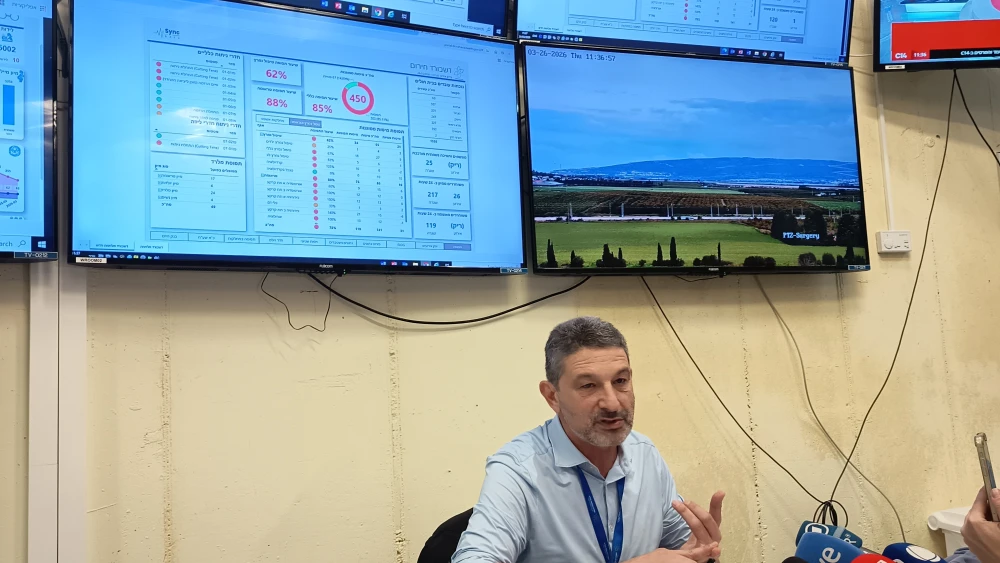
Galilee Medical Center is the closest hospital to any of Israel’s borders, says Deputy Director Dr. Tzvi Sheleg. In a meeting with journalists in an underground headquarters, screens on the wall show the latest statistics about the medical center, including how many beds are occupied and the reserves of the blood bank.
Sheleg says that in “normal” times, the Western Galilee facility has 800 beds and serves a diverse population of 650,000 people. Within four hours after the Israeli attack on Iran on Feb. 28, more than 400 patients had been moved underground, along with operating rooms and trauma rooms. There is even an underground corridor that is wide enough for an ambulance to drive through.
A separate section of the underground hospital has an air purification system in case the hospital is attacked with chemical weapons.
He said that since the beginning of the war, they have received at least 330 patients, most of them civilians. Hours after a group of journalists visited, a rocket fired by Hezbollah scored a direct hit on a residential parking lot, killing Uri Peretz, 43, a father of four, and wounding a dozen others. The wounded were brought to Galilee Medical Center. The rocket was just one of 100 that Hezbollah fired that day.
Sheleg says that because the Lebanon border is so close, there is often no warning time for missile fire, with the air-raid sirens sometimes sounding after the projectile has hit. In 2006, a rocket scored a direct hit on the ophthalmology department, where he was a resident at the time.
Since then, he said, the hospital has repeatedly had to move some of its operations underground. They have now been completely underground since the first day of the current war.
In the Galilee Panhandle
Even closer to the border is the Eastern Galilee town of Metula, which is surrounded on three sides by Lebanese territory. Before the Oct. 7, 2023, war began, there were about 1,200 residents living here and a burgeoning food truck scene. Soon after the war began, the government evacuated all the residents, and since then, only 40 to 60% have come back.
Miry Menashe, co-owner of the Bela café on the town’s main street, says evacuating the residents was a mistake. During the year that the community was empty, every house was damaged, either by Hezbollah attacks or by animals, she says.
Menashe, married and a mother of two teenagers, served as an officer in IDF reserves for over a year, and became a partner in the café last year. They reopened in December 2025 and haven’t closed their doors since.
“Our lives were stopped once for too long,” she tells JNS. “I will not willingly leave my home again. I have full confidence in the army to finish the job.”
As she operates the espresso machine, loud booms echo outside the café. Neither she nor any of the handful of customers flinches.
“It’s outgoing,” one man says. “We’re attacking Lebanon, not the other way around.”
The day we visited, Hezbollah fired more than 100 rockets at northern Israel, including at Metula. The café has a bomb shelter, and residents seem inured to the constant attacks.
“We had a bomb fall 10 meters from here on Saturday,” Menashe says matter-of-factly. “The sirens started after the bomb fell. Ten minutes later, everyone was back here drinking coffee.
These days, she serves coffee only in disposable cups.
“First of all, I’m tired of doing all the washing,” she says. “This way it’s also easier to take the coffee with you to the bomb shelter if there’s an attack.”
One of the customers, Eitan Redlich, is a reserve soldier who is trying to get some work done on his computer. It is his seventh round of reserve duty since Oct. 7. Originally from Chicago, he made aliyah eight years ago and has left his wife and three young children in Zichron Ya’akov.
“An hour ago, I was in Lebanon,” he says. He fully supports the war against Hezbollah and hopes the army continues until the job is done.
“We can have peace with Lebanon, but not with Hezbollah,” he says. “Their sworn goal is to destroy us, and every house we went into had weapons and explosives.”
Israel has an opportunity to permanently push Hezbollah north of the Litani River, Redlich says, and he hopes the army will fulfill its mission and make life safer for all the residents of northern Israel.