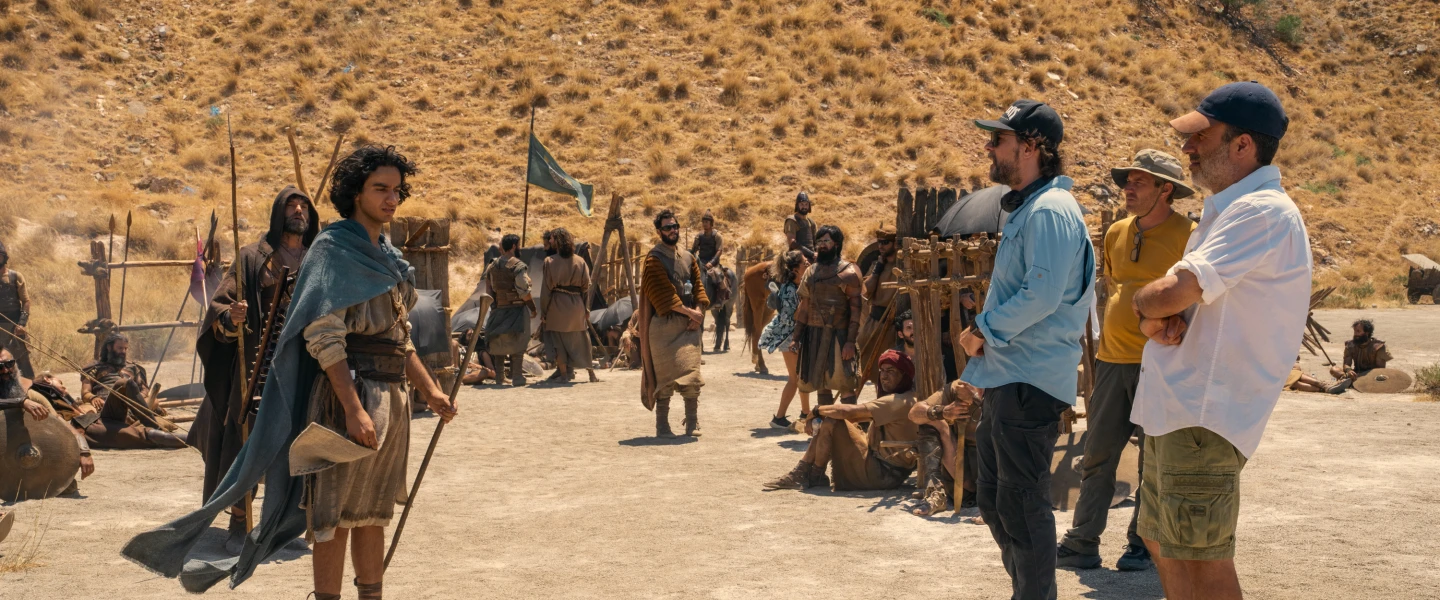
A humble childhood, a meteoric rise to power, a fatal love affair, a confrontation with a giant.
It’s no surprise that the life of King David, as told in the biblical book of Samuel, has attracted generations of filmmakers, with the second king of Israel played by Gregory Peck and Richard Gere, among others. More recently, the first season of “House of David” drew 22 million viewers in its first two weeks on Amazon Prime last year, with a second season released a little more than a week ago, on March 27. David also features in a new animated musical and a four-part biopic from Fox Nation.
Unlike previous adaptations, however, these new David shows are produced by Christian filmmakers, part of a wave of faith-based programming that began with “The Chosen,” a sleeper-hit series dramatizing the life of Jesus. “There’s a lot of interest in leadership and heroes, flawed or otherwise, right now,” says David Wolpe, rabbi emeritus of Sinai Temple in Los Angeles and author of the biography David: Divided Heart. “David’s is the fullest story in the Bible. Moses’s story isn’t so much about Moses, but David’s story is all about David.”
Still, the strong interest in David from a Christian perspective might seem surprising, given the central role he plays in Jewish tradition, where his name is synonymous with national glory and endurance. But David has long been important to Christians, though their interpretations of his tumultuous life sometimes differ. In fact, the new interest in his story revives a debate that has lasted for more than two millennia: about whether David should be remembered purely as a hero—or as something more complicated.

Faith over fear
The Bible devotes two books, Samuel 1 and 2, to David’s biography (he also appears briefly in Kings 1 and Chronicles). But Christians rely on a different text to understand David—one that, according to tradition, he authored.
“Christians have an image of David’s spirituality—David’s relationship with God—that comes from the Psalms” (Tehillim), says John Goldingay, professor emeritus of Old Testament at Fuller Theological Seminary and author of 1 and 2 Samuel for Everyone. “When they look at the Psalms, they see people declaring their trust in God, praising God, thanking God for what He’s done, and also pleading with God to act on their behalf. And they infer that that’s how David lived his life.”
In “House of David,” the young David plays the lyre and sings psalms in Hebrew—skills that Egyptian-American actor Michael Iskander acquired for the role—while he tends his father’s sheep in the hills around Bethlehem. Jenn Levine, who served as the show’s Jewish consultant, says the filmmakers were careful to match the psalm to the story: “There were occasions where they would say, ‘Which psalm would be appropriate for a scene where this is happening,’ and I would dive in and present them with some options.”
The music of the psalms returns during David’s confrontation with the giant Goliath in the first season finale. The most well-known episode in David’s life (and the source of countless underdog analogies), the battle is portrayed as a simple triumph of good over evil and faith over fear.
But a closer look at the episode reveals a side of David that is absent from the new shows. In the lead-up to their fight, David and Goliath exchange insults across the battlefield. “It becomes almost like a playground spitting battle,” says Yitzchak Etshalom, rabbi and host of the podcast “Between the Lines of the Bible.” In a frequently quoted line, David loudly proclaims that while Goliath will attack him with armor and a sword, his own weapon of choice is “the name of the Lord.”
“He doesn’t mention the slingshot or the rocks,” Etshalom notes, weapons that David will skillfully employ to disable Goliath before using the giant’s own sword to cut off his head. Jewish tradition, too, attributes the Psalms to David’s authorship. Yet generations of Jewish scholarship on the books of Samuel yield a more nuanced portrait of a leader whose faith was tempered by a healthy dose of pragmatism.
“The story of Goliath highlights David’s bravery, no question. But it also shows his strategy,” Etshalom says. “He’ll do whatever it takes to win.”

A darker persona
Giants make for exciting television: In “House of David,” producers used AI to make Martyn Ford, the 6’ 8” British bodybuilder cast as Goliath, even taller—to chilling effect. They also raise questions about the story’s historical accuracy, a subject long contested by academic scholars.
“Historical evidence for David is very, very slim. There are no archaeological remains that can be securely dated to David’s time,” says Steven L. McKenzie, professor of Hebrew Bible at Rhodes College in Memphis, Tenn., and author of King David: A Biography. Scholars estimate that, if he existed, David lived in the 10th century BCE. The oldest artifact related to David, a fragment of a monument that mentions the “House of David” and dates from the ninth century BCE, was discovered in northern Israel in 1993.
(Biblical archeologist Eilat Mazar wrote about the “large-stone structure” she discovered in the oldest part of Jerusalem in 2005, believing that it was David’s palace, though the identification remains disputed.)

McKenzie is one of several modern scholars who argue that David was, in fact, a historical figure. Current scholarship, however, rejects the idea that David authored the Psalms. Even the biblical stories that emphasize David’s faith are, McKenzie believes, an attempt to soften the image of an otherwise brutal and ruthless leader. “It’s been a very long process of turning David into some kind of saint.”
The darker side of David becomes unavoidable later in his story, most famously in his affair with Bathsheba, the wife of one of his generals, Uriah the Hittite. To cover up the scandal, David orchestrates the general’s death before marrying Bathsheba. Later, she will become the mother of King Solomon, David’s successor.
“House of David” has not dramatized the episode with Bathsheba (the new season covers the internecine conflicts that follow his triumph over Goliath). But the story has long troubled both Jewish and Christian readers. Early Christian polemics compared David unfavorably with Jesus, who never sinned. Perhaps as a result, a well-known discussion in the Talmud seeks to prove that David’s actions were not actually a violation of Jewish law. More recently, the story has been used by faith leaders to excuse the personal failings of powerful men.
The text itself, however, is unequivocal about David’s guilt. He is severely punished for his sin, his life spared only after confession and repentance. “Our heroes are human. They make mistakes,” Etshalom says. “They’re not judged on their perfection, but on how they deal with setbacks—and how they deal with their own failures.”

Once and future king
Just before the episode with Bathsheba, in the seventh chapter of 2 Samuel, God tells David that his dynasty will endure forever. Both Jews and Christians would come to understand this promise as a reference to a future redeemer, who would be a descendant of David. Early Christians saw David as a “type,” or precursor of Jesus. Like David, the New Testament asserts, Jesus was born in Bethlehem; he is known as the “good shepherd,” and the gospels refer to him as both “son of David” and “king of the Jews.”
For Jews, David has always been important for his own sake. His flaws and contradictions, like those of many other biblical characters, became an opportunity for deeper study—and debate.
The new David adaptations may not reveal the full complexity of his character, but even the most basic summary of his life raises questions that lead to deeper discussion. “Any interest in the characters of the Hebrew bible is a positive thing,” Wolpe says. “There is such tremendous biblical illiteracy in the United States compared to how important those figures were to the people who shaped this nation that I think getting to know at least something about them is almost an unalloyed good.”
However it is told, David’s life carries a lesson that both religious traditions can embrace. “Here’s this extraordinary, mysterious, up-and-down guy, and God works through him,” Goldingay says. “God works with the world, with Israel, with us, as we are. Because what alternative does He have?”