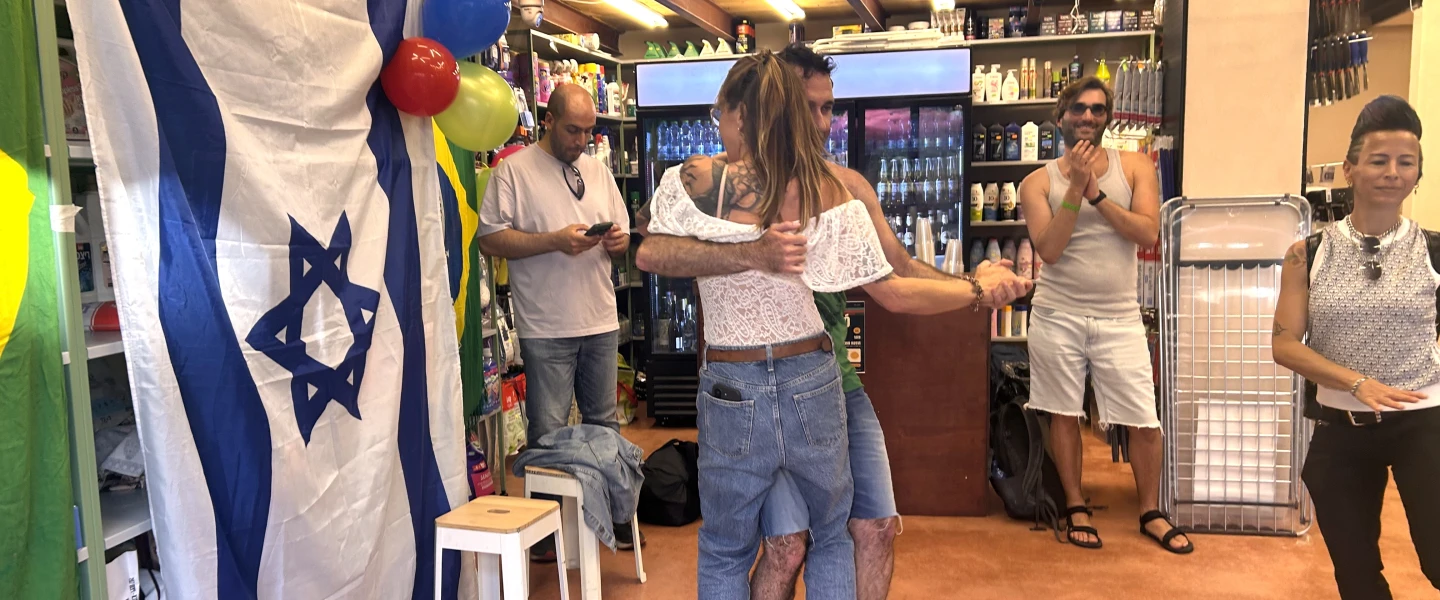
One week ago, a few hours before the sun set and Shabbat began, I found myself in the middle of a Latin street party. People of all ages and ethnicities—Jews, Arabs, tourists, locals—were salsa dancing. One couple expertly executed tango moves. Another spun and swayed to the vibes.
Music wafted through the air, coupled with the smells of food of all kinds. Tables were overflowing with fresh fruit and vegetables, buckets of olives, bottles of oil and wine, mounds of pita bread, babka.
Vendors yelled out their wares in the waning hours of daylight.

There I was, wandering through the bustling open-air shuk that runs along HaCarmel Street in Tel Aviv during my first trip to Israel as part of a press tour focused on antisemitism, sponsored by the Or Ofir Foundation and the Israeli Ministry of Tourism. At the age of 74, I was finally experiencing a place I’d heard about all my life.
Prior to the trip, more than one of my friends gave me a heads-up; they described the experience of visiting Israel as “life-changing.”
The concept of Jews being in the majority certainly was different. I had never before felt anything but part of a small minority of the U.S. population. I grew up in a small town in Southern Illinois where our family was the only Jewish household. We eventually moved to suburban St. Louis, where Jews and non-Jews created many of the city’s most important medical and educational institutions.
In Israel, I couldn’t help but notice the Star of David on numerous buildings. The blue-and-white flag can be seen everywhere. Jews clearly make up the majority of the population, but diversity is a reality in Israel; it’s a melting pot where Jews, Christians, Greek Orthodox, Muslims, Druze, Bedouin and so many others live side by side. Sometimes, they are confrontational, but more often than not—a fact rarely heralded by the international press—everyone is focused on their own domestic issues and families.


I discovered that Israelis look and dress a lot like Americans. Traffic in Tel Aviv seemed to be perpetually gridlocked, like many U.S. cities during rush hour.
I had heard that the food in Israel was incredible. I wondered if that was a hyperbolic description until I arrived at the hotel breakfast buffet on day one. It reminded me of a sumptuous cruise ship array of fruits, cheeses, breads and countless varieties of egg dishes. A fellow delegate saw me surveying the spread with amazement. He laughed and said, “Pace yourself.”
My week there was just long enough to get a glimpse of the sights, sounds and tastes of this complicated nation.
Our contingent experienced the tribute to Jewish renewal at the ANU Museum of the Jewish People. We visited Tel Aviv University, a research powerhouse, and the Peres Center for Peace and Innovation, which showcases startup businesses developed in Israel. Outside the entrance, I saw a small garden with a series of tiny tubes. I learned it was the common practice of drip irrigation, a water-saving method of agriculture developed in Israel in the 1950s.

Like many innovations, it was born out of necessity; it’s challenging to grow crops in the desert.
I was processing all that I had witnessed in the whirlwind trip on that final Friday afternoon. It was my first time in a shuk, which felt like a farmers’ market on steroids. The colors burst out from the stalls, like the sight of dozens of ripe pomegranates cut in half to reveal their juicy, ruby-red seeds. I didn’t know that many kinds of halva even existed.
After emerging from the seemingly endless line of vendors, I heard salsa music and spotted the dancers. It turns out this is a regular pop-up event in Tel Aviv.
I was lucky to have been in the right spot at the right time to see people from all walks of life, representing various cultures, dancing and celebrating life—the perfect ending to an enlightening adventure.