By the time lunchtime arrives on Tel Aviv’s Pinsker Street, it is hard to imagine that this was once the scene of one of the most devastating missile strikes of the Iran-Israel war.
Cafes are full. Diners sit under the shade of mature trees. Cyclists and scooters weave through the traffic. The neighborhood has regained much of its familiar rhythm.
But midway down the block, the illusion ends.
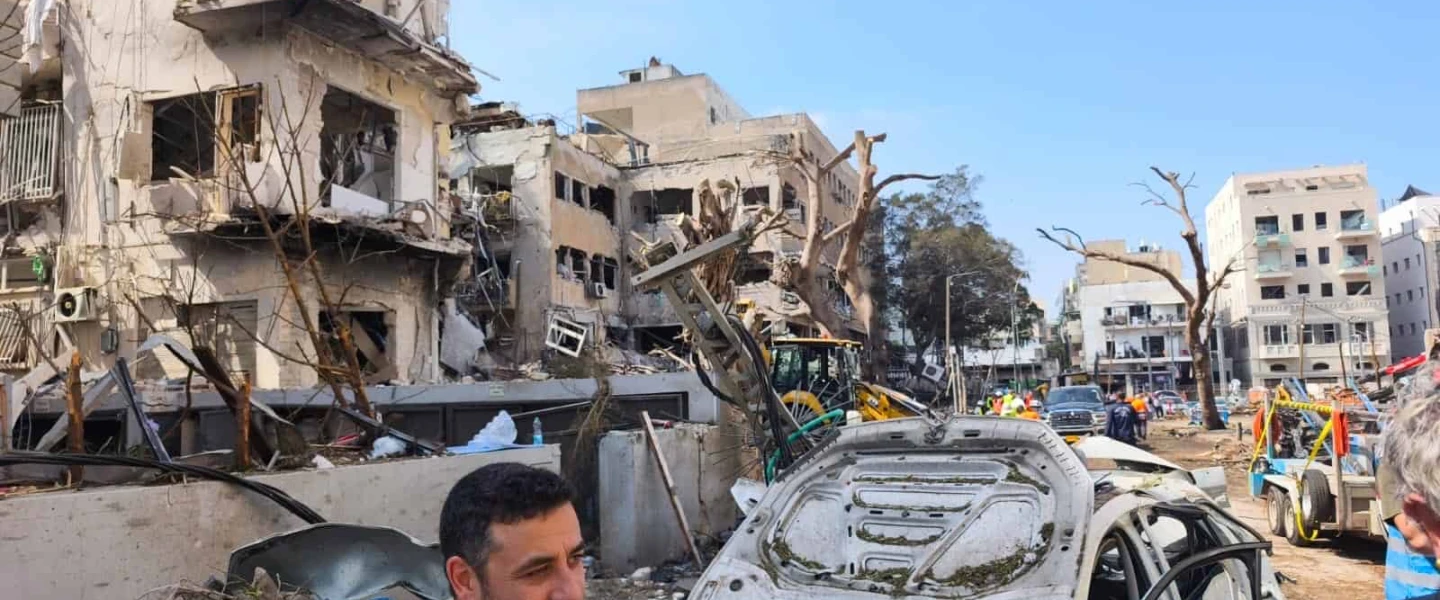
Two damaged buildings still stand behind fencing, their broken windows and scarred façades a reminder that, more than a year after an Iranian missile struck the area during Operation Rising Lion in June 2025, some wounds are taking far longer to heal than others.
The missile caused only light injuries, but for dozens of residents, life has yet to return to normal. Some remain in rented apartments while reconstruction inches forward. Others say they are still struggling with the financial and emotional fallout of losing their homes.
“It’s like a war zone,” one tenant, who was evacuated after the strike, told the Israeli news outlet Ynet. “I can’t walk down that street. It’s incredibly triggering. I go out of my way in the city just so I don’t have to pass there.”
His frustration goes beyond the daily reminder of the attack. He says he was initially promised assistance with rent until repairs were completed, only to be told recently that the support had ended even though the building remains uninhabitable.
Another resident, whose family still lives in temporary housing, described the slow pace of reconstruction and the financial burden of continuing to pay municipal property taxes on a home destroyed by the missile.
“A missile fell on my house,” she said. “I shouldn’t have to pay municipal taxes on it.”
The Tel Aviv municipality says the issue is governed by national legislation and that it has no authority to grant additional exemptions beyond those allowed by law.
For anyone walking through the neighborhood today, however, it quickly becomes clear that rebuilding these particular buildings is far more complicated than repairing damaged apartments that do not have historic value.
Tel Aviv’s historic fabric
The buildings at 4 and 6 Pinsker Street are part of Tel Aviv’s historic fabric.
The neighborhood took shape during the late 1920s and early 1930s, when Tel Aviv was rapidly expanding beyond its original boundaries. According to Tel Aviv historian Dr. Ilan Shchori, much of the street was built in the International Style, alongside several eclectic buildings that reflected the city’s early architectural character.
On the corner stood Cafe Noga, one of Tel Aviv’s best-known gathering places.
Opened in 1941, the cafe became a fixture of the city’s cultural life. British soldiers stationed in Mandatory Palestine spent time there, along with artists, writers and musicians. During Israel’s War of Independence, it became a popular meeting place for Jewish soldiers on leave.
“It was one of Tel Aviv’s legendary entertainment venues,” Shchori told Ynet. “There is no doubt that Cafe Noga played a significant role in shaping the city’s cultural life.”
Although the cafe itself has long since closed, parts of the historic structure damaged in the missile strike are expected to be incorporated into future restoration plans.
That restoration is likely to take time.
Unlike modern apartment buildings, heritage structures cannot simply be demolished and rebuilt. Original architectural elements must be documented, preserved where possible, and integrated into the reconstruction. Engineers must also strengthen the buildings to meet today’s safety standards without erasing the features that give them their historic character.
Those challenges extend well beyond Pinsker Street.
UNESCO World Heritage Site
In 2003, UNESCO designated Tel Aviv’s White City a World Heritage Site, recognizing it as an outstanding example of Modern Movement architecture. The district encompasses more than 4,000 buildings, many designed by Jewish architects who fled Europe in the 1930s and adapted modernist principles to the climate and culture of the emerging Hebrew city.
Following the Iranian missile attacks, UNESCO said it was examining reports of damage within the White City and reminded all parties of their obligations under international law to protect cultural heritage during armed conflict.
The municipality said the damage on Pinsker Street was especially severe because the buildings had never undergone structural reinforcement before the missile strike. Following engineering assessments, officials concluded that parts of the buildings could be restored rather than demolished. Planning applications are now moving through the approval process, although progress also depends on agreement among the property owners.
For the families who once lived there, those planning procedures offer little comfort.
Many are still waiting to return home. Some continue to avoid the street altogether.
Yet there is another reason why reconstruction matters.
Pinsker Street is more than another construction site. It is part of the story of Tel Aviv itself, from the city’s early decades through the British Mandate, the War of Independence and the years that followed. Restoring these buildings means preserving not only bricks and balconies, but the history they represent.