


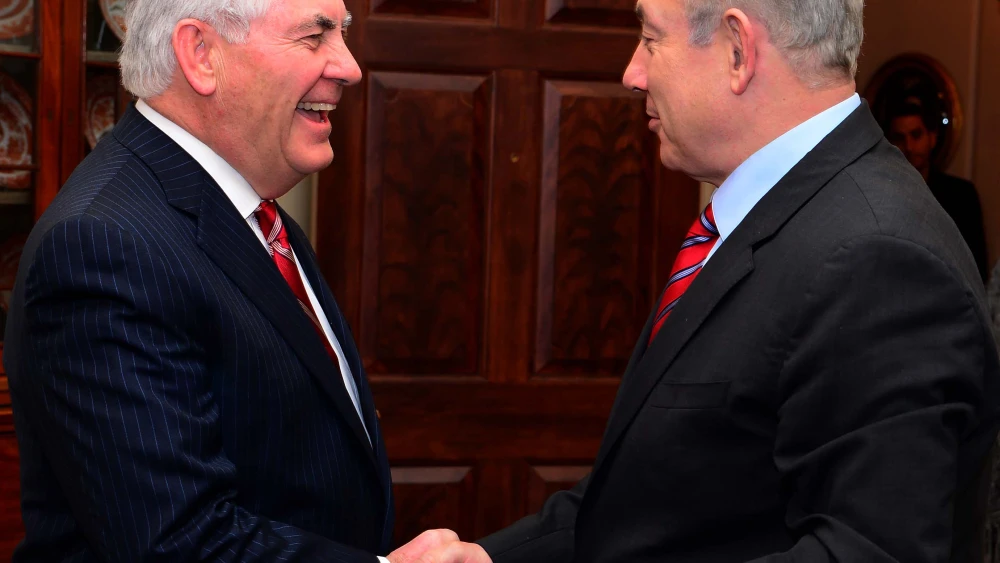
Former U.S. Secretary of State Rex Tillerson said on Thursday that U.S. President Donald Trump was “played” by Israeli Prime Minister Benjamin Netanyahu on numerous occasions.
“[The Israelis] did that with the president on a couple of occasions, to persuade him that ‘We’re the good guys, they’re the bad guys,” said Tillerson in a 90-minute discussion at Harvard University, likely referring to the Palestinians.
Tillerson, who served as the nation’s top diplomat from January 2017 to March 2018 after leading ExxonMobil, labeled Netanyahu, who is currently fighting for his political life after Tuesday’s elections, “an extraordinarily skilled” politician and statesman who is “a bit Machiavellian,” but cultivates “useful” relationships with world leaders.
“In dealing with Bibi, it’s always useful to carry a healthy amount of skepticism in your discussions with him,” said Tillerson, adding that the Israelis will give “misinformation” to convince the United States of something, if necessary.
Regarding the Middle East peace process, Tillerson said, “I did believe that we were at a moment in time where perhaps we could chart a way where the Arab world could support an outcome that the Palestinians might not think was perfect—and in the past, if it wasn’t perfect, it didn’t happen—but with enough encouragement, pressure from the Arab world, that we could get it close enough that the Palestinians would finally agree,” he said. “And in my view, it was a two-state solution.”
On the Iranian attack on two Saudi Aramco facilities on Sept. 14, the former ExxonMobil CEO said, “I have no doubt we’re going to find Iran’s fingerprints on this attack, but we may not find their hands on it.”
It means to insinuate, he noted, that the United States should go to the U.N. Security Council and seek a global coalition to impose sanctions on Iran, as opposed to enacting sanctions unilaterally.


