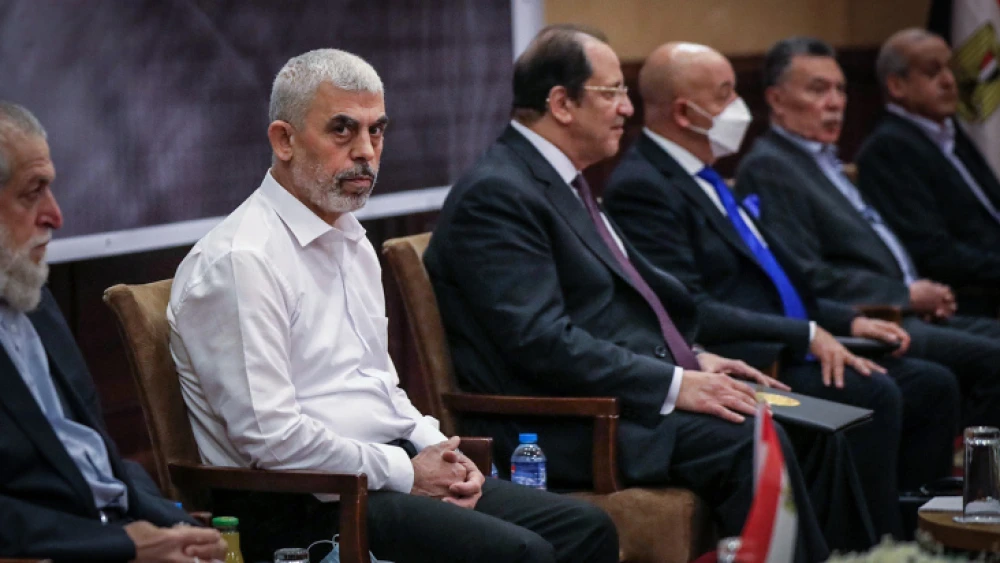
Yahya Sinwar, the leader of Hamas in the Gaza Strip, announced on Monday that the terror group was prepared for “immediate” negotiations with Israel with regard to a prisoner exchange, according to Hebrew media reports.
The announcement came on the heels of a meeting in Gaza between Sinwar and an Egyptian delegation led by Maj. Gen. Abbas Kamel, the head of Egypt’s General Intelligence Directorate.
The previous day, Kamel met in Jerusalem with Israeli Prime Minister Benjamin Netanyahu, as Israeli Foreign Minister Gabi Ashkenazi arrived in Egypt to meet with his Egyptian counterpart Sameh Shoukry. The visit is the first to Egypt by an Israeli foreign minister since 2008. The talks between the two countries are focused on bolstering the ceasefire that ended 11 days of fighting between Israel and terrorist groups in Gaza.
Israel is demanding the return of two Israeli captives and the bodies of two Israel Defense Forces soldiers held by Hamas as a pre-condition for permitting the rehabilitation of the Gaza Strip. During his meeting with Kamel, Netanyahu emphasized that the return of the captives was a top priority for Israel.
However, while Sinwar made clear his readiness for such negotiations, he intimated that Israel would have to pay a heavy price, according to the AP.
“Remember the number 1,111—find out later what it means,” Sinwar told the press, an apparent reference to the number of prisoners the terrorist group would demand in a possible prisoner exchange.
The Hamas leader went on to say that until recently there had been “movement” on the issue of the captives, but that it had stopped “due to government instability in Israel.”
Hamas is believed to be holding Israeli civilians Avera Mengistu and Hisham al-Sayed, both of whom have mental-health issues and wandered separately into the Strip, in 2014 and 2015 respectively. The terror group is also holding the bodies of two IDF soldiers, Hadar Goldin and Oron Shaul, who were killed during 2014’s “Operation Protective Edge.”
The Israeli government came under pressure from the soldiers’ families during the recent round of fighting, particularly the Goldin family. Protesters gathered outside the Prime Minister’s Office before the ceasefire and at the home of the IDF chief of staff afterwards, with the demand that the return of captives be made a key negotiating issue.
Egypt is currently acting as mediator between the two sides in an effort to reach a long-term ceasefire.
“In the coming days, we will be witness to talks in Cairo with the aim of reaching agreements on the issues at hand,” said Sinwar.