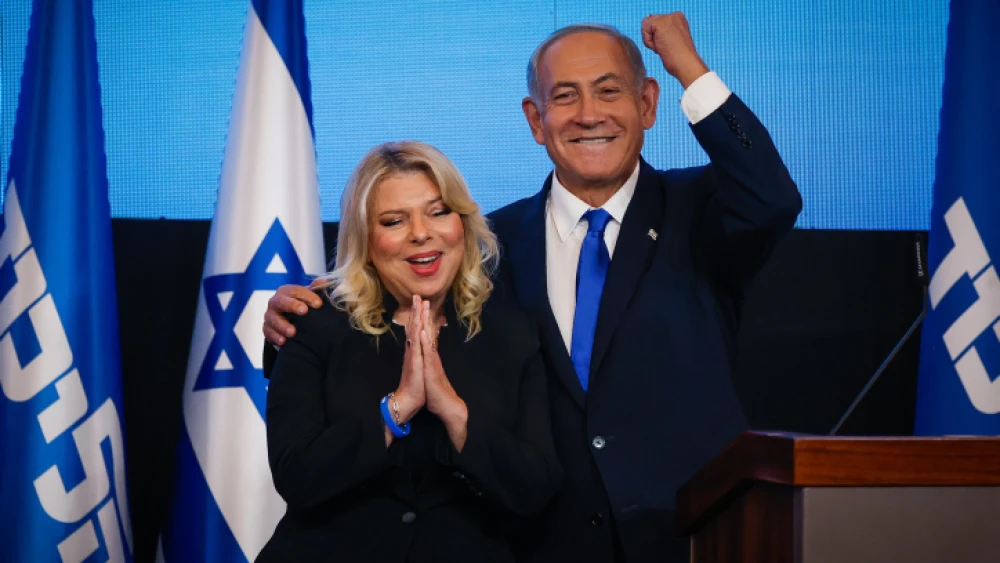
With more than 4.7 million votes officially counted, or 99.87% of the total ballots cast in Israel’s election on Tuesday, opposition leader Benjamin Netanyahu’s right-religious bloc has emerged victorious.
According to the results the Central Elections Committee (CEC) announced on Thursday evening, Netanyahu’s bloc will pick up 64 seats. The far-left Meretz and anti-Zionist Arab Balad parties have been eliminated and will not enter the Knesset.
A total of 4, 763,694 valid votes were cast, along with 29,947 invalid ones. Voter turnout was 70.6%. It took 36,213 votes for each Knesset mandate.
The results are not official until they are presented to President Isaac Herzog on Wednesday.
Netanyahu’s Likud Party will receive 32 seats in the next Knesset, with his likely coalition partners the Religious Zionist Party, Shas and United Torah Judaism receiving 14, 11 and seven mandates, respectively.
Prime Minister Yair Lapid’s Yesh Atid garnered 24 seats, followed by Defense Minister Benny Gantz’s National Unity at 12. Yisrael Beytenu will receive six seats. The Islamist Ra’am and the predominantly Arab Hadash-Ta’al will have five seats in the Knesset. The Labor Party will take four seats.
The CEC’s results confirmed exit polls, which predicted Netanyahu’s return to the Prime Minister’s Office.
Netanyahu on Wednesday hailed his bloc’s victory and thanked his supporters for their “magnificent expression of faith.”
“It’s become clear once again that the Likud is the largest party in Israel, above all the other parties by a wide margin,” the opposition leader said.
The nation, he continued, “wants another way. It wants security. It wants to lower the cost of living. It wants strength. It doesn’t want shame. It doesn’t want to lower its head. It wants an upright stance. It wants political understanding, but with firmness.”
He added: “You know what else it wants? To return the national pride that was taken from us. And this we’ll bring as well.”
Herzog will by Nov. 16 at the latest designate a candidate to form a government, and that candidate will almost certainly be Netanyahu.
The Likud leader, who served as premier from 1996 to 1999 and again from 2009 to 2021, would then have four weeks to form a coalition, with the possibility of a two-week extension.
According to reports, however, Netanyahu will attempt to form a governing coalition by Nov. 15, the date of the swearing-in of the new parliament.