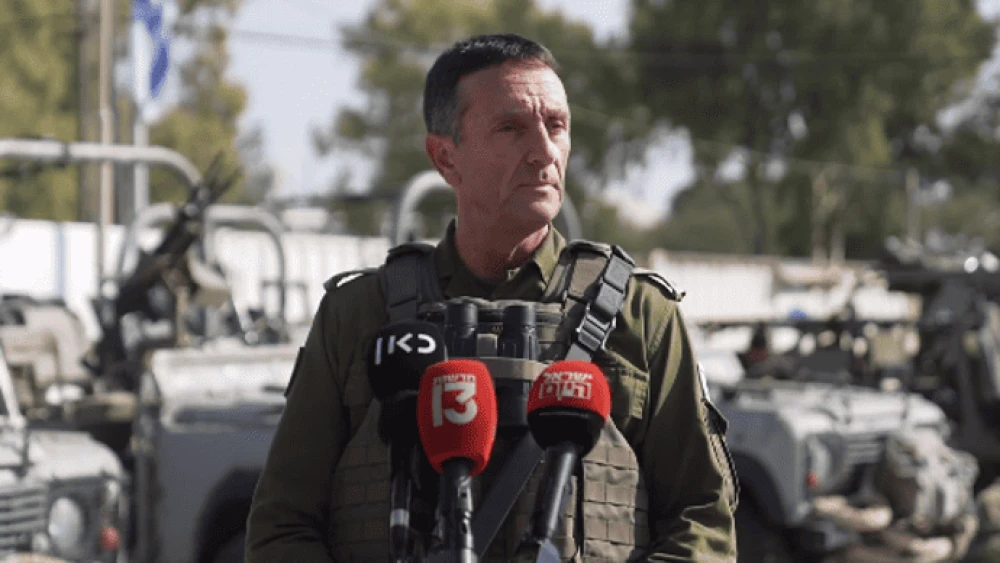
IDF Chief of Staff Lt. Gen. Herzi Halevi admitted the army failed to protect Israel’s citizens and properly guard the border fence with the Gaza Strip in a speech to reporters on Thursday.
That failure enabled hundreds of terrorists to stream through the fence on Saturday morning and wreak havoc in Israeli communities in the western Negev, killing at last count more than 1,300 persons, mostly civilians.
“The IDF is responsible for the security of the country and its citizens, and on Saturday morning in the area surrounding the Gaza Strip, we did not do it. We will learn. We will investigate. But now is the time for war,” the general said.
Halevi said the enemy are “murderous terrorists, human animals.” (On Thursday, the Prime Minister’s Office released pictures from the aftermath of babies burned alive by Hamas.)
The IDF chief promised that Yahya Sinwar, Hamas’s leader in the Gaza Strip, and “the entire system under him are dead men. We will attack them. We will dismantle them.”
הרמטכ"ל בהצהרה מעוטף עזה: "יחיא סינוואר - וכל המערכת שתחתיו הם בני מוות" pic.twitter.com/vQVm5t2jYg
— כאן חדשות (@kann_news) October 12, 2023
Halevi expressed sympathy for families whose loved ones were captured by the terrorists and pulled into the Gaza Strip. “We will do everything to return the hostages back home,” he promised.
Hamas and Islamic Jihad claim to be holding 130 hostages, with some reports estimating at least 200 are held in the Gaza Strip.
Halevi praised the Israelis who rushed south and performed many acts of bravery to repel the attack, the thousands of reservists who reported to duty and the many Israelis who are rushing back from abroad to join the fight.
“The fighting spirit of the IDF hit Gaza with all its force. And we won’t stop here. There’s in this decisiveness and rage. In the process of a widespread attack, we are killing many terrorists, many commanders, destroying and demolishing terrorist infrastructure that supported this cruel and terrible crime,” he said.
“Gaza will not look the same,” Halevi said. “We will get to a situation where whoever leads Gaza will be hit hard. We’ll take him apart. And whoever remains there will understand well that a thing like this isn’t done to the State of Israel.”
After his speech, Halevi was asked if the IDF could restore trust, the “contract” between it and the Israeli people, given the magnitude of its failure.
“We have a contract, as you say. We have built it up for many years with ups and downs. And this time, with a deep down and at a heavy price. We will do everything to restore this contract, to restore security,” he said.
“Whoever comes to try and weaken us will see at the end of this event that we’re seven times stronger,” Halevi said.
On the sixth day of war, Gaza terrorists continued to fire rockets at Israel, including a salvo that triggered sirens around Netanya and Ariel in Judea and Samaria.
According to the head of the IDF Home Front Command, the relatively slow rate of rocket fire from the Strip indicated that Hamas was preparing for a lengthy conflict.
“We have identified the behavior of Hamas, which realizes that it is entering a long war,” said Maj. Gen. Rafi Milo.
“Hamas is managing the fire in a way that is meant for weeks [of fighting], and they dropped to a rate of fire to around 200-400 rockets per day,” he added.
On Thursday, the IDF named another 31 soldiers killed since Saturday, bringing the toll of slain soldiers to 220.