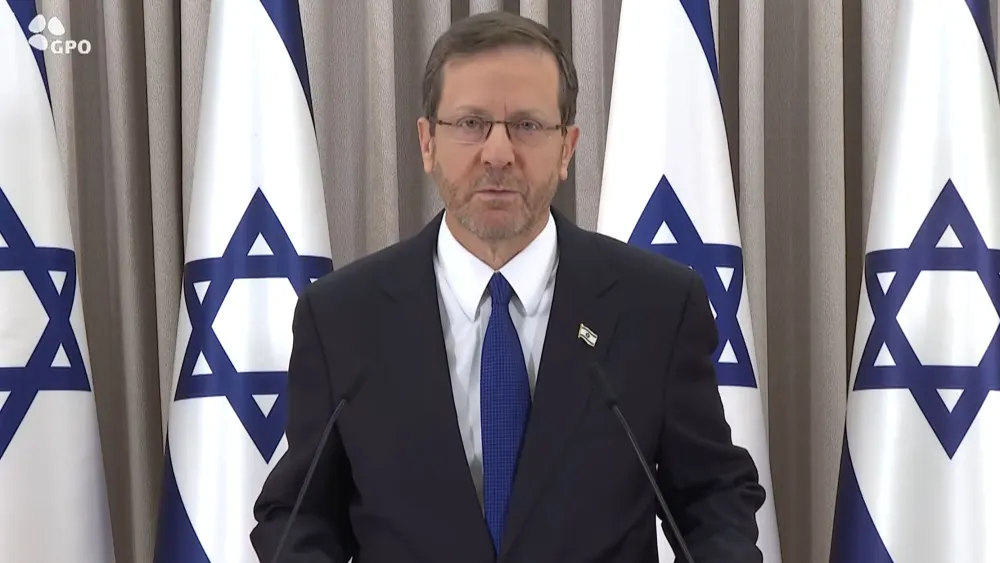
Israeli President Isaac Herzog on Sunday painted a dire picture of the country’s political situation as opposing sides battle over the government’s judicial reform program.
“We are in the midst of fateful days for our nation and for our country,” he said in a televised address. “We have for quite some time now not been in a political debate but on the brink of constitutional and social collapse.
“I feel—we all feel—that we are just before a clash, even a violent clash—a powder keg—and we are on the threshold of one man’s hand against his brother’s,” he added.
Herzog expressed sympathy with both sides of the debate, saying those in favor of reform “feel that an imbalance has developed between the branches [of government] and lines have been crossed for years,” while those against reform see it “as a real threat to Israeli democracy. They fear that the reform in its current form erases and devours all checks and balances.”
To ignore the pain and fears of either side would be “a grave mistake,” he said.
The Israeli president presented five principles as “a basis for immediate and decisive negotiations that will arrange the relations between the government branches.”
He first proposed the passage of a Basic Law: The Constitution that would establish “constitutional stability” by clarifying the relations among the three branches and between various laws. He also said the number of judges must be increased to decrease judicial workload, and the courts must be made to function more efficiently so that cases won’t drag on. And he urged a change in the way judges are selected so that no branch of government has a majority say in choosing them.
In his final principle, Herzog took a position advocated by proponents of reform, arguing against the judicial rationale of “reasonability,” whereby judges can overturn laws based on whether they consider them “reasonable.”
“An unrestricted use of the pretext of reasonableness could become the basis for a disproportionate entry of the judicial authority into the exclusive territory designated for the executive and legislative branches,” he said.
Herzog concluded by saying he’s “ready to do everything...to resolve this difficult dispute,” including appearing before the Knesset Constitution, Law and Justice Committee “in an unprecedented and exceptional manner in order to present the proposed principles in depth.”