Newsletter
Newsletter Support JNS

Israel’s Christian population grows, shines in education

According to a Christmas report by Israel’s Central Bureau of Statistics, Israel’s Christian population now stands at 177,000, and Christian high-school students lead the country in matriculation grades.

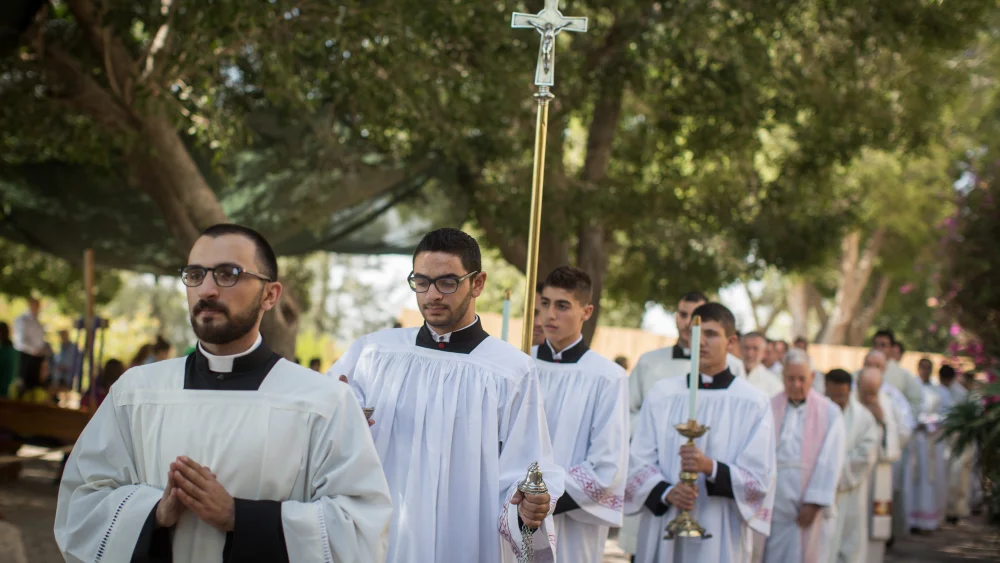
Latin clergy members begin their procession during the large mass held at the Deir Rafat Monestary on Oct. 30, 2016. Photo by Hadas Parush/Flash90.

The Christian population in Israel is slowly growing, and their educational achievements are rivaling those of the majority Jewish population, according to figures released this week by Israel’s Central Bureau of Statistics.

The data revealed that 70.9 percent of Christian high school students in Israel achieve college-entry matriculation grades, which is slightly higher than the figure among Israeli Jews (70.6 percent).

Among Israel’s Druze the figure is 63.7 percent, according to the report, while among the Muslim population it is 45.2 percent.

Three out of four Christian students who achieve a master’s degree, or 74 percent, are women, as are 63 percent of Christian doctoral students.

Some 177,000 Christians live in Israel, comprising roughly 2 percent of the population, and of those around 77.5 percent are Arabs, consisting of around 7.2 percent of Israel’s Arab community. Of those Arab Christians, 70.6 percent live in the Galilee and northern cities.

The largest Christian community in Israel, some 21,900 strong, live in Nazareth, Jesus’s childhood hometown. The second largest Christian community (16,100) resides in Haifa, followed by Jerusalem (12,700) and Shfaram (10,300).

Louay Hisham Mahmoud Basal was eliminated in a targeted strike after being identified as an immediate threat to Israeli troops.
“Our mission is to thwart every enemy, dismantle terrorist infrastructure, and serve as a front-line defense for the communities of the north,” said Zamir.
The Israeli military also targeted observation assets used against troops.
Tehran would rather send its funds to terrorist groups across the world than caring for its own people, the U.S. Secretary of State said.
Relations with Jerusalem may thaw under the new right-wing prime minister, but he may lack the political capital for a full reversal.
Among this year’s recipients was Brit HaNegev VeHa’ar, an initiative that brings together residents of the western Negev and Gush Etzion.