History has shown that in the absence of a credible military threat or actual military action, Iran will become a nuclear power, Israeli Prime Minister Benjamin Netanyahu warned on Tuesday night.
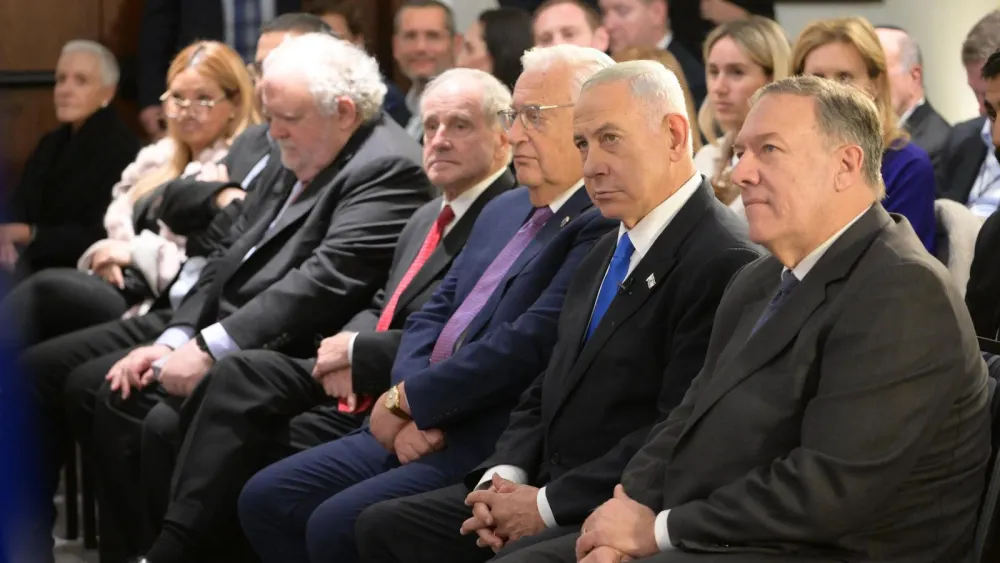
Netanyahu made the remarks during an interview with professor Walter Russell Mead at the Hertog National Security Conference, which was attended by former U.S. Secretary of State Mike Pompeo and former U.S. Ambassador to Israel David Friedman.
Netanyahu began by recapping the recent history of countries that pursued nuclear weapons.
“You had one, that’s called Saddam Hussein’s Iraq. It was stopped by military force—ours. You had a second one, that is called Syria, that tried to develop nuclear weapons. And it was stopped by a military action—ours. There was a third country, Muammar Gaddafi’s Libya. It wanted to pursue nuclear weapons and it gave it up [due to] the threat of a military action—yours [the United States]. There’s a fourth country, North Korea, that sought to develop nuclear weapons, and it wasn’t challenged. They weren’t stopped, because there was no threat of military action. And so they developed this capacity,” said the prime minister.
“Now we have Iran,” he continued. “Iran seeks to develop [nuclear weapons]. It was actually stopped for a year ... in 2003, when they thought, right after the Gulf War, when they thought that you, America, would take action against them. So they stopped, then converted [their nuclear drive] into a secret program, disguised by various civilian so-called research organizations. But they continued,” he said.
Albeit, he noted, with some delay due to sanctions and “various actions” taken by Israel.
And even the sanctions, he continued, “came about because the Americans were saying, ‘This crazy guy in Jerusalem [Netanyahu] is going to bomb them unless we do something.’ So that’s how Iran came to the table ... and did a lousy [2015 nuclear] agreement.”
These examples show that the only things to have actually stopped rogue nations from developing nuclear weapons are a credible military threat, or actual military action, he said.
“You can couple that with crippling economic sanctions, but that’s not a sufficient condition. A necessary condition, and an often sufficient condition, is credible military action,” he continued.
Furthermore, he argued, time was of the essence.
“The longer you wait, the harder that becomes. We’ve waited very long. I can tell you that I will do everything in my power to prevent Iran from acquiring nuclear weapons. That is not merely an Israeli interest; it’s an American interest; it’s in the interest of the entire world,” he concluded.
Earlier on Tuesday, Israeli Foreign Minister Eli Cohen called on Washington to take steps to convince Tehran that the United States is not bluffing when it comes to the possibility of the use of force.
“If the United States does not establish a credible military threat immediately, either Israel will attack, or Iran will have a nuclear weapon, which we will not allow under any circumstance,” said the foreign minister.
The Iranian threat is two-fold, as the Islamic Republic is both an aspiring nuclear power and “the largest funder of global terrorism,” added Cohen.
With respect to the Trump administration-brokered Abraham Accords, which normalized Israel’s relations with four Arab states, Netanyahu said during the interview on Tuesday that normalization with Saudi Arabia was the big prize.
“If we expand the circle of peace to Saudi Arabia, then I think we effectively end the Arab-Israeli conflict, which means we work our way not inside out ... to solve the Palestinian problem,” said Netanyahu. “I think we can have a quantum leap if the Saudi leadership decides that it wants to be formally part of this. Informally, they’re [already] part of this,” said the prime minister.