


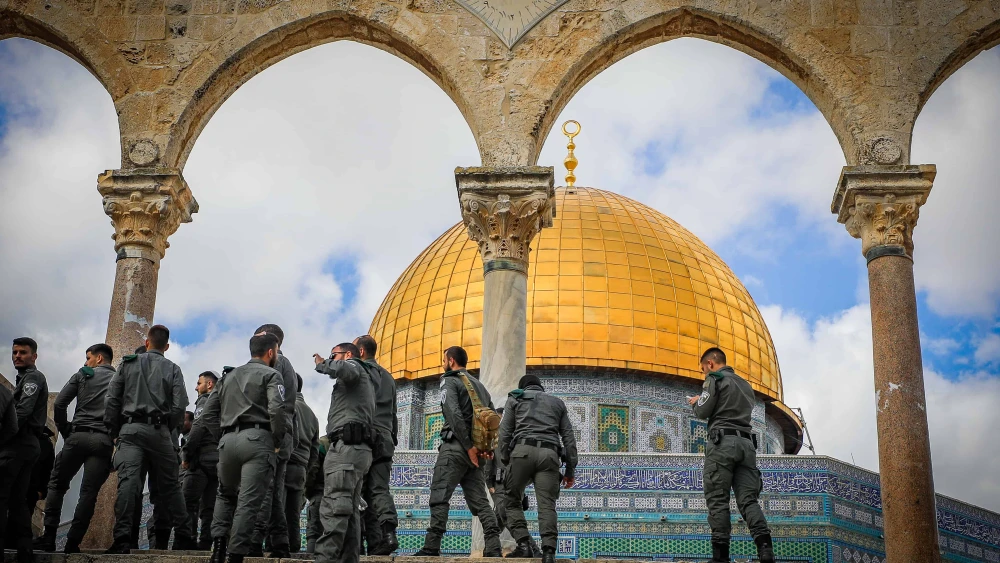
The Israel Police has wrapped up its preparations ahead of Ramadan, which is expected to start after sundown on Tuesday.
Police officers will be deployed “day and night” to secure the free flow of worshippers to the Temple Mount in Jerusalem, Jerusalem District Deputy Subdistrict commander Arad Braverman told reporters in a phone press briefing on Monday.
“Our goal is to allow everyone, [including Jews], to reach the Temple Mount as long as they are not here to create riots,” he said.
The police emphasized that it was determined to maintain the status quo on the ground, acting forcefully against any violator.
Jews who enter the historic flashpoint will arrive “during the customary hours according to the customary rules that have been in place,” police spokesman Dean Elsdunne said.
He added that approved “guidance sheets” for Jewish prayer are permitted in certain areas that “are limited to police direction.”
Elsdunne described the police’s work as a “huge logistical operation” that ensures that tens of thousands to hundreds of thousands of worshippers can arrive safely at the same time to an area whose size is less than one-square mile. “That’s what we’re there for,” he said.
Contrary to some media headlines that he encountered, the spokesman stressed that “Ramadan is not Israel Police versus Arab Muslims. … The Israel Police is made up of Muslims, people of all religions, of all backgrounds, and we’re here to protect people of all faiths and backgrounds.”
As for non-Israelis, entry of Palestinians with permits from Judea and Samaria is subject to a government decision, and police will follow orders, Braverman said.
It was moreover stated that police will not soften enforcement against those who incite to violence during Ramadan.
Under Israeli Prime Minister Benjamin Netanyahu’s current government, the Temple Mount has seen a surge in Jewish visits, including with open worship, especially on major holidays such as Tisha B’Av, the day commemorating the fall of the Temple.
The Prime Minister’s Office, however, said in a statement on Tisha B’Av, which last year fell on Aug. 3, that Israel’s policy on the Temple Mount “has not changed and will not change.”



