The Israel Police confirmed to JNS on Wednesday that, for the first time, it has been allowing “guidance sheets” for Jewish prayer to be brought onto the Temple Mount in Jerusalem.
The status quo on the Temple Mount, as formulated by Israel’s then Defense Minister Moshe Dayan following the compound’s capture during the 1967 Six-Day War, has generally barred Jewish visitors from bringing religious items such as prayer books and tefillin, or phylacteries, to the site.
Dayan offered the Jordanian Waqf control of activities within the walls of the Mount itself, while Israel would be responsible for the security and public order. Dayan further conceded that Muslims would be granted free access to the Mount, and that while there would be no cap on the number of Jewish visitors, they would not be allowed to pray there.
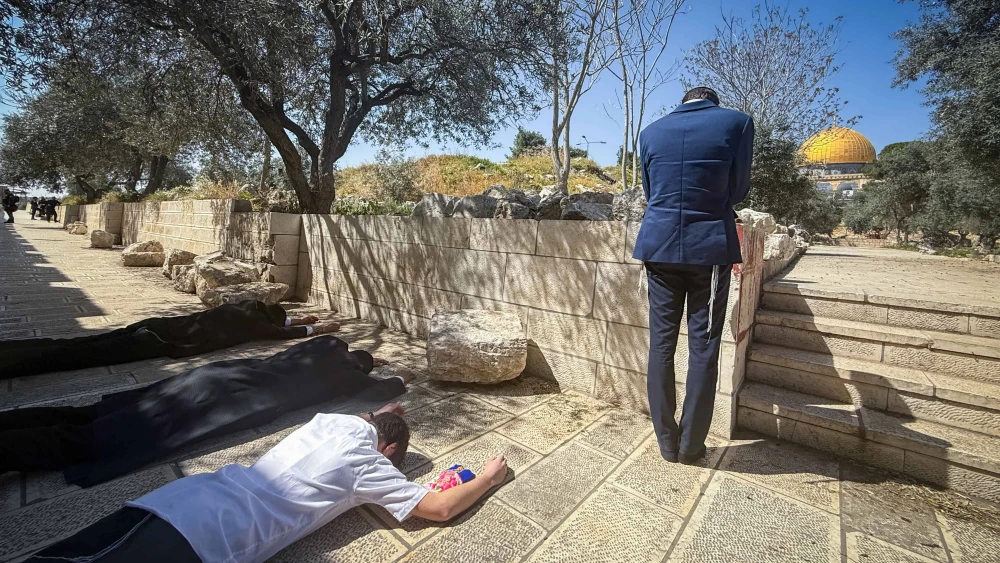
The status quo has increasingly been tested in recent years, with Jewish rights activists pushing the boundaries and police at times appearing to tolerate visible prayer, in particular since Otzma Yehudit Party leader Itamar Ben-Gvir took office as national security minister in late 2022.
Ben-Gvir himself led morning services on the Temple Mount on Aug. 3.
The police’s decision to allow the prayer leaflets to be brought onto the site was first reported by Haaretz on Wednesday, which shared a photo of one sheet, containing a Kabbalistic “Leshem Yichud” (“for the sake of unification”) prayer before ascending the Mount, as well as the text of the “Amidah,” or “Shemoneh Esrei,” the daily central Jewish silent prayer.
“Following a request submitted by the administration of the Temple Mount Yeshivah, police approved the entry of guidance sheets for visitors,” a police spokesman told JNS in response to the report.
The use of the sheets will remain “solely” restricted to “specific areas defined by the police” to maintain “the existing order” on the Mount.
The statement noted that police operate throughout the year to “enable freedom of worship and visitation at the Temple Mount for all religions and communities while strictly maintaining public order, the rules in place at the site, and in accordance with directives of the political level.
“The Israel Police continues to act with discretion and responsibility in order to maintain a balance between the various needs at the Temple Mount,” it concluded.
Under Israeli Prime Minister Benjamin Netanyahu’s current government, the Temple Mount has seen a surge in Jewish visits, including with open worship, especially on major holidays such as Tisha B’Av, the day commemorating the fall of the Temple.
Israel’s Prime Minister’s Office, however, said in a statement on Tisha B’Av that Jerusalem’s official policy on the Temple Mount “has not changed and will not change.”
The PMO did not immediately respond to a JNS request for comment on Wednesday on whether police allowing the prayer sheets onto the site amounted to a change in the status quo.