Neo-Nazis in Florida. Synagogue desecration in Chicago. Regular assaults in Brooklyn, N.Y. When it comes to anti-Semitism in America, it’s time to start connecting the dots.
“If we’re going to better understand the nature and scope of the threats, we need the FBI to lead, taking everyone out of their silo, getting all the information that they’re uniquely positioned to get, and then having a desk that’s going to review things and have access to other agencies—domestic and otherwise—in order for us to quantify and qualify what’s going on,” Rabbi Abraham Cooper, associate dean and director of global social action at the Simon Wiesenthal Center, told JNS.
Cooper met this month with top FBI officials from the counterterrorism and criminal divisions at FBI headquarters in Washington, D.C. They included Luis Quesada, assistant director of the criminal investigative division; George Beach, assistant director of the office of partner engagement; and Jay Greenberg, deputy assistant director of the criminal division. One of the officials Cooper met with was among those who scrambled the FBI SWAT team in Washington and positioned the team in Colleyville, Texas, within three hours during the Jan. 15 hostage situation at Beth Israel Congregation. Cooper said he also met with an undersecretary from the U.S. Department of Homeland Security.
He went to the capital with two asks. Firstly, to urge the immediate creation of a special FBI Taskforce Against Anti-Semitism, which would make it easier for local law enforcement and other agencies to be able to have a single address in dealing with anti-Semitism and to allow for the FBI to utilize its immense resources to begin piecing together the broader picture of Jew-hatred in America. The Simon Wiesenthal Center made a similar request to former President Donald Trump following an escalating series of anti-Semitic violence in 2019.
“Maybe it’s just social media that has that immediate punch to the gut for every Jew who sees [increasing anti-Semitism]. But there are a lot of different things that are roiling, and we need to know if the individuals perpetrating this are working in concert or are they just inspired because of the 24/7 hate on social media.”
He continued, saying that “when you have these kinds of violent attacks, the issue of the possibility of coordination, and to what extent and whether there are overseas players or not needs to be looked at. Thankfully, Congress and many state local governments have and are enabling synagogues and community centers to harden the target, get more cameras, etc. All of that is good. But we don’t want to live in an armed camp. We want to understand the nature of the threat.”
Cooper lamented the current law-enforcement trend of going from anti-Semitic incident to incident without an ability to collect data in a coherent fashion, analyze it, and help the broader law-enforcement and Jewish communities to better understand the nature of the threats.

‘Where it connects with extremists and hate groups’
Cooper’s second request is the adoption of the International Holocaust Remembrance Alliance’s (IHRA) working definition of anti-Semitism by federal law-enforcement agencies.
“We can’t expect the agencies that we’re dealing with to understand every aspect of anti-Semitism or to see it from the perspective of the world Jewish community. So, having that working definition means we’re all on the same page. I think it would be extremely useful to create some training for the FBI and for Homeland Security as to the nature of anti-Semitism, how it’s unique, and how and where it interconnects with other extremists and other hate groups,” said Cooper.
“There are a lot of different things that are roiling, and we need to know if the individuals perpetrating this are working in concert or are they just inspired because of the 24/7 hate on social media.”
Ultimately, the decision as to whether or not to take action will lay with FBI director Christopher Wray, with whom Cooper has requested a meeting, as he departed Washington with no concrete commitments in hand. Still, the vast majority of anti-Semitism in America doesn’t rise to the level of a crime, meaning that it can be tricky for federal law-enforcement agencies to put out broad trackers when looking for trends and threats.
Cooper noted that law-enforcement officials he spoke with estimate that more than 95% of the anti-Semitic material they’re looking at is not actionable. But he believes that those kinds of postings and platforms do add up to a picture that is resurrecting old anti-Semitic conspiracies and finding new recruits to target the Jewish people. Anti-Semitic hate crimes in New York City almost quadrupled in January 2022 compared to the same month last year, according to New York Police Department statistics. The Simon Wiesenthal Center is close to releasing its annual report with a snapshot of current trends in anti-Semitism (though it recently released its global anti-Semitism 2021 “Top Ten” list). Cooper sounded glum about the nature and direction of the data in the report.
Still, he insists that he’s not asking the FBI and Homeland Security to become the thought police, but rather, as coordinating agencies.
“We don’t need the FBI for the ideologies. They’re not going to prosecute it. This is the United States of America. But when you sit with people who are in these kinds of agencies and say, OK, someone from London parachutes into Texas, stays in a homeless shelter, buys a gun. Who told that individual that that particular synagogue was near the penitentiary where ‘Lady ISIS’ is being held?” said Cooper, referring to the hostage-taking situation in Colleyville, Texas, which saw 44-year-old British citizen Malik Faisal Akram fly into America from the United Kingdom two weeks before the attack, eventually traveling from New York to Dallas before purchasing a gun and taking hostages during Shabbat services at Congregation Beth Israel in Colleyville.
During hostage negotiations, Akram stated that his motivation was to free Aafia Siddiqui, a Pakistani national and alleged Al-Qaeda operative formerly dubbed “Lady Al-Qaeda.” Siddiqui has a documented history of anti-Semitism, and Congregation Beth Israel is close in proximity to the penitentiary where Siddiqui is incarcerated.
‘I don’t know that it’s going to be a game-changer’
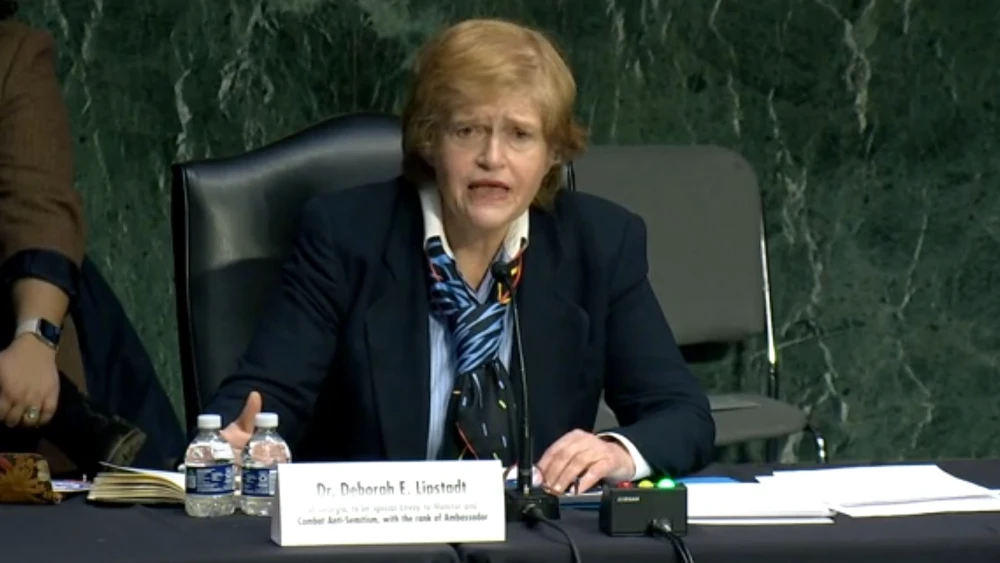
Jewish community leaders have largely lauded the recent movement on the nomination of Deborah Lipstadt to the post of U.S. State Department’s Special Envoy to Monitor and Combat Anti-Semitism. After a six-month delay largely believed to be a result of a personal animus held by an individual senator against Lipstadt, the Senate Foreign Relations Committee approved her nomination earlier this month, setting her up for a final confirmation vote before the full Senate.
The office of the special envoy, however, deals with anti-Semitism abroad. Some have suggested that it is time to create a government post to deal with domestic anti-Semitism, as well, in part to assist law enforcement. Cooper said he feels otherwise, dismissing the notion that hate can be defeated by any legislation or particular personality in government.
“I hope we don’t come to that. We’re free citizens. We have the right to assembly and freedom of religion, thank G-d, in the United States. And the idea of offloading that kind of responsibility domestically to one person, I don’t know that it’s going to be a big game-changer, and I think psychologically, it’s the wrong way to go,” said Cooper.
He pointed out that “you have in Germany a federal anti-Semitism czar. You’ve got now in every major city someone who’s designated to lead the fight against anti-Semitism. How’s that going?”