Newsletter
Newsletter Support JNS

Israel to free 602 terrorists as part of ceasefire

Of these, 108 are expected to be deported to Egypt and from there to third countries.

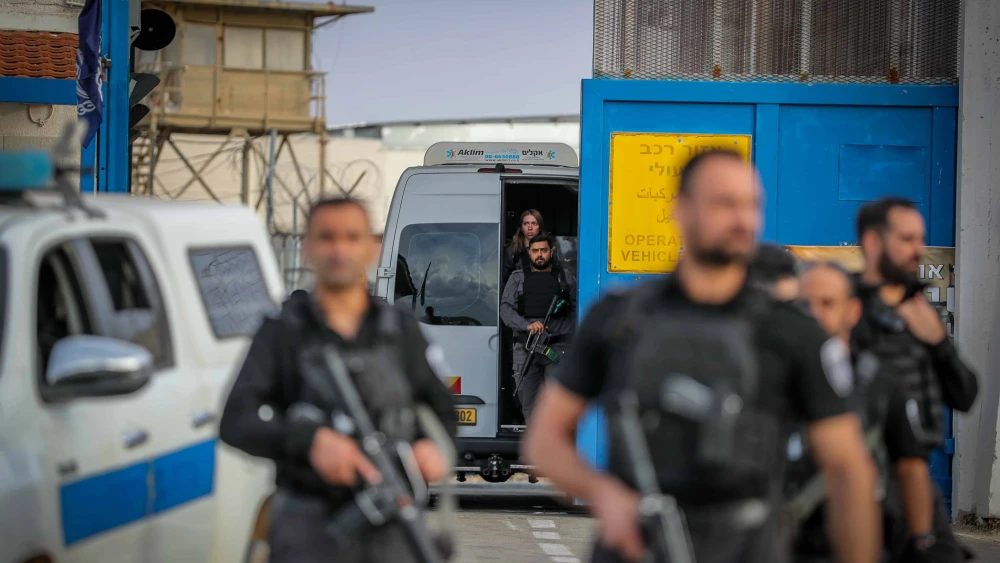
Guards escort Palestinian terrorists arriving at Ofer Prison, southwest of Ramallah, being released as part of a deal between Israel and Hamas, Nov. 25, 2023. Photo by Jamal Awad/Flash90.

Israel is set to commute the sentences of 602 imprisoned terrorists this week as part of the last two releases of the first phase of its ceasefire agreement with Hamas, Hebrew media reported on Thursday.

In accordance with the deal, the bodies of four hostages were returned to the Jewish state on Thursday morning. The remains are said to be those of Shiri Bibas (32 when captured on Oct. 7, 2023) and her sons, Ariel (4 when taken) and Kfir (9 months old when taken), as well as of Oded Lifshitz (83 when taken).

Six living hostages are scheduled to be released on Saturday.

Of the prisoners to be released by Israel this week, 445—residents of the Gaza Strip who were arrested by Israeli forces after the Oct. 7 massacre—are set to be freed later on Thursday.

The remaining 157 terrorists are to be released after the six hostages return to Israeli territory on Saturday. This figure includes 50 terrorists who were serving life sentences, 60 with long sentences and 47 who were released in a 2011 deal with Hamas and later rearrested.

Of the 602 terrorists to be released this week, 108 are expected to be deported to Egypt before being moved to other countries from there.

Among those scheduled for release is Khalil Jabarin, who murdered dual U.S.-Israeli citizen Ari Fuld at Judea’s Gush Etzion Junction in 2018.

Another is Omar al-Zaban, a senior operative in Hamas’s “military wing” serving 27 life sentences plus 25 years for his role in attacks that claimed the lives of at least 27 people.

Bilal Abu-Ghanem is serving three life sentences for the 2015 murder of Haviv Haim, 78, Alon Govberg, 51, and Richard Lakin, 76, on bus 78 in Jerusalem’s Armon Hanatziv area.

Also to be released is Nael Barghouti, convicted of murdering of Israeli bus driver Mordechai Yekuelin, 27, in January 1978. He was released in the 2011 Shalit deal but rearrested after once again engaging in terrorist activity.

Abed el-Nasser Isa—widely considered to be a student of infamous Hamas bomb-maker Yahya Ayyash—is also to be released.

In the current first phase of the truce, Hamas has agreed to free 33 hostages, while Israel agreed to commute the sentences of some 2,000 terrorists.

Akiva Van Koningsveld is a news desk editor for JNS.org. Originally from The Hague, he made the big move from the Netherlands to Israel in 2020. Before joining JNS, he worked as a policy officer at the Center for Information and Documentation Israel, a Dutch organization dedicated to fighting antisemitism and spreading awareness about the Arab-Israel conflict. With a passion for storytelling and justice, he studied journalism at the University of Applied Sciences Utrecht and later earned a law degree from Utrecht University, focusing on human rights and civil liability.
In a draft report delivered to the U.S. president, the commission also called for improved religious accommodations for U.S. service members.
Salah Salem Sarsour, accused of concealing Israeli military court convictions on immigration forms, argued his detention was part of a Trump admin effort to target the pro-Palestinian movement.
CENTCOM stated that the strikes targeted missile, drone and radar facilities after the Islamic Republic attacked a cargo ship in the Strait of Hormuz, calling the assault a violation of the ceasefire.
Now that the primaries are over, “we hope that everyone will come together and be united,” Christine Quinn, chair of the executive committee of the New York State Democratic Party, told JNS.
An Iranian official warned on Friday that the safety of ships passing through the Strait of Hormuz without Iran’s permission “cannot be guaranteed.”
“We have put the train back on the tracks and going in the right direction,” said Yechiel Leiter, Israeli ambassador in Washington. “Final destination? Peace between our two countries.”
Benny Gantz, JNS editor-in-chief Jonathan S. Tobin, Gilad Erdan, Mosab Hassan Yousef, Nissim Black and leading voices in security, diplomacy, media, law and Jewish communal affairs headline the summit’s third day in Jerusalem.