


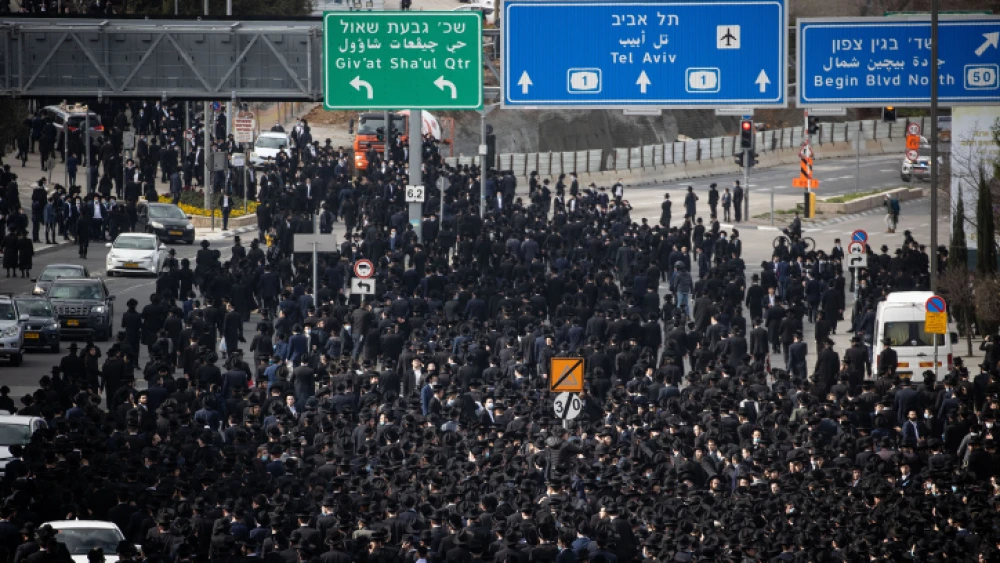
Thousands of people packed the streets Sunday in Jerusalem to participate in the funeral processions of two prominent haredi rabbis, both of whom passed away due to complications from COVID-19.
The large processions—the first on Sunday afternoon for Rabbi Meshulam Dovid Soloveitchik, 99, head of one of the Brisk yeshivahs in Jerusalem, and the second in the evening for Rabbi Yitzchok Scheiner, 98—took place despite Israel’s current coronavirus lockdown restrictions, which forbid large gatherings and with no intervention from police.
Scheiner had specifically cautioned people to stay away from crowded places in a letter of instructions he wrote about a month ago to students and followers.
The funerals came amid continued tensions within Israel over coronavirus restrictions and mass gatherings. Many segments within Israeli society, including both the secular and national religious, have been upset with the haredim for ignoring the rules.
Commenting on the large gatherings, Jerusalem Deputy Mayor Fleur Hassan-Nahoum told JNS, “I just think it is completely ironic that the [rabbis] died of COVID, and the people who are going to the funeral are basically bringing more COVID on the rest of the community and the rest or the country.”
She added that “it seems to me like this community still hasn’t internalized the fact that these deaths have all been avoidable. It’s their [the community’s] actions that make them unavoidable.”
The deputy mayor was also quick to add that the overwhelming percentage of haredim are abiding by the restrictions. Hassan-Nahoum had equally harsh words for the large gatherings of protesters demonstrating against Prime Minister Benjamin Netanyahu every Saturday night near the prime minister’s house in Jerusalem’s near Balfour Street.
“They are no better. They are still gathering,” she said. “They are using a democratic principle to gather and still spread the disease. I don’t think there is any difference. And what are they demonstrating about exactly? There is going to be an election in a month-and-a-half. If you believe in a democracy, then vote! They choose to see it as [participating in] an active democracy in the midst of a pandemic ... it’s like the lunatics have taken over the asylum.”
‘They aren’t trying to put other people in danger’
Prominent haredi journalist Ariel Elharar summed up frustration in segments of the haredi world tweeting, “Crazy how the people who attended the demonstration yesterday are writing today against the funeral.”
Yehuda Meshi Zahav, founder and head of the volunteer rescue and recovery organization ZAKA and a well-known activist in the haredi community, criticized members of his community for wasting their time complaining about being discriminated against and pointing fingers at the demonstrators outside the prime minister’s house.
Recently, in the span of a few days, he lost his brother, father and mother to COVID-19.
“I feel like I’m in a horror movie,” he said in an interview on Channel 12. “People are dropping like flies [in the haredi community], and this is what they’re harping on? I cannot understand the disregard for human life. It’s enough to pass through ultra-Orthodox neighborhoods and see the death notices going up, one after the other.”
Deputy Health Minister Yoav Kisch tweeted a video showing a sea of haredi men at the first funeral on Jan. 31: “Very bad in every way. Public attitude to restrictions: poor. Police ability to enforce: poor. Funeral with a failed health score. A funeral that will, unfortunately, lead to more funerals. Then they wonder why the closure does not reduce the morbidity.”
Rav Shlomo Chanan, who runs Hasheveinu—an institution for young men at risk in Jerusalem’s Old City—explicitly does not sanction going to large gatherings and suggests that both sides may be looking at the issue in the wrong way.
He contends, “It’s not a “war between the haredim and Balfour.’ ”
“If we think about why Balfour has a lot of people and why the haredim have a lot of people, we have to ask: What is the common denominator? It must be that the crowds who go to these events perceive their purpose as bigger than the danger of corona,” says Chanan. “For the haredim, they aren’t trying to put other people in danger. If you don’t listen to the news or go into the hospitals, the lockdowns wouldn’t even make sense. [They] are most likely listening to what their rabbis say in shul. If their rabbi tells them to go to the funeral, they look at it as a mitzvah that protects them from corona. It’s not something against the government.”
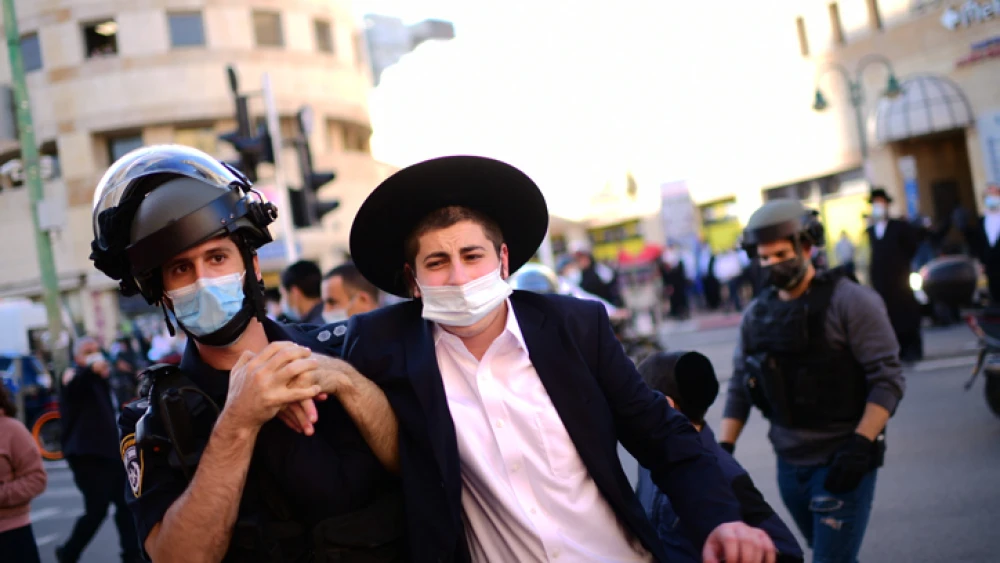
Nevertheless, the funerals hit a particularly raw nerve as they followed after a week of violent clashes between haredim and police in various locations around the country over yeshivah shutdowns.


