Newsletter
Newsletter Support JNS

Lebanese Armed Forces chief warns of military collapse amid economic crisis

The nation’s currency has dropped 85 percent since 2019 with the monthly salary of a soldier or police officer down to $120 from $800.

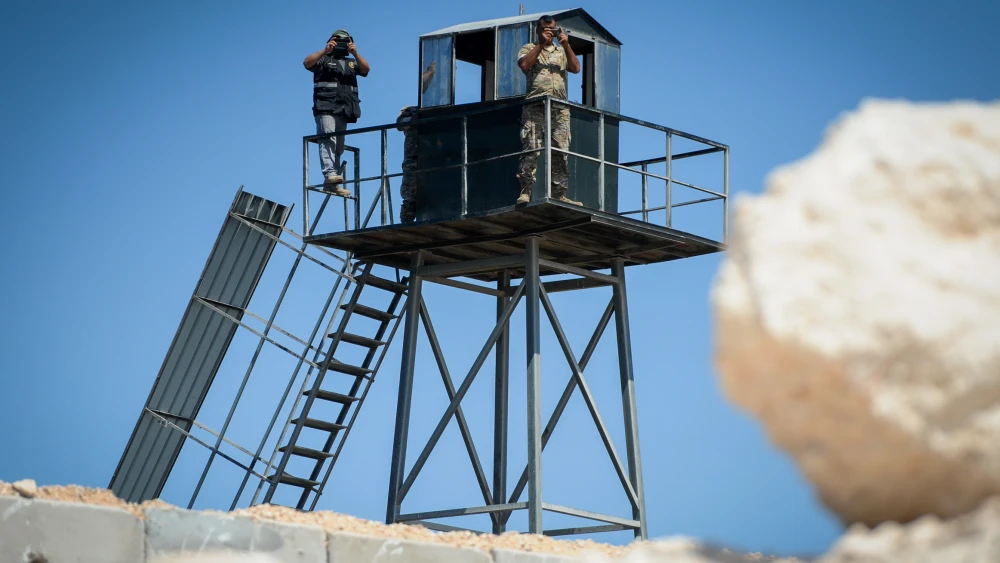
Lebanese soldiers and a member of Hezbollah on the border between Israel and Lebanon on Sept. 5, 2018. Photo by Basel Awidat/Flash90.

Lebanon’s army is suffering from instability as the country’s economic crisis has put pressure on soldiers’ livelihoods, said Gen. Joseph Aoun, commander of the Lebanese Armed Forces.

“Soldiers are going hungry, like the people,” said Aoun on Monday, according to Reuters.

In the report, he said low morale could lead to an “implosion” and questioned: “Do they want the army or not? Do you want the army to stay on its feet or not? ... They don’t care.”

The Lebanese currency has dropped 85 percent since 2019 with the monthly salary of a soldier or police officer that had been worth about $800 now worth less than $120, according to the report. The situation became so dire that the French embassy donated food last month to the army, including basic staples such as rice, pasta and cooking oil.

Three security sources told Reuters that the result could be desertion by low-ranking members of the security forces at a time when crime in the country has spiked.

Amid the deteriorating situation in Lebanon, the Israeli Military Intelligence Directorate has recently assessed that Hezbollah could, for the first time in years, be prepared to initiate military escalation that in the terror group’s view would lead to a number of “battle days.”

If Ismael Jimenez were suspended, it would be “an encouraging sign of the much-needed systemic change for the district,” Mika Hackner, of the North American Values Institute, told JNS.
Prayer notes calling for peace have been sent from Arab countries to the holy site in Jerusalem, and some even from Iran.
Iraq’s Interior Ministry stated that it is using “precise intelligence information” to locate Shelly Kittleson, a U.S. freelance journalist who reports extensively from Iraq, Syria and Afghanistan.
The Israeli prime minister said strikes on steel production facilities weaken the Islamic Revolutionary Guard Corps as the operation against Iran progresses “beyond the halfway point.”
Adm. Brad Cooper, commander of the U.S. Central Command, and Lt. Gen. Eyal Zamir, chief of staff of the Israel Defense Forces, also discussed ongoing efforts to curb Iran’s reach.
“Organizations and individuals tied to terrorism have no place operating under the protection of Canadian law,” the Centre for Israel and Jewish Affairs wrote.

