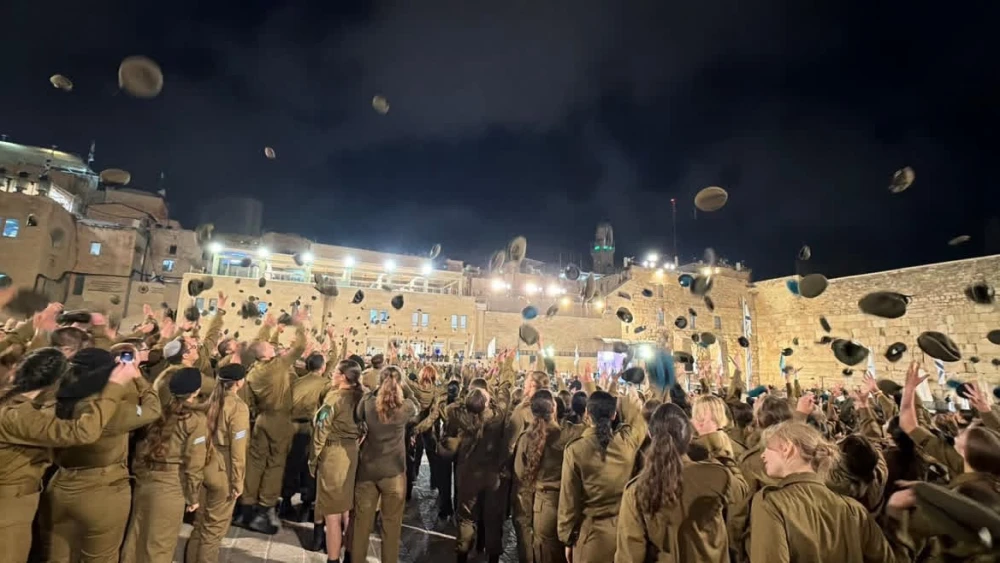
The Israel Defense Forces held an emotional ceremony at the Western Wall in Jerusalem on Tuesday evening, celebrating the completion of the Hebrew-language training track by more than 600 new recruits from Israel and 40 countries around the world.
The three-month training program took place at the IDF’s Michve Alon Base, under the Magen Division, which oversees educational and integration programs within the IDF’s Education and Youth Corps.
Upon arriving at the base, none of the recruits had a sufficient command of Hebrew to serve in the military. They are therefore taught according to their individual Hebrew proficiency levels.
The program combines basic military training with intensive Hebrew instruction, helping the recruits transition from civilian life into military service. During the course, they also build friendships with fellow soldiers from around the world and undergo screening for various military positions.
After completing the program, the soldiers are prepared to move on to the next stage of their military service, with assignments to positions, courses and training programs throughout the IDF.
Tuesday evening’s ceremony also doubled as the swearing-in ceremony for many of the new soldiers, marking their formal entry into military service.
Captain Ariel (last name withheld) commander of Dror Company at the Michve Alon Base, told JNS the main idea of the program is to prepare the soldiers for their military service so they can begin their roles on an equal footing with all other Israeli soldiers.
She explained that the program serves a diverse group of recruits, including new immigrants from around the world as well as native Israelis who need to strengthen their Hebrew skills.
According to Ariel, one of the five companies is made up of Israeli recruits from minority communities, including Bedouins and Druze, whose native language is Arabic. The other four companies are comprised primarily of immigrants, including some who immigrated specifically to enlist in the IDF. Others have come from abroad to volunteer for military service, with plans to eventually return to their families and careers overseas.
Ariel emphasized that the program goes far beyond a traditional Hebrew-language course, explaining that while learning Hebrew is a central component, the soldiers are also immersed in Israeli culture, history and Zionist values.
“It’s not just an ulpan,” she told JNS. “We do learn Hebrew most of the time, but we do it in a different way—through songs, history and activities that help create a deeper connection.”
The soldiers also attend classes focused on Hebrew grammar and proper language use, alongside lessons about Zionism and Israeli history.
She said that the program also provides opportunities for the soldiers to explore Israel firsthand, visiting different regions of the country, its landscapes and historical sites.
This reflects a Hebrew expression that translates literally as “to know the country through your feet,” she said; the idea that truly getting to know Israel means walking its land, experiencing its history and developing a personal connection to the country.
She also noted that Hebrew is the same language spoken by the Jewish people’s ancestors and used to describe some of the most meaningful and defining moments in Jewish history.
“These soldiers are using those exact same words and letters. I think that combination of learning and connection is what allows them to feel part of something bigger than themselves and part of the State of Israel,” she said.
Private S., a 28-year-old teacher who immigrated to Israel last year from Boston and volunteered for IDF service as a lone soldier, meaning a soldier with no close family in the country, completed the course as a member of Carmel Company.
He described the program to JNS as a “soft landing” into military life, giving recruits time to learn Hebrew, complete basic training and adjust alongside others in similar circumstances.
He said the program can be particularly helpful for people overseas who may be nervous about enlisting, offering them a gradual introduction to military service. He also praised the commanders for helping recruits prepare for the army and pursue the positions they want, so that by the time they move on, they are ready to serve on equal footing with other Israelis.
“It’s a great way, if someone’s nervous about going to the army, to kind of ease your way in,” he said. “It’s a really nice program.”
S. also expressed hope that more Jews in the United States and around the world would consider immigrating, saying, “This is really the place where you can be yourself, no one ever questions you, and it’s your home.”
Private N., a soldier in Lehava Company, who immigrated to Israel with her family from Argentina, told JNS that the course helped her improve her Hebrew while also teaching her how to work more effectively with others. She explained that she had previously been accustomed to working independently, and that learning to cooperate and build relationships with fellow soldiers was a significant change for her.
“The program really helped me. I learned new words in Hebrew that I didn’t know before, and how to work as part of a team,” she said, adding, “It has changed a lot for me.”
After completing the Hebrew course, N. shared that she will be moving on to the Nativ program, an IDF course that introduces participants to Jewish history, tradition and religious practice as part of the conversion process to Judaism. She hopes to eventually serve in a combat role, ideally in the Border Police.
As the ceremony was about to begin, Capt. Ariel wanted to share one final message, urging Jews around the world to find their own way to support Israel and be part of the Jewish nation.
“We need everyone to be part of this. Ideally, we want everyone here in Israel, close together, as part of one big family. But if you are living far away, you can still make a difference. Speak positively about Israel, support us from abroad and be ambassadors for the Jewish nation. Share the amazing and unbelievable things happening here in this small country in the Middle East. Everyone can choose how they want to be involved, but we all have a role to play.”