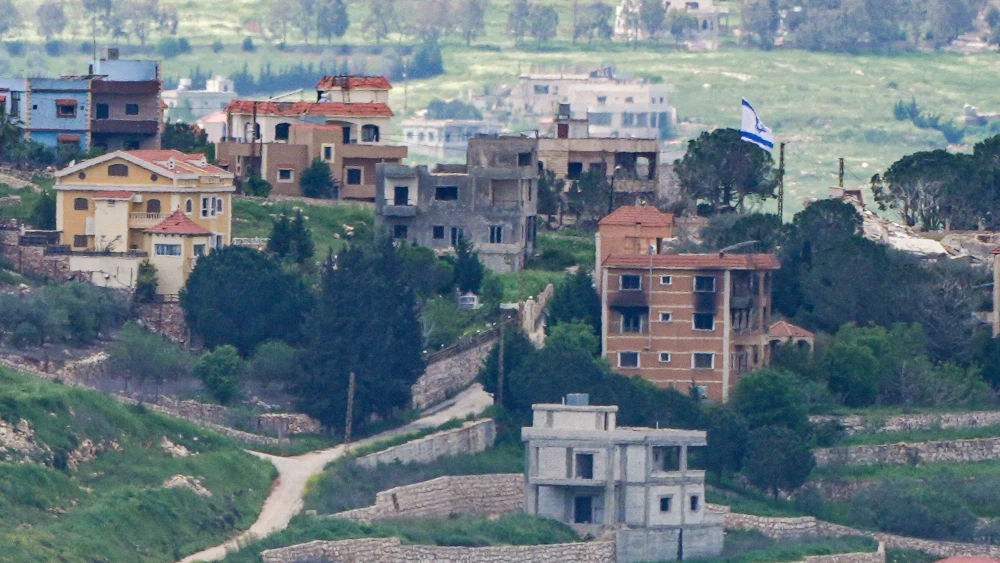
Iranian-backed Hezbollah terrorists on Thursday launched an anti-tank missile toward Israel Defense Forces soldiers, in violation of the ceasefire between Beirut and Jerusalem.
“The anti-tank missile landed adjacent to IDF soldiers,” the military said. “No IDF injuries were reported.”
Earlier on Thursday, the IDF intercepted an unmanned aerial vehicle that was launched in Southern Lebanon.
“Following the initial report of an interceptor launched toward a suspicious aerial target in Southern Lebanon, the Israeli Air Force successfully intercepted the target,” the military stated.
The confirmation came around an hour after the army first announced that an interceptor was launched toward a UAV “identified in the area in which IDF soldiers are operating in Southern Lebanon.” The drone did not cross into Israeli territory and, accordingly, no air-raid sirens were activated, the IDF added.
On Wednesday, the IDF eliminated a Hezbollah terrorist at a launch site in Southern Lebanon’s Sejoud area, “to prevent a direct threat to the communities of northern Israel.”
“The terrorist was eliminated in an aerial strike in order to prevent the continuation of his activity at the launch site,” the military stated.
On Tuesday night, Hezbollah launched several rockets toward IDF soldiers operating south of the truce line in Southern Lebanon, in what the military called a “blatant violation of the ceasefire agreement.”
The IDF in recent days also eliminated several Hezbollah terrorists after they violated the truce understandings and threatened Israeli troops.
Hezbollah began firing rockets, missiles and drones at Israel on March 2, in retaliation for the Jewish state’s targeted killing of Iranian Supreme Leader Ali Khamenei. Khamenei was eliminated in the opening strikes of “Operation Roaring Lion/Epic Fury” against the Islamic regime on Feb. 28.
In response to the terrorist organization’s violation of the U.S.-brokered Nov. 27, 2024, truce agreement, Jerusalem launched an aerial campaign against Hezbollah and ordered IDF troops to advance and take control of additional areas in Southern Lebanon to halt cross-border attacks.
Jerusalem and Beirut on April 16 agreed to a 10-day ceasefire following mediation by U.S. President Donald Trump.
A week prior, Israeli Prime Minister Benjamin Netanyahu announced that the Lebanese government had requested direct negotiations with the Jewish state aimed at disarming Hezbollah, and a first round of talks between Israeli Ambassador to the United States Yechiel Leiter and his Lebanese counterpart was held in Washington, D.C., on April 14.
A second round of negotiations is scheduled to take place on Thursday. A source at the Lebanese Embassy told the An-Nahar daily that the talks were expected to kick off at 4 p.m. Washington time.