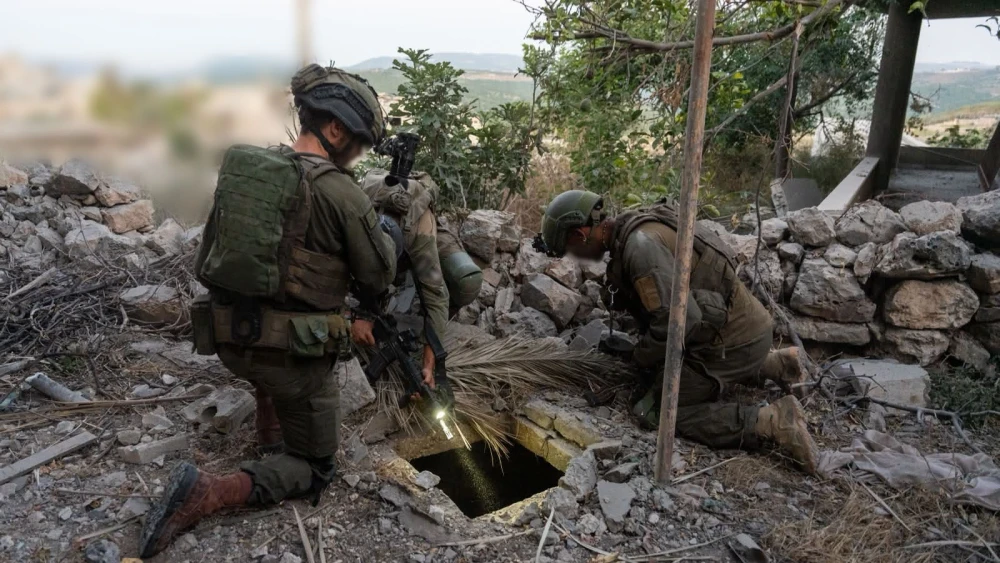
The Israel Defense Forces uncovered an underground Hezbollah “drone airport” located some five miles north of the Israeli border, including more than 20 terrorists who were all eliminated, the military revealed on Sunday.
The underground facility was built under the village of Majdal Zoun, several miles east of the Mediterranean Sea.
The Israeli Air Force bombed the entrance to the underground structure in 2024, but the Iranian proxy group had rehabilitated it since, according to the IDF.
Troops of the IDF’s Yahalom special operations engineering unit, led by the 551st Brigade, under the command of the 91st Division, are currently operating in the area in accordance with the Memorandum of Understanding signed by the United States and Iran last week, the army said.
The soldiers identified terrorist infrastructure above ground, connected to a tunnel network roughly 200 meters long. The underground facility consisted of four launch shafts, 12 lodging rooms and storage space for explosive devices, anti-tank missiles and unmanned aerial vehicles, the IDF said.
Hezbollah used the infrastructure, which runs underneath civilian buildings, a mosque and a school, to assemble, store, and launch drones at the State of Israel and IDF troops, the military continued.
“We found more than 50 drones here, along with over eight tons of additional weaponry—primarily explosives and firearms. You can see models with wingspans of up to 2.5 meters. They arrived disassembled, were assembled here, and then launched from the same location,” said Lt. Col. D., a commander in Yahalom.
“These are systems capable of reaching ranges of between 200 and 500 kilometers [125-310 miles], which means they threatened not only northern Israel, but most of Israel’s coastline. We came here specifically to deprive Hezbollah of those capabilities,” he continued.
The commander stressed that the military equipment found is similar to that used by Iran’s other proxy groups, such as the Houthis in Yemen.
“There is still a lot of work ahead. But the soldiers here have a tremendous sense of accomplishment. We managed to locate the tunnel and the infrastructure through blood, sweat and tears. Today, thanks to this operation, we understand that our presence is helping protect the children of northern Israel—and their security is, in fact, everyone’s security,” he concluded.