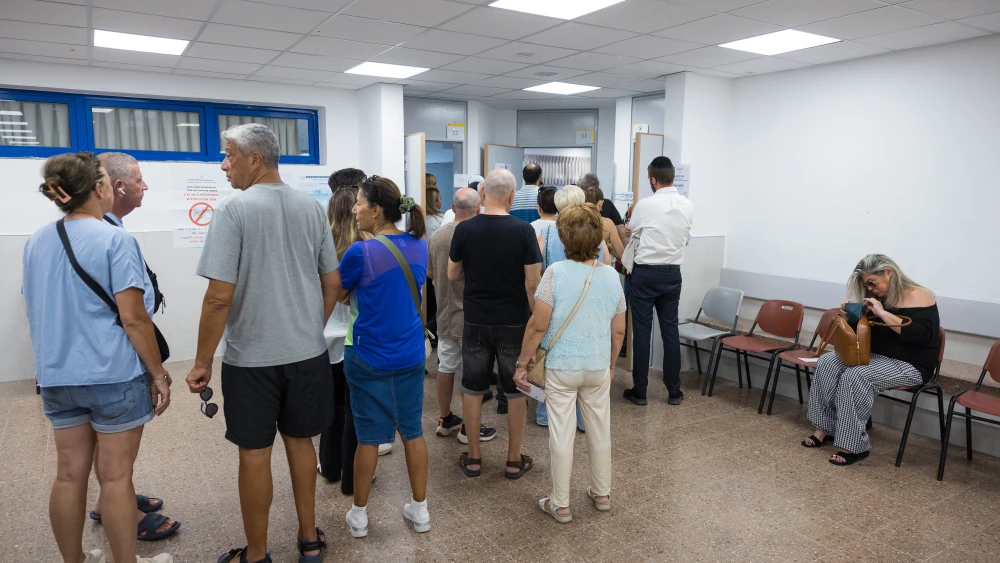
Voter turnout in Israel’s election for the 26th Knesset reached 74.3% by 8 p.m. on Tuesday, already exceeding the final turnout of 70.63% in the 2022 election, according to the Central Elections Committee.
A total of 5,449,277 voters had cast ballots two hours before polling stations were scheduled to close. At the same hour in 2022, turnout stood at 66.3%—eight percentage points below Tuesday’s figure.
Participation rose from 66.7% at 6 p.m., when 4,892,186 voters had cast ballots. Acting director-general Dean Livne told reporters at the Knesset that the 6 p.m. reading was the highest recorded for that hour. The committee began measuring hourly turnout figures in 1973.
Turnout had stood at 55.7% at 4 p.m., also a record for that hour and up from 47.5% at the same time in 2022.
“The last time we saw similar voting numbers, we reached almost 80% nationwide,” Livne said when presenting the 4 p.m. figures.
The Central Elections Committee on Tuesday evening rejected a request to extend voting beyond 10 p.m., saying there was no justification to do so.
The committee’s presidium considered the request from Prime Minister Benjamin Netanyahu’s Likud party. National Security Minister Itamar Ben-Gvir’s Otzma Yehudit party and the haredi Shas party told JNS they had joined the appeal.
Otzma Yehudit cited heavy crowding and unusually long waits at polling stations across the country.
The committee said high nationwide turnout “across all sectors of society” demonstrated “strong public engagement in the democratic process.” It stressed that every voter who reaches a polling station by its closing time will be able to vote.
Updated locality figures published by the committee showed turnout of 83.5% in Sakhnin, 81.3% in Kafr Qasim, 80% in Elad, 79.8% in Rahat, 79% in Rosh Ha’ayin and 76.5% in Modi’in-Maccabim-Reut.
In that tally, Tel Aviv–Jaffa recorded the largest number of ballots cast, with 301,639 voters participating, representing turnout of 63.6%. Jerusalem followed with 282,870 voters, or 62%, while Haifa recorded 160,146 voters and turnout of 59.8%. Among other large cities, turnout reached 70.2% in Petach Tikvah, 68.6% in Rishon Letzion, 65.9% in Ashkelon, 65.3% in Ashdod and 63% in Beersheva.
Dr. Martin Sherman, head of the Israeli Institute for Strategic Studies, told JNS that increased participation appeared to reflect significant mobilization among Arab voters, which he viewed as a challenge for right-wing parties.
“High turnout for the Arabs is bad news for the right wing,” he said.
Sherman attributed opposition mobilization primarily to hostility toward Netanyahu and the dispute over haredi enlistment.
Turnout among Israel Defense Forces personnel reached 68% as of 5 p.m., compared with 65% at the same hour in the 2022 election, the military said.
Military voting began on Oct. 21, allowing soldiers and reservists to cast ballots early due to operational requirements. More than 850 polling stations, many of them mobile, were deployed at bases and outposts across operational arenas, including in Gaza, Lebanon and Syria.
Sherman predicted that military and younger voters would bolster right-wing parties. Referring to first-time voters, he said they “will strengthen the right.”
Tuesday’s election for the 26th Knesset is Israel’s first general election since the Hamas-led massacre on Oct. 7, 2023.
The committee will continue publishing national turnout updates until 11 p.m.