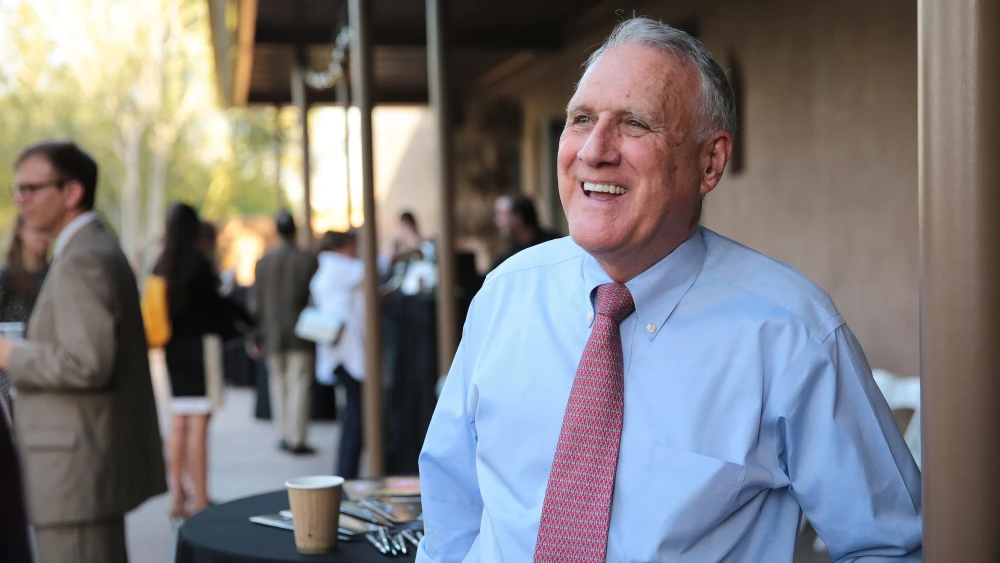

During his time as a U.S. senator representing Arizona, Jon Kyl, who passed away on Sept. 17 at the age of 84, was known as a top American politician, even listed in 2010 as one of the most influential people in the world. He did many extraordinary things in the Senate, known mainly to those who cared about Israel.
A member of the Republican Party, he was a leading voice on pro-Israel issues. When people would approach him and ask why, as a Presbyterian, he was leading efforts to move the U.S. embassy to Jerusalem and recognize the city as Israel’s capital, the senator would respond: “Because it is just and right.” So simple, and yet so profound.
My co-author, Leonard Grunstein, and I decided to adopt that response and make it the title of our book on the U.S. recognition of Jerusalem as the capital. Kyl appreciated that we used his response, and he wrote the foreword for the book.
In one of my meetings with him a few years ago, he looked back in amazement that as a first-year freshman, he was able to lead the efforts related to the Jerusalem embassy legislation, which passed 93-5 in the Senate and 374-37 in the House, despite opposition from the Clinton administration.
Kyl brilliantly got then-Senate Majority Leader Bob Dole (R-Kan.) to support the legislation, which led to the Republican caucus quickly following suit.
Sen. Joe Lieberman (I-Conn.) was the leading voice on the Democratic side, and in the pivotal meeting in Dole’s office at the urging of Kyl, Democratic Sen. Daniel Inouye (D-Hawaii) made a strong appeal for the legislation. Dennis Ross was in the meeting on behalf of the Clinton administration, and he was fighting against the legislation. Dole got Sen. Dianne Feinstein (D-Calif.) and Frank Lautenberg (D-N.J.) to agree to the legislation in exchange for a waiver provision.
As it later turned out, a U.S. Supreme Court decision, Zivotofsky v. Kerry, related to the waiver provision likely saved the Jerusalem Embassy Act from being ruled unconstitutional. The timing of Trump’s decision to recognize Jerusalem in December 2017 was due to him having to decide whether or not to invoke the six-month waiver, as required in June and December in the Jerusalem Embassy Act of 1995.
It is interesting to note that Ross continued to oppose the embassy move, even advocating that only western Jerusalem be recognized and not eastern Jerusalem (where the Western Wall is located) as part of Israel’s sovereignty. He erroneously predicted that such a move would lead to massive violence and an upending of the Middle East. Trump properly rejected that recommendation. Instead, the embassy move helped lead to the Abraham Accords in September 2020, when Israel established diplomatic relations with four Muslim-majority countries.
I was the president of Young Israel of Phoenix, Ariz., when Kyl got elected to the Senate. We held the first dinner thanking the senator for leading the legislation regarding the United States moving its embassy from Tel Aviv to Jerusalem. A year later, then-mayor of Jerusalem—a future prime minister—Ehud Olmert came to Phoenix and to our dinner honoring Kyl.
There, he commented that for what he has done for Israel and the Jewish people, saying that “Senator Kyl’s name would go down in golden letters in Jewish history.”
When I discussed with the senator why he was so low-key about what he had done when the norm for politicians was to constantly talk about their accomplishments, his response was that those who need to know are aware of what he has done.
Kyl retired from the Senate despite being in good health because, unlike others in that position, he acted ethically and lived modestly. He decided, while he still had good health, that he should try to see if he could make more money for his family (his wife and two children) since he didn’t have much savings, making the $174,000 salary that senators receive. One of his jobs in private life was to assist in the confirmation of Brett Kavanaugh to the U.S. Supreme Court in 2018.
Kyl, an extraordinary legislator, was a man of brilliance and ethics. Politically, there has been no one else that I have had the honor to meet who I have learned more from than he. Although I was invited to his funeral, because it was on a Saturday, I was not able to attend.
I had a meeting with Arieh King, the deputy mayor of Jerusalem, before Kyl died. He suggested that a way for Israel to honor the senator was to name a street after him in Jerusalem. I agreed, and we are now working toward that outcome.
Thirty years ago, Olmert said the people of Jerusalem will never forget what the senator had done for Israel and the Jewish people. With the Jerusalem street-naming, everyone walking by will know his name … and remember.