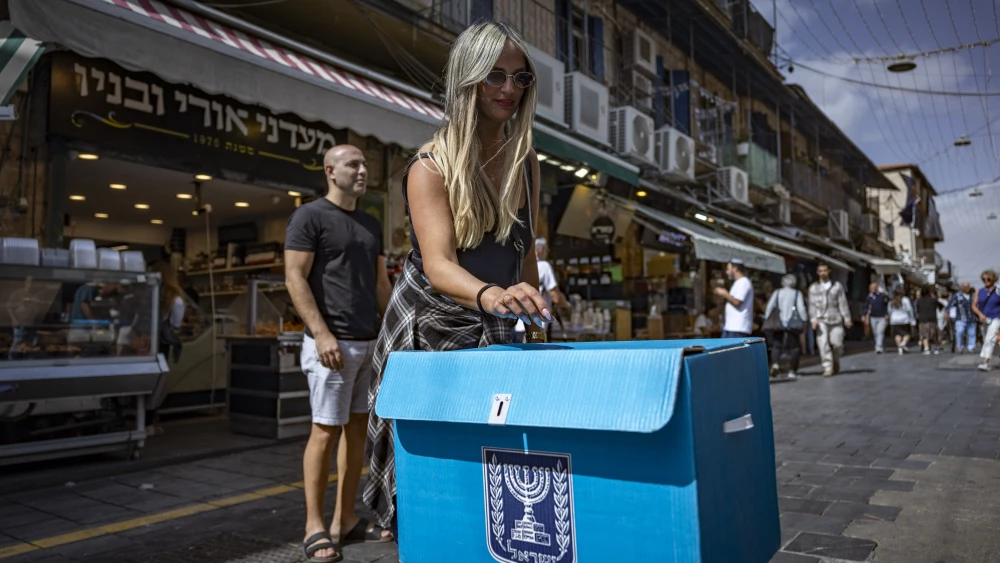
At 10 p.m. on Tuesday, the polls close in Israel. The work of the voter has ended. The work of the ballot counters begins. It’s a multi-step process that starts the moment all those still in line at the time the polls close have exercised their right to vote.
Without delay, the blue boxes into which voters drop their ballots are opened. This election, 18,000 ballot boxes have been distributed across 12,018 polling stations across the country. Ballots are counted by polling station committee members and other officials. Only certain people are allowed to be present during the count and different parties are represented to keep everyone honest.
Officials remove the voting envelopes and examine the ballot slips. They sort and count the votes while identifying invalid ballots according to election rules, such as envelopes containing more than one ballot slip. Invalid votes are excluded from the vote total.
Ballots are checked against the number of voters. The number of voters is known because they are identified and checked against a voter register as they enter the polling station. If the numbers don’t reconcile, that is, the number of voters doesn’t match the number of votes cast, the count must be checked again. The totals are recorded in an official written tally.
When the count is finished, the ballots and related election materials are packaged, along with the official tally, and sent to Regional Election Committees for processing and review. Each Regional Election Committee is headed by a judge appointed by the president of the Supreme Court. There are 20 regional committees.
The Regional Election Committees then transfer the materials to the Central Election Committee, whose headquarters is located in the Knesset.
On election night, initial results are provided by Israeli television stations and polling firms based on exit polls.
However, the results may change due to a category of ballot that is not counted on Election Day. These are the so-called “double-envelope” ballots. An outer envelope includes identifying details of the voter. The second, inner envelope includes the ballot. These are for special groups of voters, such as on-duty military personnel, diplomats and their families serving abroad, hospital staff and patients, and inmates in prisons (prisoners are allowed to vote in Israel).
Soldiers make up the largest number of double-envelope voters. In the 2022 election for the 25th Knesset, more than 460,000 double-envelope votes were cast. The Central Elections Committee estimated that number will rise to 650,000 this year, Ynet reported on Sunday. This is due to the large number of reservists serving in the war and Israeli citizens who remain in temporary housing after being evacuated from their homes.
That number is equivalent to 15 seats in the 120-seat Knesset, enough to bring about a meaningful change from the early results.
The Central Elections Committee is required by law to publish the official results within eight days of the election.