Newsletter
Newsletter Support JNS

PA chief Abbas thanks Saudi Arabia for ‘steadfast’ support

The Palestinian Authority leader noted Riyadh’s call to “establish a Palestinian state with east[ern] Jerusalem as its capital.”

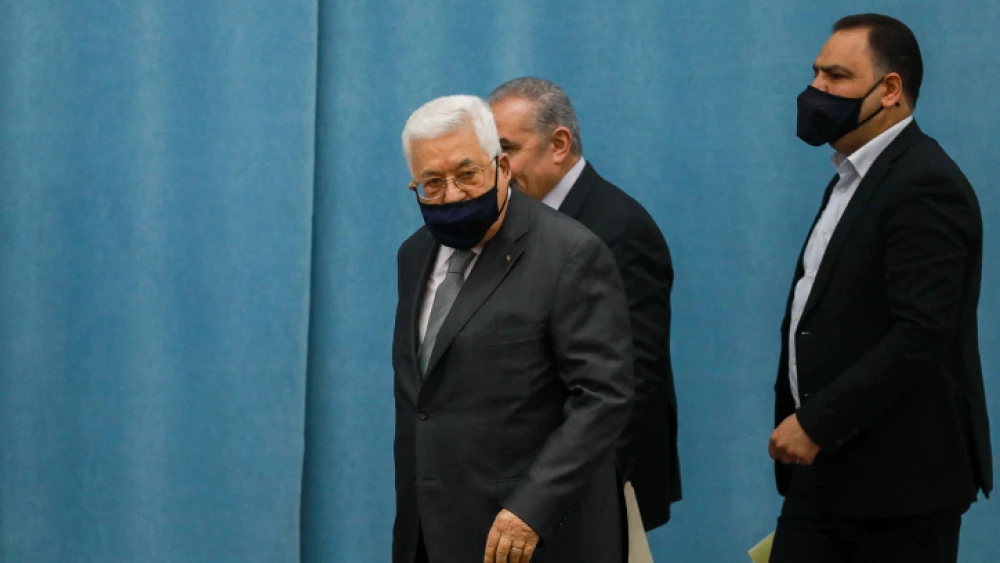
Palestinian Authority leader Mahmoud Abbas heads for a meeting of the P.A. leadership in Ramallah. May 7, 2020. Photo by Flash90.

Palestinian Authority leader Mahmoud Abbas sent a letter to Saudi Arabia’s king and crown prince to express appreciation for what he described as Riyadh’s “steadfast stance” in support of the Palestinian people, the official P.A. Wafa news agency reported on Sunday.

In his letter, Abbas noted the Saudi call to “end the Israeli occupation and establish a Palestinian state with east[ern] Jerusalem as its capital,” said the report.

Abbas also conveyed gratitude to the Arab nations—the other five Gulf states, as well as Iraq, Egypt and Jordan—that participated in the summit in Jeddah on Saturday.

Abbas’s missive comes after Saudi Arabia’s foreign minister denied reports that his country has been involved in discussions on setting up a Gulf-Israeli defense alliance.

Prince Faisal bin Farhan Al Saud also told journalists after the summit, which was attended by U.S. President Joe Biden, that Riyadh’s “decision to open its airspace to all air carriers [including Israeli airliners] had nothing to do with establishing diplomatic ties with Israel and was not a precursor to further steps,” according to Reuters.
“For 20 years prior, secretly, I was learning Torah, I was learning the Bible, the biblical understanding of history, and I wanted to go to a place where I can live and also play,” the NBA legend said of his time playing in Israel.
Some see the transfer of law enforcement from the IDF to the police as a step toward greater Israeli governance, while a legal expert says it would bring greater normalcy to Israeli life in Judea and Samaria but not advance sovereignty.
Israeli forces killed a senior commander in Hezbollah’s Badr Unit in Southern Lebanon following the group’s attack on three soldiers within the Security Zone.
Israel’s U.N. envoy says the inquiry shows that anti-Israel hostility is “not organic” and warns of foreign efforts to sow division.