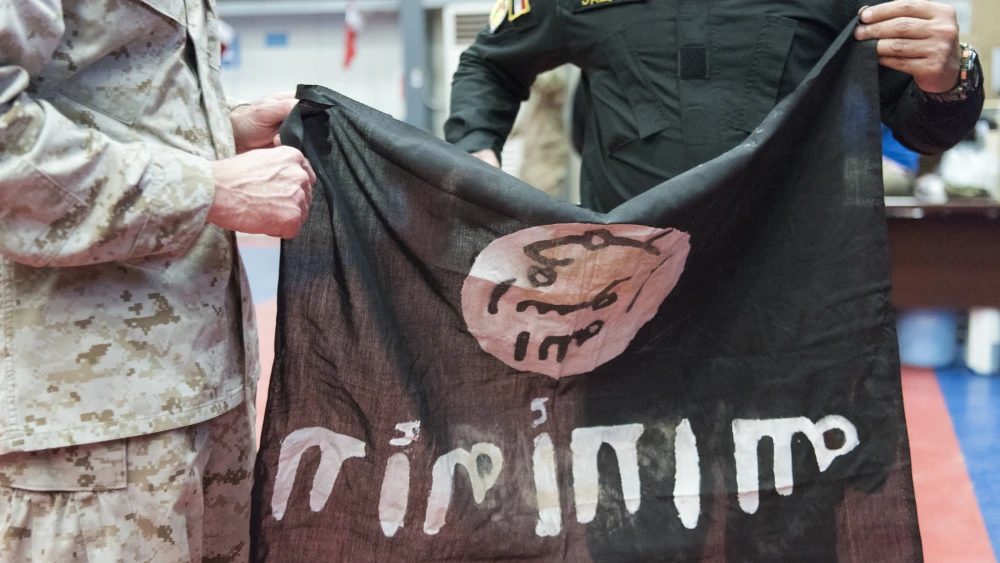
Ahmad Khalil Elshazly, 29, of West Haven, Conn., was sentenced to 92 months in prison—more than seven-and-a-half years—for trying to support the Islamic State, a U.S.-designated terror organization also known as ISIS, the U.S. Justice Department said on Monday.
“There is no higher priority than the security of our nation and its citizens,” stated David X. Sullivan, U.S. attorney for the District of Connecticut. “My office and our law enforcement partners will continue to tenaciously work to investigate, apprehend and bring to justice anyone who threatens us.”
After his term, Elshazly, who has been in jail since he was arrested on Dec. 15, 2019, will be under supervised release for the rest of his life, the department said.
The prior day, he paid $500 to an undercover agent, whom he believed to work with ISIS. He thought the person would smuggle him out of the United States to Turkey and introduce him to an ISIS terrorist who would help him get to Syria. Officers arrested him in Stonington, Conn., before he boarded a boat, the Justice Department said.
In the 15 months prior to his arrest, Elshazly swore allegiance to ISIS and posted “hundreds” of pro-ISIS messages on an instant-messaging platform, per court documents.
He pleaded guilty on Nov. 30, 2022, to conspiring to support a terror group. “While detained, Elshazly has had numerous disciplinary infractions,” the Justice Department said. “In August 2025, officers searched his cell and found a handwritten plan for a coordinated uprising at the detention facility, complete with diagrams of the housing unit, instructions for breaching secured areas and tactics for confronting the correctional emergency response team.”
The Justice Department sought 15 years for Elshazly, whose attorneys said that “treating Mr. Elshazly with compassion will show those who practice the Muslim faith that the United States is not the enemy of Islam that the radical Islamists claim the U.S. to be.”
In a sentencing memo filed on Sept. 1, his attorneys wrote that Elshazly had “a chaotic upbringing, an unequipped mother, educational failure, low self esteem, extreme isolation, the stupidity of youth, never treated Autism Spectrum Disorder and bouts of depression,” which “made him vulnerable to the toxic Syrian and ISIS propaganda he found while unsupervised and alone in his bedroom.”
“A disappointment to himself and others in real life, he became increasingly mired in fantasy, making cinematic promises of bold military actions and boasting of skills and abilities, such as rocket manufacturing, that were entirely nonexistent,” they wrote. They added that his autism and related issues could “be successfully addressed in therapy.”