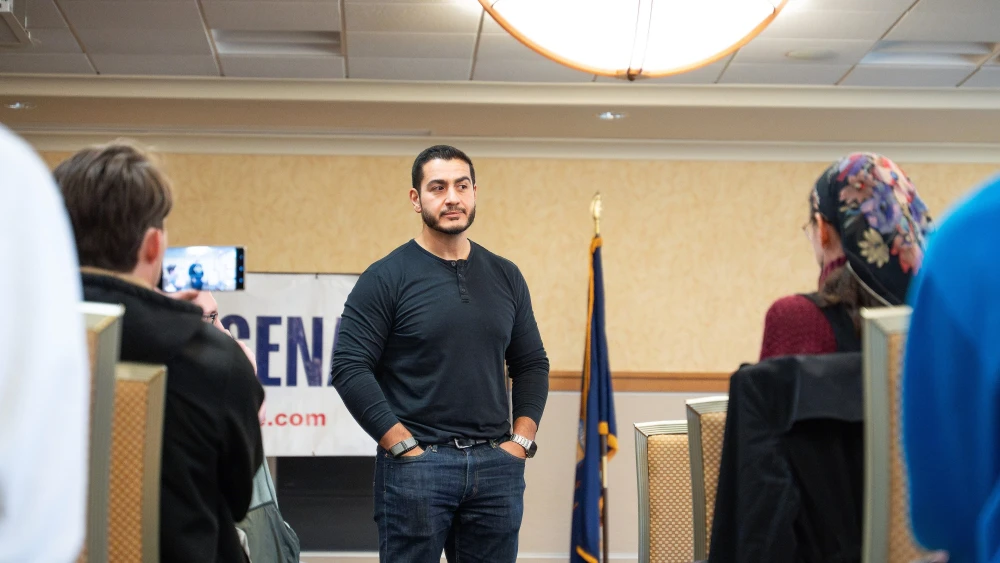
Dr. Abdul El-Sayed, a former Detroit health director who is the Democratic nominee for Senate in Michigan, declined to denounce the Iranian regime when a student called on him to do so at a Sept. 23 event.
“I just don’t want to comment on Khamenei at all,” the politician said. “Like, I don’t think it’s worth even touching that.”
A student, who identified himself as a University of Michigan senior, said that El-Sayed “could not answer the question.”
The student noted audio that leaked of El-Sayed saying at a staff meeting that “a lot of people in Dearborn” were sad about the death of Ayatollah Ali Khameini, who was killed in an airstrike in February 2026.
“My cousin was hunted in the streets of Iran by the IRGC,” the Islamic Revolutionary Guard Corps, “because her hijab wasn’t on right,” the student said. “My uncle was sentenced to die and received 50 lashes by Ali Khameini’s government, and the terror we’ve experienced is insurmountable.”
“You can imagine our surprise, as Persians, our sadness when we heard you, Abdul, in a leaked audiotape of you saying that you didn’t want to comment on Supreme Leader Khameini’s death and that people in Dearborn were sad when he died,” the student said.
The student called El-Sayed’s “silence” a “gaping hole in our community.”
“I want to ask if you regret that silence,” the student said. “I want to ask if you renounce the people that held vigils, that supported this terrorist for all the stuff that he’s done. I want to ask if you stand unequivocally against the IRGC, against the Islamic Republic of Iran, that has killed 50,000 protesters.”
El-Sayed said that the Unites States has “turned ourselves into the world’s policemen.”
“I think what we all want, what we all need, is more democracy, more freedom in the world but also an understanding of what we actually can and should do with respect to that,” he said. “One can disagree with the governance of a foreign country.”
“One can stand in solidarity with freedom and democracy movements, but my worry is when one decides that we are going to go in and take out the leadership of a foreign government,” the Michigan Democrat said. “A lot of times that frustration gets used to justify corporate interests that have a real stake in the natural resources of a particular country.”
El-Sayed has repeatedly condemned another foreign state, Israel, in a way that Jewish leaders have said is dangerous.
Mike Rogers, a former Michigan Republican congressman who is running against El-Sayed, said that his opponent “is looking a young man in the eyes and can’t even condemn a terrorist dictator murdering thousands of his own people.”
“Pathetic,” Rogers stated.