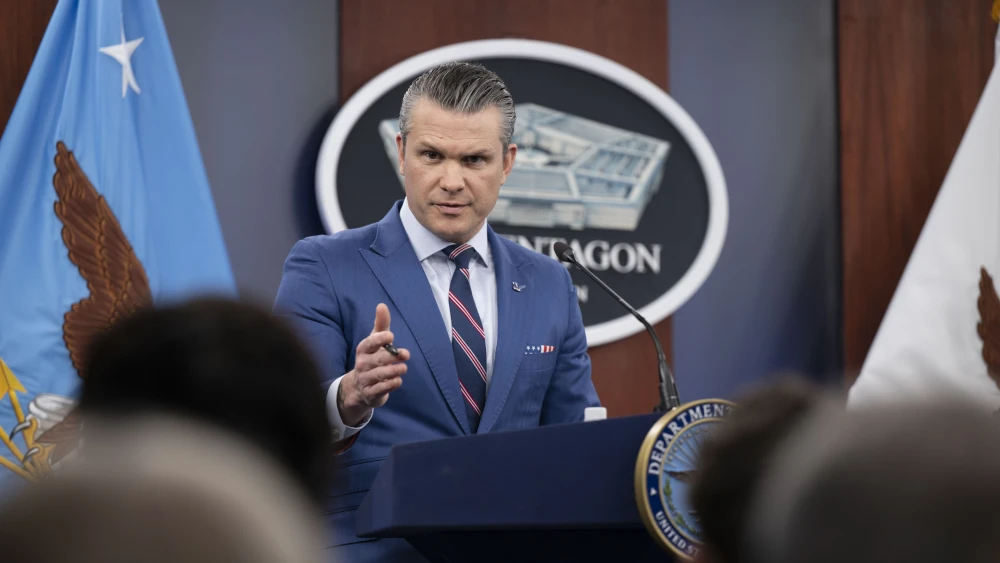
U.S. President Donald Trump “made history” in his series of actions against Iran, which culminated in the “decisive military victory we just achieved in Operation Epic Fury,” Defense Secretary Pete Hegseth stated on Wednesday at a press briefing in the Pentagon.
“In less than 40 days, [U.S.] Central Command, using less than 10% of America’s total combat power, dismantled one of the world’s largest militaries, the world’s leading state sponsor of terrorism,” Hegseth said.
“Iran proved utterly incapable of defending itself. ... Together with our Israeli partners, America’s military achieved every single objective, on plan, on schedule, exactly as laid out from day one,” the defense secretary stressed.
Iran “begged for this ceasefire and we all know it,” he said of the two-week truce agreement reached the previous night.
In the meantime, U.S. forces are “not going anywhere” and will ensure that Tehran “complies with this ceasefire, and then ultimately comes to the table and makes a deal,” Hegseth continued.
“We’ll stay put, stay ready, stay vigilant ... our troops are prepared to defend, prepared to go on offense, prepared to restart at a moment’s notice with whatever target package would be needed,” he added.
He said that “by any measure” Iran’s military has been decimated and will be “ineffective for years to come.”
Iran’s navy is “at the bottom of the sea,” its air force has been “wiped out” and Iran no longer has “a comprehensive air defense system—we own their skies. Their missile program is functionally destroyed,” Hegseth went on to say. “Iran shot hundreds and hundreds of missiles and one-way attack drones at one of our aircraft carriers. They were obsessed with it. And they never got even close.”
The defense secretary said that Iran can still fire missiles from the stockpiles left in their underground bunkers, “but that would be very, very unwise.” Iran, he stated, can no longer build new missiles and unmanned aerial vehicles as their factories have been “razed to the ground.”
The next targets would have been Tehran’s defenseless power plants, bridges and oil and energy infrastructure, had the regime not accepted Washington’s ceasefire terms, Hegseth noted.
These sites would have taken the Iranian regime decades to rebuild, and “we were locked and loaded,” he said.
Trump had the power to “cripple Iran’s entire economy in minutes. But he chose mercy,” he added.
Iran accepted Washington’s terms because it was under “overwhelming pressure,” he said.
On the Strait of Hormuz, Hegseth noted that, according to the present ceasefire agreement, Iran is permitting the passage of ships through the waterway. Vessels “will be sailing. And, ultimately, we’ve done an incredible job militarily inside the Strait of Hormuz … Iran doesn’t have the same ability to defend it the way they did before [war],” he said.
The top official further stated that America uses only a “tiny fraction” of the energy commodities that flow through the strait and it is “time for the rest of the world to step up and ensure that [the waterway] stays open, after President Trump and the War Department brought Iran to the place where they’re voluntarily opening it right now.”
The Trump administration changed the name of the Defense Department to the Department of War in September.
.@SecWar: "We're going to make sure Iran complies with this ceasefire, and then ultimately comes to the table and makes a deal. We'll stay put, stay ready, stay vigilant...our troops are prepared to defend, prepared to go on offense, prepared to restart at a moment's notice..." pic.twitter.com/yrF8JyZCGy
— Rapid Response 47 (@RapidResponse47) April 8, 2026
Gen. Dan Caine, chairman of the Joint Chiefs of Staff, spoke in the briefing, as well, saying, “Over the course of 38 days of major combat operations, the Joint Force achieved the military objectives as defined by the president.”
These were the destruction of Iran’s ballistic-missile and drone capabilities, the Iranian navy and Tehran’s defense industrial base, Caine noted.
“We welcome the ongoing ceasefire … But let us be clear, a ceasefire is a pause, and the Joint Force remains ready if ordered to resume combat operations,” he added.
Gen. Dan Caine: "On Feb. 28, @POTUS ordered the Joint Force to execute Operation Epic Fury with the direct direction to accomplish three distinct military objectives: destroy Iran's ballistic missile and drone capabilities, destroy the Iranian navy, and destroy their defense… pic.twitter.com/9ASjP1EMru
— Rapid Response 47 (@RapidResponse47) April 8, 2026