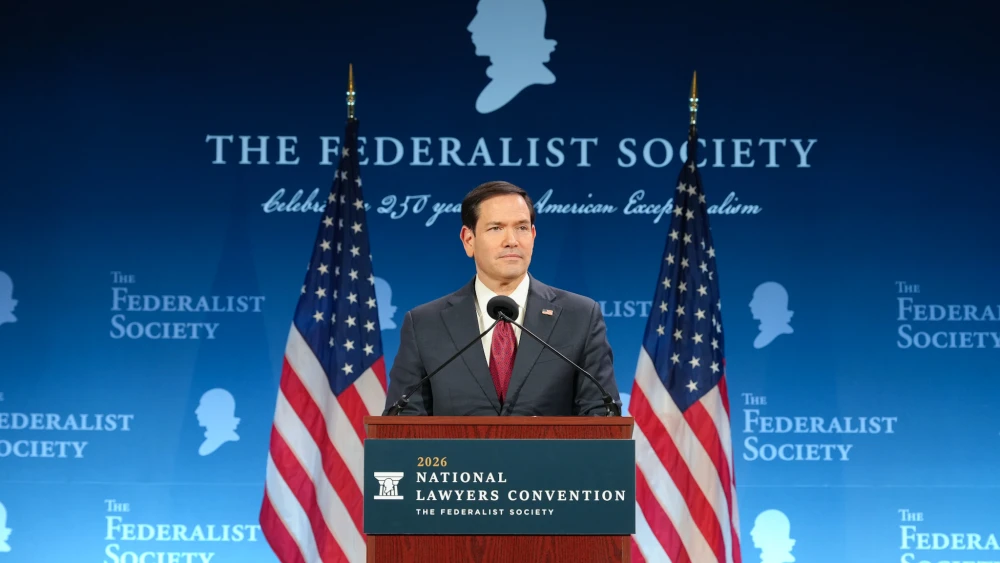
U.S. Secretary of State Marco Rubio offered a stark contrast on Friday with U.S. Vice President JD Vance, as he assessed the Republican party’s losses in the midterm elections.
Speaking at the Federalist Society’s national lawyers convention in Washington, Rubio compared the 2026 election defeat to President Ronald Reagan’s setback in the 1982 elections, when Democrats won the popular vote in the House by nearly 12 points and increased their majority by 26 seats.
“It was against that backdrop, amid the plummeting morale, the anxiety, the despair, that something new began to stir,” Rubio said of the emergence of the conservative legal movement.
“Great things that last are built in decades, not election cycles,” he said later in his remarks. “We have much more to do over the next two, the next six, the next 20 years.”

Neither Rubio nor Vance has declared that he will run for the presidency in 2028, but post-election statements from both offer a preview of what that race might look like.
The day after the midterms, Vance said that the war on Iran and a failure to “change our relationship to Israel” had caused Republican voters to abandon the party.
“The reason we lost is the war,” Vance wrote. “If you’d like to argue it was worth it, that losing the Senate for the next six years was worth it, then do so. Argue it was a worthwhile cost to pay.”
Rubio noted the war’s unpopularity on Friday but made a case for why the Trump administration decided to attack Iran in February.
“They built themselves to a point where, over the years of neglect on this topic, we have allowed them to build up so many missiles and so many drones that they were going to hide behind that conventional shield to do whatever they wanted with their nuclear capability, and it had to be addressed,” Rubio said.
He defined “victory” against Iran as preventing it from acquiring a nuclear weapon. Acknowledging that goal might sound “simplistic,” he said that it did not require any further escalation of the war.
“Right now, frankly, the economic pain that we are inflicting on that regime is so great that there’s no need for military action because we’ve weakened them so much,” he said.

Any Republican candidate for the presidency in 2028 will have to address U.S. President Donald Trump’s legacy and reckon with the political coalition that he has assembled under the “America First” banner of “Making America Great Again.”
That coalition that propelled Trump to victory in 2016 and 2024 is less educated, poorer and less white than the base that elected George W. Bush to the presidency in 2000 and 2004, when college-educated white Americans still preferred to vote Republican.
Both Vance and Rubio have said that “America First” is part of their world views. Vance has suggested that he would reassess the U.S.-Israel relationship. Rubio took aim on Friday at international institutions that have targeted both the United States and Israel.
“We’ve heard the concept ‘international law’ invoked against nearly every major foreign policy decision or action of this administration,” Rubio said. “The founding chief prosecutor of the fake and illegitimate International Criminal Court even accused us of crimes against humanity.”
Rubio did not explicitly mention Israel during his more than 30 minutes of prepared remarks, but his descriptions of “the weaponization of international law” by the “sprawling network of NGOs and agencies staffed by international activists” was similar to the ways that Israeli officials have criticized the United Nations and the ICC.
“That court and its allies in the global bureaucracy have appointed themselves judge and jury and executioner of the international order,” he said. “They think they have the right to rule over everyone, but they are accountable to no one, armed with the power to investigate, to prosecute, to persecute and to jail our citizens, according to laws we neither consent nor control.”
“They can certainly try,” Rubio said. “If they’re foolish enough to try to enforce their paper decrees on Americans, our answer will probably be the same as the Roman general Pompey when he said to those who were trying to invoke their city’s charters against his legions, he said, ‘Stop quoting laws to men with swords.’”