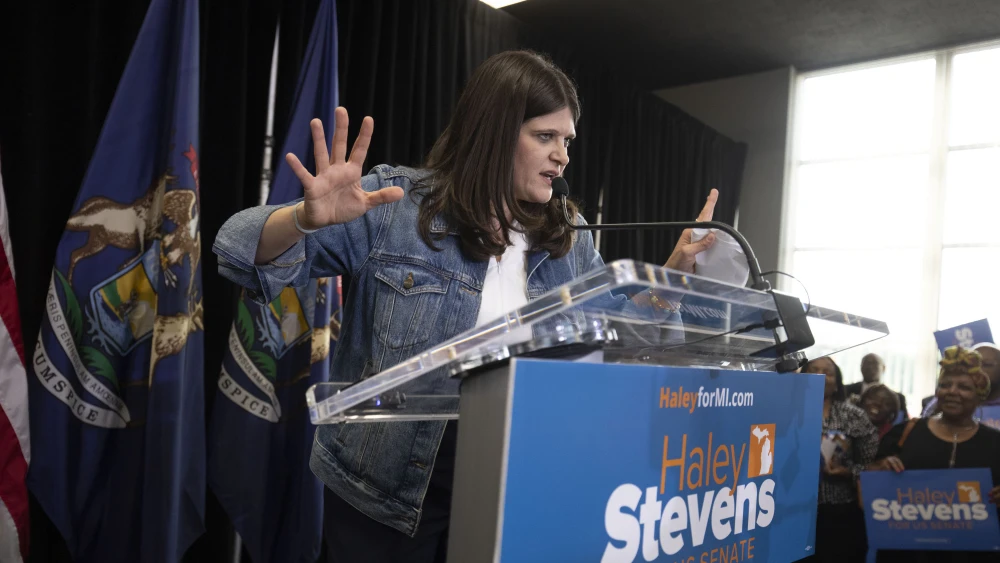
Rep. Haley Stevens (D-Mich.) defended her support for Israel and her relationship with Michigan’s Jewish community during a Democratic U.S. Senate debate, as progressive challenger Abdul El-Sayed repeatedly accused pro-Israel groups of trying to buy influence and push the United States into “stupid wars.”
El-Sayed, a physician and former Wayne County health director, is challenging Stevens, a four-term congresswoman, for the Democratic nomination to succeed retiring Sen. Gary Peters (D-Mich.). The winner will face former Rep. Mike Rogers, the leading Republican candidate, in a race viewed as important to both parties’ hopes of controlling the Senate.
The candidates clashed repeatedly over outside spending in the race. The American Israel Public Affairs Committee-affiliated super PAC, the United Democracy Project, has spent roughly $30 million supporting Stevens, its largest investment in a single race, according to reporting by the media-tracking firm AdImpact. Five additional super PACs that do not disclose their donors have collectively spent another $29.4 million on her behalf.
“When you’re bought off by DTE and Blue Cross and Big Pharma and Big Tech and AIPAC, don’t be surprised that there’s a quid pro quo that comes with that,” El-Sayed said during the televised debate hosted by Fox 2 Detroit. “That money doesn’t just fall off trees.”
El-Sayed argued the spending demonstrated that Stevens was beholden to pro-Israel donors, pointing to her vote against legislation that would have blocked additional U.S. aid to Israel.

“Just last week, our friend here voted to send $3.3 billion of your tax dollars to a foreign government,” El-Sayed said. “That is the pro quo that comes with the quid of $30 million spent by AIPAC.”
Stevens rejected the accusation, saying her views are based on her own convictions and noting that she supports a “two-state solution.”
“Absolutely not,” she said when asked whether outside spending would influence her decisions in the Senate. “I have been very clear, consistent and transparent.”
“I want to see long-term peace,” she added. “I want to see a two-state solution. I believe in a two-state solution.”
Stevens said that El-Sayed “has attacked me by name for purporting that the people of Palestine and the people of Israel deserve to live side by side peacefully.”
She also argued that criticism from Israeli Prime Minister Benjamin Netanyahu showed she was not aligned with any foreign government or political faction.
“The prime minister of Israel has attacked me by name,” Stevens said. “They both represent the extremes. Look, Michiganders want peace. They deserve to see peace.”
Stevens also highlighted her relationship with Michigan’s Jewish community, saying she was “deeply proud” to represent one of the nation’s largest Jewish constituencies.
“This is a community that I have grieved alongside, that I’ve mourned alongside and have fought to bring the hostages home,” she said. “And I’m still working to get us to long-term peace.”
In his remarks, El-Sayed accused Israel of “aiding and abetting the very people who want to foreclose on the possibility of Palestinian self-determination” and said that U.S. aid to the Jewish state was being used “to kill kids and women.”
“That’s exactly what $46 million in spending will buy you,” he said. “I believe that we should not be fighting stupid wars that AIPAC wants us to fight in the first place. And I believe we have a responsibility to keep our money here, to invest here.”
El-Sayed also defended his broader economic message after being asked whether he considered himself a socialist.
“I’m not a socialist,” he said. “I’m just a capitalist who understands how capitalism works. The biggest threat to capitalism was never the idea of government regulation. It was always monopoly.”
El-Sayed again linked AIPAC with corporations and other interest groups supporting Stevens.
“Blue Cross and Big Pharma and Big Tech and AIPAC—all funded by the same people,” he said. “We need a choice.”
“I’m the only candidate in this race who does not take corporate money,” he added.
The debate also addressed leaked audio in which El-Sayed referred to an “ogre” whose head should be put “on a pike.” El-Sayed said he was referring to Sen. John Fetterman (D-Pa.), not Stevens, before accusing AIPAC’s United Democracy Project of spending millions to attack his character.
“Well, thank you,” Stevens replied, “for clarifying that you didn’t call me an ogre.”