U.S. President Donald Trump on Thursday denounced Iran for its “very poor job” in allowing freedom of navigation through the Strait of Hormuz, a key condition of the two-week ceasefire agreed by Washington and Tehran that paused 40 days of war in the Middle East.
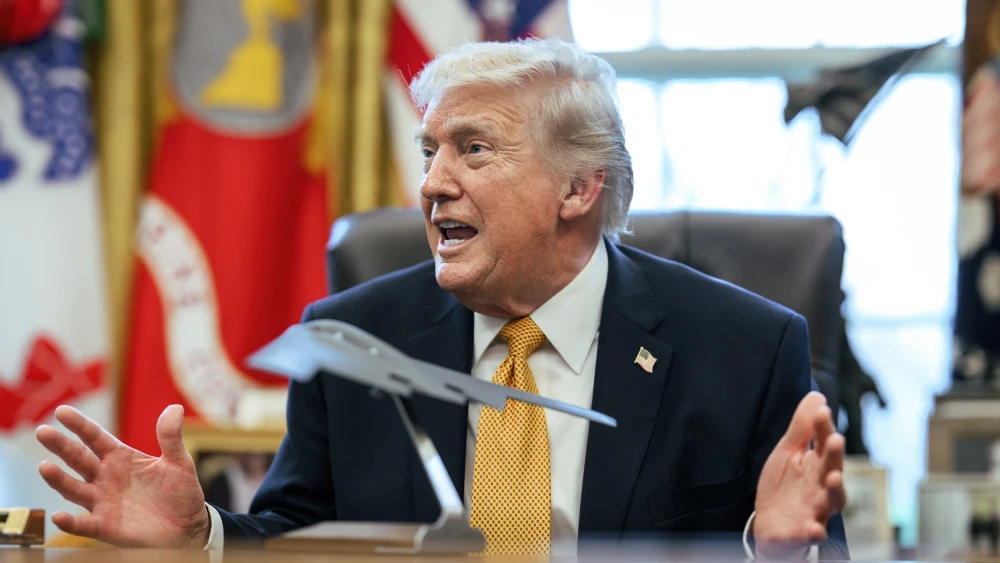
“Iran is doing a very poor job, dishonorable some would say, of allowing Oil to go through the Strait of Hormuz. That is not the agreement we have!” Trump posted to Truth Social.
One hour earlier, Trump had posted: “There are reports that Iran is charging fees to tankers going through the Hormuz Strait—They better not be and, if they are, they better stop now!”
"Iran is doing a very poor job, dishonorable some would say, of allowing Oil to go through the Strait of Hormuz. That is not the agreement we have!" - President DONALD J. TRUMP pic.twitter.com/IcIpGzc7CZ
— The White House (@WhiteHouse) April 9, 2026
Trump said on Thursday that American military forces, ships and aircraft will remain deployed “in, and around, Iran” until a “real agreement” is fully implemented.
The U.S. military is “loading up and resting,” and its next action will be “bigger, better and stronger than anyone has ever seen before” if the deal is not complied with, Trump wrote on Truth Social.
He added that the agreement prohibits Iranian nuclear weapons and ensures the Strait of Hormuz “will be open and safe.”
Trump announced on Tuesday evening that he agreed to a “double-sided ceasefire” with the regime in Tehran after talking to the Pakistani prime minister and military chief, who “requested that I hold off the destructive force being sent tonight to Iran.”
The deal came after Trump warned on Tuesday that if Iran did not meet his 8 p.m. EST deadline to reopen the Strait of Hormuz, “a whole civilization will die tonight, never to be brought back again.”
Likud lawmaker Tally Gotliv told JNS on Thursday that Israel has achieved “unimaginable” results in Iran, striking approximately 20,000 targets “in a manner that only history can fully capture,” and weakening the Revolutionary Guards while demonstrating “extraordinary intelligence superiority” that led to the elimination of the Islamic Republic’s entire leadership.
“All of this occurred in coordination with the United States,” Gotliv continued. “The coalition demonstrated clear strength and prompted expansionist countries such as Russia and China to refrain from intervening.
“If Iran does not agree to the conditions set by the United States regarding enriched uranium, the Strait of Hormuz and its nuclear program, U.S. military power remains in the region and is not going anywhere,” she said.
Likud Knesset member Dan Illouz told JNS on Thursday that Israel has decisively achieved its immediate military objectives, severely degrading the Islamic Republic’s capabilities and demonstrating the great reach of its forces.
“From my perspective, this ceasefire is not a concession in any way. It is essentially a final ultimatum, a last chance for the regime in Tehran to completely alter its course,” Illouz said.
He expressed skepticism regarding the possibility of the 14-day ceasefire turning into a permanent end to the war.
“You cannot negotiate a lasting peace with a regime whose very foundation is deeply entrenched in terror, fanaticism and hatred. They have historically used pauses simply as a smokescreen to regroup and plot their next move,” he said.
“I remain firm in my belief that the only viable, long-term solution is regime change. The current leadership is an irredeemable threat to global stability. Furthermore, the Iranian people have suffered for decades under this brutal theocracy and they truly deserve freedom.
“Until that regime falls and the Iranian people are finally free, any ceasefire is just a tactical pause, not a true end to the conflict,” Illouz said.
Religious Zionism Party lawmaker Moshe Solomon told JNS on Thursday that it would be premature to declare mission accomplished.
“We set out to remove the threat posed by Iran’s ballistic missiles, drones and nuclear program. While we have dealt Iran a significant blow and set it back years, there is still work to be done. We would have preferred to continue this mission until all the objectives of the war were achieved,” he said.
“The fact that they are asking for a ceasefire is a victory in itself and something we have not seen before,” he added. “However, this ceasefire should be on our terms, not theirs. They made significant demands and did not get everything, but we insist on the removal of uranium and the elimination of the nuclear threat—whether through an agreement or by force.