


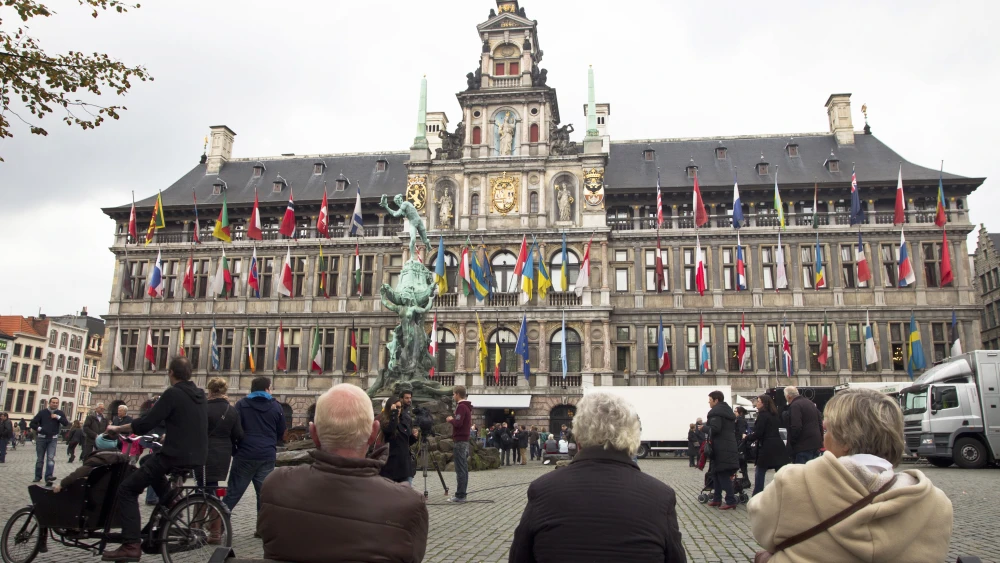
The city council of Antwerp, Belgium last week decided by a narrow majority not to remove Israel’s flag from its façade.
Twenty-seven members of the city council’s 55 seats voted in favor of keeping the flag in a vote held at the request for left-wing and far-left parties that wanted it removed. Another 24 voted in favor of removing it, and another four did not vote.
“Removing the Israeli flag from this city hall would by no means be a neutral gesture. It would be a political signal. And for many—including myself—it would mean [a signal] that Israel has no right to exist,” Michel Freilich, a member of the Antwerp City Council and a federal lawmaker of Belgium for the New Flemish Alliance of Prime Minister Bart De Wever, said in a speech ahead of the vote.
Antwerp Mayor Els van Doesburg, who represents the same party, has resisted pressure to have to flag removed, bringing the matter to a vote.
Antwerp displays all the flags of countries with accredited envoys or consulates in Belgium, Freilich told JNS. The PLO flag is not on display at city hall. In 2022, Antwerp removed the Russian flag from the façade to protest Russia’s invasion into Ukraine. Anti-Israel activists argued the same should be done with the Israeli flag, but the mayor has resisted this argument, noting that Belgium has downgraded its diplomatic relations with Russia.
In 2022, Belgium kicked out of its territory more than 20 Russian diplomats and applied sanctions a year later that it has not applied against Israel, resulting in a fundamentally different bilateral relationship than the one it has with Israel.
The New Flemish Alliance has 30 seats in Antwerp’s city council, where it formed a coalition with the left-wing Vooruit party, which pushed for removing Israel’s flag.
Israeli-Belgian ties have improved under De Wever, who replaced last year that of former prime minister Alexander de Croo. His government had relied on a coalition featuring the deeply anti-Israel Green Party and the Socialist Party. It was one of the most hostile to Jerusalem in the history of the two countries’ relationship.
However, tensions have burdened ties also under De Wever. His coalition partner, the center-left Les Engagés (“The Committed Ones”) party, has pushed an anti-Israel line under Foreign Minister Maxime Prévot, the party’s previous president. Prévot appeared to suggest Israel was involved in war crimes in Gaza and promoted Belgian recognition of Palestinian statehood, though the government stopped short of granting it.
Separately, Prévot accused the U.S. under President Donald Trump of breaching international law by striking Iran with Israel on Feb. 28.
A diplomatic row between Belgium, on one side, and Israel and the United States on the other erupted in May over the decision to indict three Jewish circumcisers, or mohels, for unlawfully conducting brit milah, the Jewish ritual circumcision of boys, typically performed on eight-day-old infants.
Bill White, the U.S. Ambassador in Brussels, wrote on X that month that, “Belgium will be thought of now as antisemitic by the world. Until this is resolved—there is no way around it,” he added.
Israeli Foreign Minister Gideon Sa’ar wrote that with the decision to prosecute the mohels, “Belgium joins a short and shameful list, together with Ireland, of countries that use criminal law to prosecute Jews for practicing Judaism. This is a scarlet letter on Belgian society.”
Prévot attempted to defend against the allegation by saying the prosecution was initiated by “Jewish [community] representatives,” but this claim was rebuffed by the community.
The complaint against the mohels was based on complaints lodged against them by Moshe Aryeh Friedman, an anti-Zionist activist who has lobbied authorities to limit several Jewish customs, including the one that enables Haredi schools to separate girls and boys at state-recognized Jewish schools. The mainstream Jewish community of Antwerp, which is largely Haredi, shuns Friedman.
“This is simply not true: This was not initiated by ‘the Jewish representatives themselves,’ but by someone who denies the Holocaust, was invited to a Holocaust denial conference by former Iranian president [Mahmoud] Ahmadinejad, and calls himself Jewish but is not supported by any Jew in the world,” the Jewish Information and Documentation Center (JID), a Belgian-Jewish advocacy group, said in response to Prévot. Friedman has said he had never denied the Holocaust.




