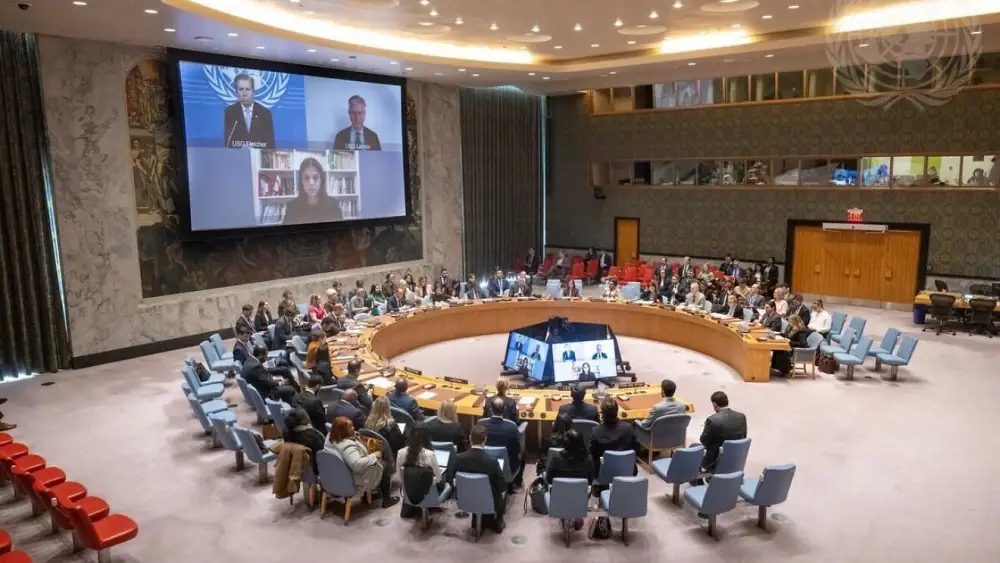
Israel rebuked Colombia sharply at the United Nations after Gustavo Petro, the latter’s president, who wrote “heil Hitler” on social media days prior, invoked Nazism repeatedly when talking about Israel and migration issues at a Security Council meeting and said that “we are going back to the era of the Nazis.”
Petro’s comments amount to “bizarre ideological rants” and a “dangerous distortion of Holocaust history” that “dishonors the victims of the Holocaust,” Danny Danon, Israeli ambassador to the global body, said on Wednesday.
The Colombian president, who is not favored to win a runoff election on June 21, reportedly declined a call from Danon, who sought an apology from Petro before the latter chaired the council session on the Middle East on Wednesday. Colombia serves as president of the Security Council this month.
The meeting centered on concerns of all-out war in the Middle East, and it came hours before U.S. President Donald Trump’s decision to launch additional strikes on Iran.
Jennifer Locetta, the U.S. alternative representative for special political affairs in the United Nations, told the council that the Middle East needs “real solutions and political capital, not recycled failed approaches.”
She blamed the Iranian regime for holding “the world’s economy hostage by unlawfully attempting to restrict freedom of navigation in the Strait of Hormuz” and for its patronage of terror proxies in Lebanon, Iraq and Yemen.
Locetta also accused Russia and China of covering for Tehran, in part by vetoing a draft Security Council resolution in April that would have authorized an international effort to secure vessels going through the strait.
“Dialogue without consequences failed to prevent destabilizing behavior,” she said.
Locetta noted a lack of enforcement behind the international diplomatic efforts.
Vassily Nebenzia, Russian ambassador to the global body, accused those outside the Middle East of trying to redraw the region’s political map.
The Security Council “should not attempt to impose a solution beneficial exclusively to one side or directed against any regional state,” the Russian envoy said.
Fu Cong, the Chinese envoy to the United Nations, said that the lack of a Palestinian state is “the greatest injustice in today’s world.”
Asim Iftikhar Ahmad, Pakistan’s ambassador to the United Nations, said that the regional situation, which his country has tried to calm in mediations, “is fragile and increasingly volatile,” and that “unresolved disputes have become protracted conflicts, and cycles of violence are becoming normalized.”
Ahmad pushed for a return to pre-war conditions in the Strait of Hormuz, which Iran closed and which Washington subsequently blockaded.