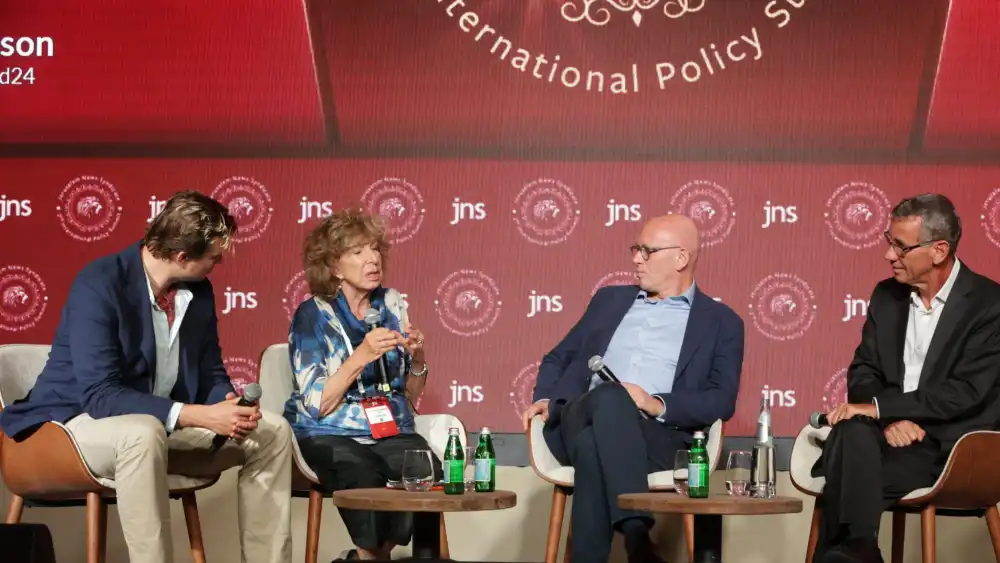
Cheers rang out at the Waldorf Astoria hotel in Jerusalem on Monday when Mark Regev, a former Israeli ambassador to the United Kingdom, mentioned the resignation announcement earlier that day of British Prime Minister Keir Starmer.
“As you hear from the audience, Keir Starmer was seen not as a friend of Israel,” Regev, a former spokesperson for Israeli Prime Minister Benjamin Netanyahu and a host of JNS’s Israel Undiplomatic Podcast, said at the second JNS International Policy Summit during a panel discussion about Israel-European relations.
But Starmer’s replacement, likely to be former Manchester mayor Andy Burnham, is unlikely to improve the strained ties between London and Jerusalem, panelist David Wolfson, the Conservative Party’s shadow attorney-general, told the audience.
“There is no prospect, I think, that Prime Minister Burnham ... will be any more pro-Israeli than Prime Minister Starmer,” said Wolfson. Starmer’s policies on Israel would likely “not only continue but intensify” under Burnham.
Starmer said he’d quit to clear the path to Labour’s leadership for the more popular Burnham amid social unrest over immigration and a recent Labour blowout in a regional election.
The prediction underlined a theme that reemerged in the panel discussion across countries: How Israel’s relationship with traditional allies in Europe is increasingly stained by dynamics that are rooted in profound demographic and ideological shifts, which therefore lie far beyond the policies of almost any single political player.
“My concern increasingly is that European countries are moving to a position where speaking up for Jews costs you votes,” said Wolfson, a member of the House of Lords, the upper house of the British parliament.
Starmer was accused by his critics of exacerbating the United Kingdom’s spiraling antisemitism crisis with unprecedented steps against Israel, including an arms ban, visa bans on government officials and recognition of Palestinian statehood in 2025 despite Israel’s protests that this would reward terrorism.
To Wolfson, the most immediate threat facing Jewish communities in Britain comes from an alliance between elements of the radical left and Islamist movements, though he added that antisemitism exists across the political spectrum. His comment touched on the effects of mass migration from the Middle East into Europe, which created a new and sizable electorate that is deeply hostile to Israel, and often to Jews.
In Italy, political realities have significantly strained bilateral ties with Israel even under Giorgia Meloni, a right-wing populist who many thought would defend the Jewish state and take ties with it to new heights, noted panelist Fiamma Nirenstein, a JNS senior contributing editor and former vice president of the Italian Parliament’s Foreign Affairs Committee.
A recent referendum in Italy, Nirenstein said, showed Meloni the limitations of her party’s mandate. This was a reference to a March vote on judicial reform, which was rejected in a major political setback of Meloni. “She realized she has to give something to the left, and what’s the easiest concession? The Middle East, and support of Israel,” said Nirenstein.
Earlier this month, Italian prosecutors joined French counterparts in launching a criminal investigation against Israeli National Security Minister Itamar Ben-Gvir for alleged torture and kidnapping of anti-Israel activists who were briefly detained while trying to reach Gaza on boats in defiance of Israel’s blockade of the area.
Nirenstein also pointed to hostility to U.S. President Donald Trump across Europe as a major political force shaping the continent’s leaders. “The new identity of Europe has been founded for many months on hostility to Trump,” and Meloni is responding to this sentiment, Nirenstein added. Trump “did not help matters” when he claimed, falsely, according to Nirenstein, that Meloni had “begged” him for a photo-op recently, she noted.
Meloni responded sharply to Trump’s claim over the weekend, posting on X to Trump: “Being your friend has certainly not helped it [Meloni’s popularity], nor does it depend on my relationship with you.” She added: “My popularity is none of your concern. I suggest you focus on yours.”
According to Nirenstein, European leaders increasingly define themselves in opposition to Trump, making it more difficult for politicians such as Meloni to maintain close alignment with both Washington and Jerusalem.
Zeljka Cvijanovic, the Serb member of the three-person presidency of Bosnia and Herzegovina, spoke at the summit ahead of the panel, expressing support for Israel.
“No people will survive if they must ask their enemies for permission to exist,” said Cvijanovic, explaining the support of Republika Srpska—the Serb-majority entity that comprises almost half of Bosnia and Herzegovina’s territory—for Israel’s security policies following the Oct. 7, 2023, attack. “Israel has demonstrated something remarkable—that a nation can remain democratic, innovative, prosperous and free even while confronting constant security threats,” said Cvijanovic.
Stefan Tompson, the founder of the Visegrad24 news site, a conservative medium with a European focus and a model that Tompson calls open-source journalism, said that Eastern and Central Europe were seeing a replication of anti-Israel attitudes popularized in Western Europe through the political alliances of radical Islam and the far-left.
“We’re seeing that strain of third-world politics in countries that haven’t yet been infected by mass migration, but which have a tendency of copying and emulating everything that is ‘better and shinier’ in the West. We’re seeing that pattern to a certain extent in Central and Eastern Europe,” said Tompson, a Polish South African who was born in London and educated in French schools.
Visegrad is a reference to the regional cooperation alliance between the Czech Republic, Hungary, Poland and Slovakia. Tompson’s website often contrasts the quality of living in those countries, which have relatively few Muslim and African immigrants, with dysfunctions in Western European countries with millions of immigrants from the Middle East and Africa.
Tompson encouraged the panel’s audience to take stock of Israel’s friends in Europe despite the prominence of its opponents. “I do think that there are many causes for hope and I think that much of the European populist right is learning from Israel and from Israel’s withstanding against the Islamist threat,” he said.
Israel’s government recently lifted its boycott on several right-wing parties in Europe, including the National Rally in France.
“There are many friends on the European populist right for the people of Israel,” said Tompson, noting Geert Wilders and his Party for Freedom in the Netherlands, the Vox party in Spain and the Sweden Democrats. “These are all people who are friends of Israel, who are inspired by Israel and Israel’s stories of resilience,” he added.