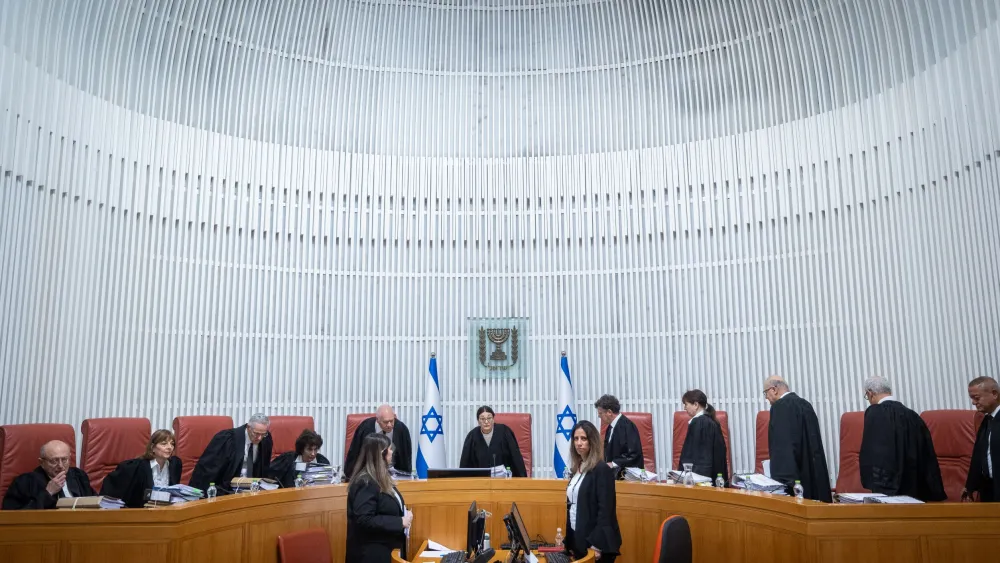

According to the University of Haifa’s annual index for public sector performance, the public’s level of trust in the Israeli judicial system is at the lowest level since the index was first published in 2001. — i24News, Nov. 6, 2018.
After a decade in which left-wing voters expressed 44% confidence in the judiciary, their confidence has eroded since 2017 to 25% in 2020. — Haaretz, June 4, 2020.
Israel is now engulfed in a tumultuous public dispute between advocates of sorely needed reform of the country’s legal system and their increasingly strident opponents.
Waxing ever more vehement and venomous, these opponents are engaged in a desperate last-ditch effort to preserve the remaining vestiges of their waning political power. They seek to freeze the current reality, which allows them—despite their minuscule and diminishing electoral support—to control much of the national decision-making process in Israel.
A litany of travesties
The arrogance and blatant double standards of the legal establishment in general and the judiciary in particular, together with an increasing number of verdicts that fly in the face of common sense, have led to a steep and ongoing erosion in public confidence in the impartiality of the courts—including the Supreme Court itself.
Indeed, the catalog of mystifying decisions is as long as it is disconcerting. The following is a far from exhaustive list:
- The trampling of the right of the opponents of the 2005 Gaza disengagement to protest.
- The disregard of the fact that the investigation against Prime Minister Benjamin Netanyahu was launched in flagrant disregard of explicit legal requirements—not to mention a litany of brazenly improper police and prosecution measures during the investigation itself.
- The discriminatory prohibitions on demonstrations during the COVID-19 pandemic, which prevented ultra-Orthodox gatherings while permitting anti-Netanyahu protests.
- The repeated overturning of government decisions aimed at stemming the flood of illegal infiltration by African migrants and its detrimental effects on the lives and livelihoods of less affluent neighborhoods in south Tel Aviv and elsewhere.
“Blaming everyone but itself…”
The well-known social activist and left-leaning law professor Yuval Elbashan warned as recently as last December, “Confidence in Israel’s justice system, once so high, has slumped, and the time has come for the system to stop blaming everyone but itself.”
Over a decade earlier, in a book entitled Towards Juristocracy published in 2004 by Harvard University Press, Professor of Political Science and Law at the University of Toronto Ran Hirschl cautioned, “In Israel, the negative impact of the judicialization of politics on the Supreme Court’s legitimacy is already beginning to show its mark. Over the past decade, the public image of the Supreme Court as an autonomous and impartial arbiter has been increasingly eroded.”
He added that “as political arrangements and public policies agreed upon in majoritarian decision-making arenas are likely to be reviewed by an often-hostile Supreme Court … the court and its judges are increasingly viewed by a considerable portion of the Israeli public as pushing forward their own political agenda.”
The current government’s proposed judicial reforms are thus an inevitable result of the ongoing erosion of public trust in the judiciary.
Victims of judicial intervention in policy
The harm that the current system inflicts on Israeli society can take very tangible and tragic forms. Perhaps the most horrific—and I use the term with careful deliberation—example came on May 2, 2004, when a young social worker, Tali Hatuel, who was eight months pregnant with her fifth child, was driving home with her four children aged two to 11 years old.
On the way, they were ambushed by two Palestinian terrorists who were lying in wait in a roadside building. From their hiding place, the terrorists opened fire, forcing Hatuel off the road. The terrorists then approached the vehicle and slaughtered all its occupants at point-blank range.
What is both staggering and infuriating about this tragedy is that the IDF had intended to demolish the building that gave cover to the murderers, because the building had been previously used by terrorists to kill Israeli civilians and soldiers.
The demolition, however, was prevented by order of the Supreme Court, which, under today’s system, is the ultimate arbiter of what is “reasonable” and “proportionate,” even in areas where its justices have no professional expertise.
The perils of unbridled authority with no responsibility
Sadly, Tali Hatuel and her four daughters paid with their lives for this absurd judicial intervention in Israel’s security policy. The justices who made the decision, of course, suffered no repercussions.
That is how things are when the judiciary has overriding authority but zero responsibility.
Clearly, a stop must be put to this travesty.
Dr. Martin Sherman spent seven years in operational capacities in the Israeli defense establishment. He is the founder of the Israel Institute for Strategic Studies (IISS), a member of the Habithonistim-Israel Defense & Security Forum (IDSF) research team and a participant in the Israel Victory Project.