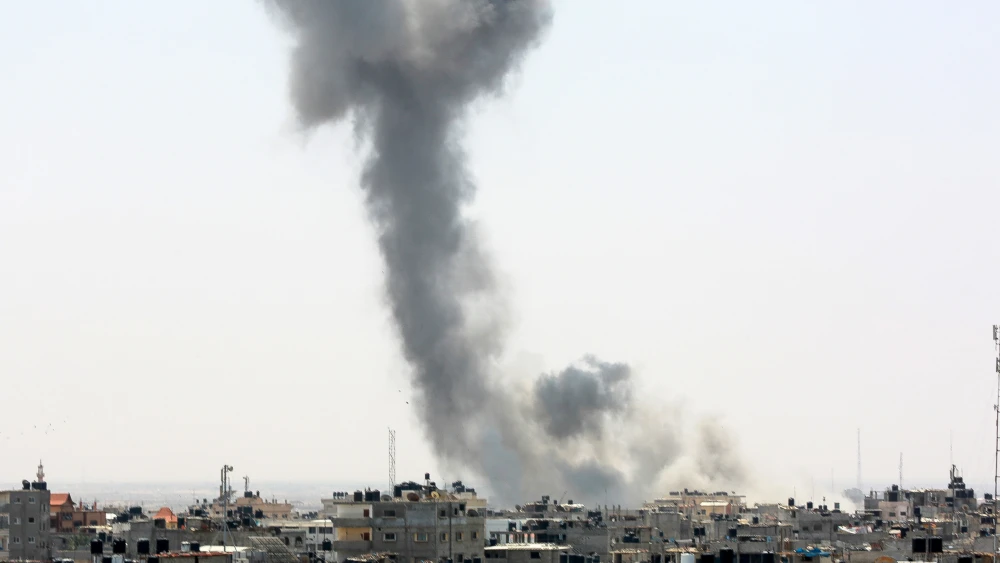

It did not take long for Hamas and Islamic Jihad to deny any involvement in Wednesday’s rocket fire on Israel, and the two Gaza Strip-based groups rushed to express their commitment to Egypt’s efforts to broker a ceasefire between Israel and Gaza.
Hamas could be lying—it wouldn’t be the first time—and its operatives may have been the one to fire two Grad rockets at Beersheva and central Israel. At the very least, Hamas probably encourage the rogue groups in Gaza to fire on Israel.
One must remember that while Hamas has no real interest in provoking a full-fledged war with Israel, it has every interest in improving its position in the Egyptian-led mediation and maybe even forcing Israel to accept a reality in which sporadic rocket fire is a part of any future deal in Gaza.
What is particularly troubling, however, is the possibility that Hamas had nothing to do with Wednesday’s rocket fire, and that the attack was mounted contrary to its direct orders.
This would mean that Hamas has lost its notorious iron grip on the situation on the ground in Gaza. Moreover, it would mean that any deal Israel signs with it may not be worth the paper it is written on, as it will not guarantee any calm on the border.
Achieving some form of quiet on the border is a prominent Israeli interest, as it wants to focus its attention on the northern sector, where efforts to curtail Iran’s attempts to cement its presence in Syria and curb Hezbollah are paramount.
Iran, we must remember, is the only one that stands to gain from a conflagration in Gaza, as it would divert everyone’s attention from what it is doing in Syria and what it is trying to do in the region.
Reaching a ceasefire is also in Hamas’s interest, as it would grant it legitimization and all but guarantee that it will rule Gaza for many years to come. This is why Israel must ensure that in return to any concessions offered Hamas, it would be guaranteed absolute calm on the border.
Israel will most likely choose to contain Wednesday’s incident both because it did not result in fatalities and over Hamas’s denouncing it. But this does not bode well for the efforts to achieve a ceasefire, as one cannot survive if one of the parties involved has no intention of meeting it. It is important that Israel not lose sight of this when it comes to the Gaza Strip, but also when it comes to Judea and Samaria.
The Trump administration is gearing up to present the “deal of the century” for the Israeli-Palestinian conflict, which would undoubtedly require not only Israeli concessions, but also a demand to contain and tolerate the Palestinian Authority’s incompetent counter-terrorism efforts.
Experience, however, has taught us that any deal that does not guarantee security will not last.
Eyal Zisser is a lecturer in the Middle East History Department at Tel Aviv University.