



It is “getting to be decision time” on Iran, U.S. President Donald Trump declared on Oct. 25. “Do I finish it off … or do I make a deal?” So, he has put a clock on it.
American and Israeli planners have reportedly mapped out a short, days-long campaign against Iran’s nuclear, missile and energy sites.
After January’s million-strong domestic uprising that shocked the Iranian regime to its core and the massacre that quelled it, as well as the killing of Supreme Leader Ali Khamenei on Feb. 28 and the start of the U.S.-Israel joint war, many expected the regime to collapse.
Yet Tehran did not fall, and Trump’s “finish it off or make a deal” framing repeats the original error of assuming the regime is one short campaign away from falling or morphing into a norm-abiding actor.
Whether the regime can fall or only be tamed is the wrong question. Every dictator eventually falls, and this particular dictatorship’s fall is an existential imperative for Western democracies and their regional allies. The right question is how to pursue that goal realistically.
The expectation of a quick collapse rested on a misreading of the adversary. Too many underestimated the Islamic Republic’s unconventional warfare abroad and its willingness to go as far as it takes in domestic suppression. Add in Tehran’s sophisticated information war and Trump’s failure to explain the conflict to the American public, and the result is today’s stalemate.
None of this changes what the regime is. The Islamic Republic is a sophisticated death cult hell-bent on exporting its destructive ideology, and the war it launched against the world in 1979 will not end as long as it stands. However, the mistakes of the past year can and should be fixed.
Fixing them starts with setting the record straight about the regime’s Islamic Revolutionary Guard Corps. The war did not concentrate power in the IRGC’s hands. That was Khamenei’s decades-long project and is only now openly visible.
Since becoming Supreme Leader in 1989, Khamenei—who has since been succeeded by his son, Mojtaba Khamenei—entrenched the IRGC in every aspect of Iranian life, from domestic security to the economy and media to espionage and terror abroad.
Blaming the war for the Islamic Republic’s evolution from turbans to boots is, as we say in Persian, like blowing the horn from the wrong end.
The Islamic Republic has sat on its bayonet for 47 years. It cannot sit there forever.
World leaders also need to realize that the regime is not only designed to absorb tension: It feeds on conflict. That has made the U.S.-Israel military campaign cut both ways. It has eliminated key players and installations, curbing the regime’s brain and muscle, while the naval blockade and sanctions drain Tehran’s coffers.
But in today’s anti-Western and anti-Israel climate, the regime’s survival has been a recruitment boon beyond its borders, while sowing despair among Iranians who were told regime change would be a walk in the park.
That is why a post-midterm campaign would work only as part of a wider strategy to dismantle the Islamic Republic. A few days of strikes would inflict damage the regime is built to absorb. The more consequential goal should be to disrupt Tehran’s ability to govern and project power.
That requires a multi-pronged approach: maintain the blockade and tighten sanctions; launch a program of targeted killings of Islamic Republic officials to disrupt its decision-making capabilities; conduct low-signature operations inside Iran to ground its nuclear, missile and drone programs; decimate Tehran’s proxies in the Middle East and crush its bid for a foothold in Africa; dismantle its influence network in the West; and counter its information war inside and outside Iran.
However, no strategy can succeed without the Iranian people.
The massacre of tens of thousands in January settled the question of whether intervention is necessary: A regime that kills unarmed protesters at that scale will not be removed by its people alone.
But Iranians are the ones who will usher in a new age, and they must be convinced that their hopes and the strategic goals of the world’s democracies point in the same direction. That means going beyond lip service with measures like technical support to breach the regime’s digital iron curtain, training and sustained armed drone cover for protesters in the streets.
The Iranian diaspora has its own work to do.
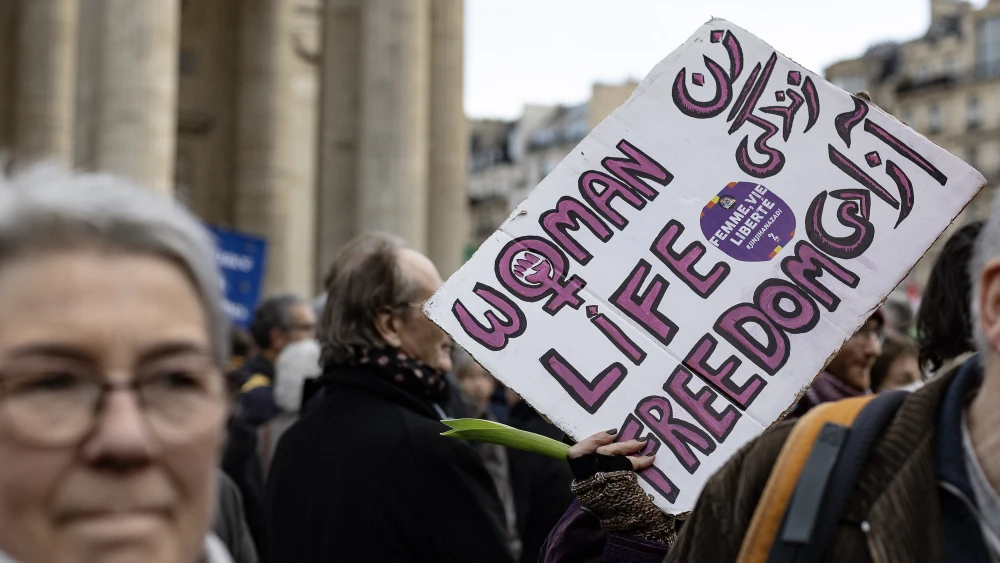
During the 2022 “Woman, Life, Freedom” movement, I interviewed many protesters in Iran. The theme that kept coming up unprompted was unity on the ground. One protester told me that when you are looking death in the eye with a gun pointed at your chest, you don’t ask the person you’ve linked arms with what model of democracy they prefer. You protect them with your life.
The diaspora needs to match that urgency. Repeated coalition efforts have foundered on bad blood, shortsightedness and regime infiltration. It is high time for the diaspora to move past petty grievances.
There is a poem from the era of Iran’s early-twentieth-century Constitutional Revolution that states you can capture a land with a bayonet, but you cannot sit on a bayonet forever.
The Islamic Republic has sat on its bayonet for 47 years; it cannot sit there forever. Whether it falls in a way that serves Iranians and the democracies they want to join depends not on when the next campaign begins, but on whether it is fought with a clearer view of the adversary than the last.


