
Winds of change are finally beginning to blow across Europe.
With them, they carry potential implications not only for the European continent itself but for Israel and the wider Middle East, as well as for relations with Washington, particularly with the current administration of U.S. President Donald Trump.
A clear indication of the stiffening of political will was reflected in a recent conference held in Vienna.
Under the auspices of former Austrian Vice Chancellor Heinz-Christian Strache and with the participation of members of the European Parliament from Germany, the Netherlands and Belgium, in addition to prominent guests of honor from across the continent, including France, Hungary and the United Kingdom, the conference focused on “Peace, Freedom and Security.”
Billed as “The Vienna Conference of European Patriots,” it evinced the ominous banner, “Europe on the Brink—Between Self-Denial, Islamism and Geopolitical Irrelevance,” reflecting the sense of concern that prevailed at the event. Speakers warned that what once was celebrated as “multicultural open-mindedness” is increasingly proving to be myopic political naivety.
Several speakers expressed alarm at what they perceived as an “urgent threat”—i.e., the looming specter of a steadily creeping transformation of European social order into “Islamist authoritarianism.” The overall sentiment was that the real threat menacing Europe today is not an external one, but more an internal one—eroding the very core of European society.
This perception dovetails well with the perturbing findings of a government-commissioned probe into the activities of the Muslim Brotherhood in France. The report warns that “The Muslim Brotherhood movement is a threat to national cohesion” in France and that action must be taken to stop the spread of “political Islamism.”
Indeed, there was particular disapproval of France, which, it will be recalled, granted the Ayatollah Khomeini political asylum. It was here that he spent his last months in exile under the benign neglect of the French authorities, before returning triumphantly to Iran, where hordes of his devotees, inflamed by his corrosive credo, swept the radical Islamists to power, later to be “exported” globally.
Moreover, along with a considerable body of expert opinion, blame was also attributed, in large measure, to France for the turmoil in Libya and the overthrow of a then-much chastened Muammar Gaddafi. Paris’s rash haste in siding with the rebels precipitated the current chaos and subsequent flow of migrants into the European Union.
According to one 2020 study of events in Libya, “Paris soon became the most intransigent power in international efforts to foster negotiations between the Gaddafi regime and the leadership of the revolutionaries. The result of this policy is clearly visible: What has ensued is almost 10 years of conflict and social distress.
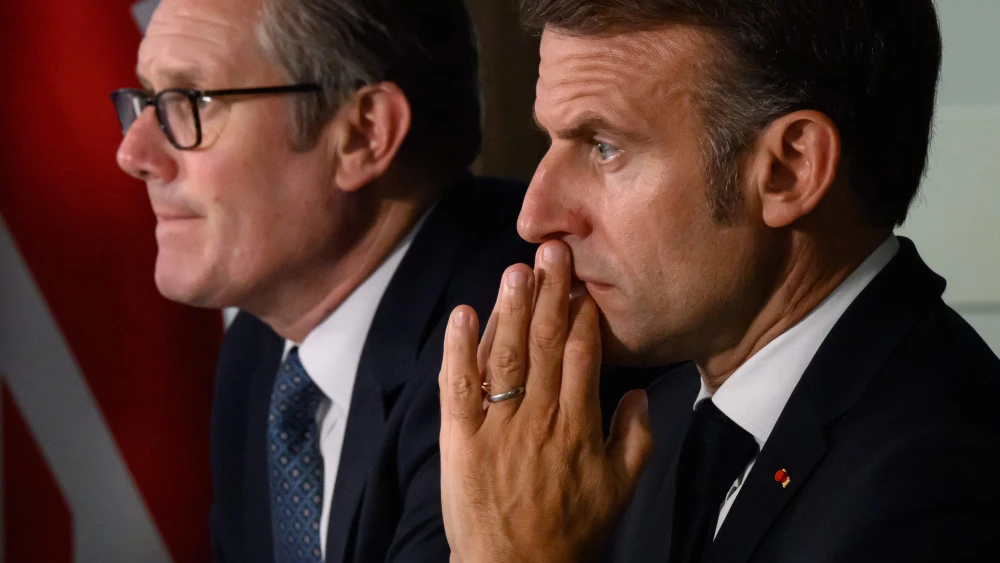
Significantly, the failure of the current French administration, under Emmanuel Macron, to control the still ongoing tide of Muslim migrants and their overflow across the English Channel into the United Kingdom has earned the ire of his British neighbors, even eliciting calls for his recent—and unduly ostentatious—state visit to be canceled.
Indeed, at the Vienna conference, Macron was taken severely to task for blunders at home and abroad.
Indeed, the French daily Le Monde recently outlined the pervasive domestic strife afflicting the country: “There is a rise in bankruptcies and restructuring plans, alongside calls for strikes at Air France, the national rail company … and within the civil service. Additionally, a new wave of unrest is spreading among farmers, stemming from economic difficulties and budgetary austerity measures.”
Yet with the home front in turmoil, Macron chose to commit his foreign policy to what is increasingly becoming a forlorn anachronism—a Palestinian state—and one likely to place him in direct confrontation with an increasingly assertive and proactive Trump administration.
Moreover, given the appalling atrocities of Oct. 7, 2023, together with the overwhelming support they received from the Palestinian public, both in Gaza and the West Bank, this policy would be an unconscionable reward for blood-curdling terror. As such, it is not only practically unfeasible but morally bankrupt as well.
In contrast to the censure of the flaccid E.U. policy, there was praise for Israel and the Trump administration. Israel was lauded for conveying a clear message with its resolute military action and pinpoint intelligence that left the Iranian nuclear program largely in ruins.
Likewise, Trump was commended for launching his B-2 bunker-busting bombs and Tomahawk missile airstrikes on the Fordow, Natanz and Isfahan facilities in support of Israel’s action, and for laying the foundation for a restructured Middle East via the Abraham Accords.
There are accumulating signs of a new political assertiveness and a growing appreciation of Israeli resolve to resist and stare down what, until recently, seemed to be intimidating radical Islamist threats.
With it, a grudging appreciation of Donald Trump may also be emerging, together with a budding acknowledgement of the efficacy of his tough stance on issues his predecessors eschewed. Hopefully, the recent Vienna conference is a sign that the edifice of Europe’s socio-cultural heritage can still be salvaged.