
Last Tuesday, Israel’s interim government agreed to a deal with the government of Lebanon involving the offshore Karish gas field. Lebanon claimed that part of Karish was in its territorial waters and staked out a maximalist position on its right to the proceeds from exploiting the field. In the talks leading up to the agreement, the Lebanese government—controlled by the Iran-backed terrorist group Hezbollah—used a complex strategy that combined Hezbollah threats with diplomatic obstinacy.
Israel has now conceded to the Lebanese demands. It is impossible not to conclude that the threats from Hezbollah, which has 150,000 missiles aimed at Israel, did not factor into this equation.
Hezbollah threatened to attack a ship and oil rig operated by French company Energean if the company began extracting gas from the Karish field before Lebanon’s maximalist demands were met. The Biden administration, whose record has been littered with abject failures since its feckless withdrawal from Afghanistan, seized upon the negotiations in hopes of a much-needed foreign policy success.
President Joe Biden called the Israel-Lebanon agreement “a historic breakthrough” that “will provide for the development of energy fields for the benefit of both countries, setting the stage for a more stable and prosperous region, and harnessing vital new energy resources for the world. It is now critical that all parties uphold their commitments and work towards implementation.”
A White House spokesperson added, “This agreement is not a win-lose agreement. The parties are not getting more than the other, because they get different things. The win for Israel is around security, stability and economic gain. The win for Lebanon is economic prosperity, economic development, foreign direct investment and hope for an economic recovery.”
Of course, one must empathize with the immensity of Lebanon’s current economic crisis. The Lebanese pound has lost 95% of its value and, according to the United Nations, 80% of the population is living below the poverty line. The World Bank has stated that “because of a combination of corruption, poor economic policies and unsustainable financial policies [the Lebanese economic crisis] is one of the worst globally since the mid-19th century.”
Yet one has to wonder how much of the profits from the agreement will end up in the hands of the impoverished Lebanese people, and how much will go to lining the pockets of Hezbollah.
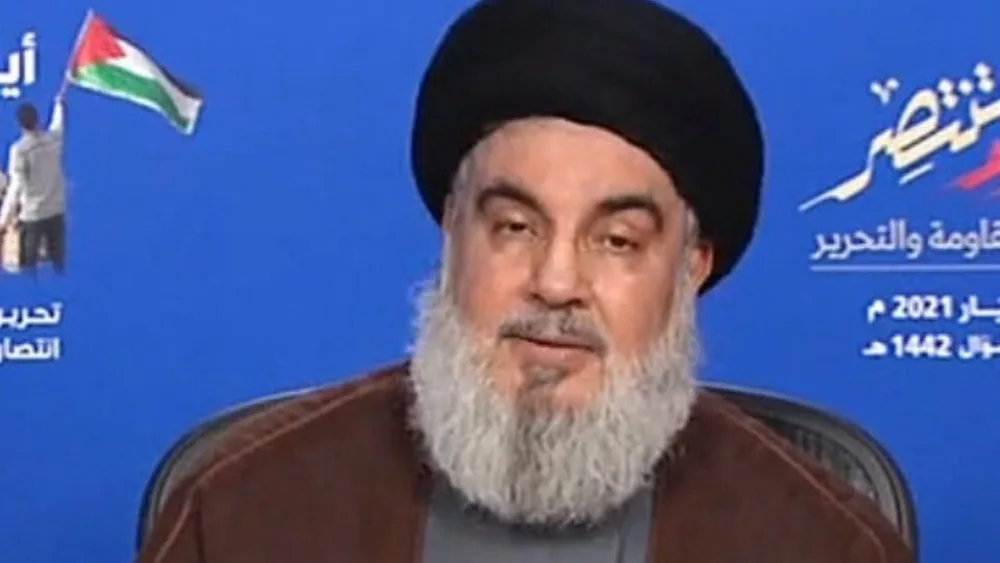
In terms of Israel’s “security, stability and economic gain,” it is an open question how long Israel’s security and stability will remain. With Israeli elections coming in a few short weeks, the current caretaker government needed a foreign policy “win” as much as the Biden administration. No doubt, then, the agreement will be popular among members of the government and their parties. But to find ominous signs of what the repercussions of the agreement may be, one need look no further than Hezbollah leader Hassan Nasrallah’s boast, “Now is not the time for threats. Now is the time for celebration and applause.”
I hope and pray that I am wrong, but based on Nasrallah’s jubilant statement, this deal seems to be yet another example of the triumph of short-term wishful thinking over long-term, realistic strategy.
Sarah N. Stern is founder and president of EMET, a think tank and policy institute in Washington, D.C.