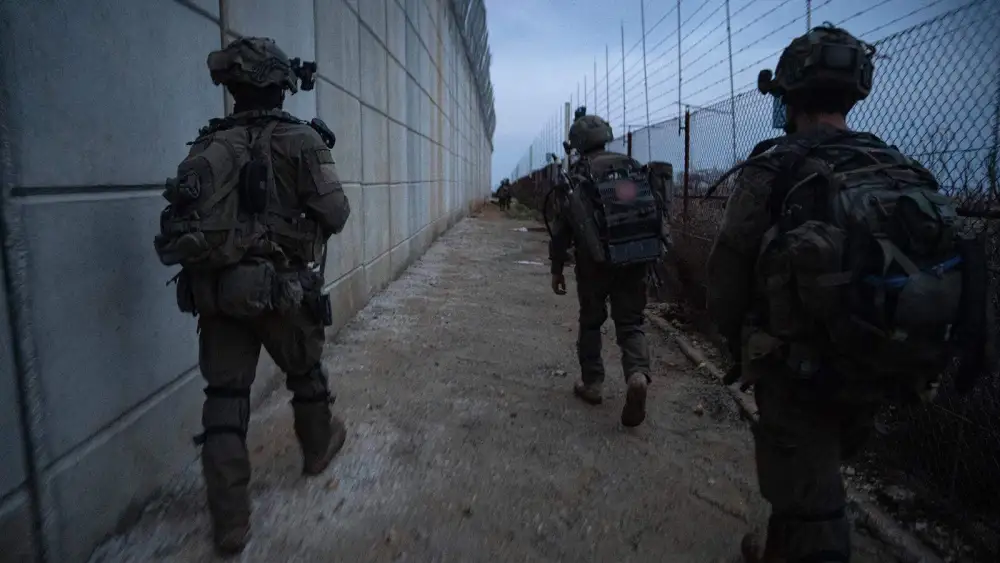

Lt. Gen. Eyal Zamir, chief of staff of the Israel Defense Forces, was recently quoted warning that without a major increase in combat soldiers, the Israel Defense Forces may struggle to meet its operational demands. It’s a serious statement, and it should be taken seriously, but not uncritically. Because beneath it lies a dangerous framing of both how wars are won and what leadership is meant to do in a moment like this.
Of course, numbers matter. The IDF does need sufficient manpower to sustain operations, hold territory, rotate forces and manage the demands of a prolonged conflict. Expanding the pool of those who serve is a real and necessary national challenge that must be addressed seriously. No responsible discussion of military readiness can ignore that.
But acknowledging the importance of manpower is not the same as mistaking it for the decisive factor. The argument here is not that numbers do not matter; it is that they are not what ultimately determine victory. It’s not a choice between manpower or effectiveness. It is recognition that effectiveness is what gives manpower its value. No matter how much you increase the numbers, the only way to achieve victory is through lethality.
What has consistently given Israel the edge is not how many soldiers it fields but how effectively those soldiers operate. Precision intelligence, technological superiority, air dominance and highly trained ground forces have allowed the IDF to impose disproportionate costs on enemies far larger in size. A smaller force that can strike harder, faster and smarter will outperform a larger but less capable one. Lethality compensates for limited manpower because when force is applied correctly and strategically, it can win wars more decisively than a much larger force weighed down by hesitation ever could. That has always been Israel’s model, and it remains the only viable one.
The real question is not only how many soldiers Israel has, but how to make them more lethal. That begins with clarity of purpose. Soldiers educated in the justice of their mission, in the moral framework of Jewish warfare, and in the historical and biblical connection to the land fight with greater confidence and resolve.
It also requires operational freedom. Commanders must be empowered to act decisively and with overwhelming force without being constrained by unrealistic standards that create hesitation in the field. And it demands smarter allocation of manpower, ensuring that highly trained combat soldiers are used where they are most needed, rather than being stretched thin across tasks that could be easily filled by other, less trained and effective troops.
This is where the conversation around Haredi service needs to be addressed honestly. This is not an argument against Haredim joining the army. On the contrary, expanding participation is important. But treating recruitment as the primary or decisive solution misses the point.
The issue is not simply how many people are drafted, but how effectively the system uses those it has. Not everyone needs to be a frontline combat soldier to contribute meaningfully to victory. Broader frameworks of national service, including roles that support logistics, infrastructure and the home front, can free up trained fighters to focus on front-line combat. The goal is not to turn those who are unprepared into warriors overnight but to ensure that everyone is carrying their share of the national responsibility in a way that strengthens the overall war effort.
Shifting the public conversation toward a narrative of insufficiency risks undermining the model that has brought Israel success. It suggests that victory is out of reach without expansion, rather than reinforcing the truth that victory comes from maximizing the effectiveness of what the Jewish state has. Worse still, when the conversation moves toward imposing ever more restrictive and often unrealistic rules of engagement that blunt the IDF’s ability to strike the enemy decisively, it does not just limit tactics but erodes lethality. And when lethality is reduced, the cost is paid in longer wars, greater strain on manpower, and ultimately, a weaker fighting force.
But this is not just about military doctrine. It is about leadership.
A chief of staff is not only responsible for building the army; he is responsible for strengthening the nation. Words matter, especially in wartime. When the most senior military figure signals limitation or shortfall, it does not stay contained within professional circles. It reverberates outward into the hearts of the public, into the soldiers and into the ears of Israel’s enemies.
The Torah addresses this directly—not as abstract philosophy but as concrete military policy. In Sefer Devarim, as Bnei Yisrael prepare to form their first national army before entering the Land of Israel, the Torah lays out the rules of engagement and the composition of the fighting force. Among them is a striking command:
“מִי הָאִישׁ הַיָּרֵא וְרַךְ הַלֵּבָב? יֵלֵךְ וְיָשֹׁב לְבֵיתוֹ, וְלֹא יִמַּס אֶת לְבַב אֶחָיו כִּלְבָבוֹ.” (דברים כ׳:ח׳)
“Who is the man who is fearful and fainthearted? Let him go and return to his house, so that he does not melt the heart of his brothers like his own.”
This is not a side note; it is a foundational principle in how the Jewish army is built. Before a battle even begins, the Torah is concerned not only with weapons or numbers, but with the psychological and spiritual integrity of the force.
The reasoning is clear and deeply strategic. Fear is not contained within the individual. It spreads. One hesitant soldier becomes two, two become 10, and before long, the cohesion of the unit begins to erode. The Torah recognizes the reality of what we would today call a chain reaction of a collapse of morale. Weakness, when voiced or displayed, can ripple outward, undermining confidence, degrading performance and costing lives.
That is why the Torah does something counterintuitive. It willingly reduces numbers in order to preserve strength. A smaller force with clarity, confidence and resolve is far more dangerous and far more capable than a larger force compromised by doubt.
This principle extends beyond the battlefield. The army is a reflection of the nation, and the nation draws strength from the army. When the fighting spirit weakens at the front, it inevitably weakens at home. And when national resolve begins to crack, the consequences are not just tactical but existential.
Rav Eliav Turgeman embodies this idea in a very real way. He is not only a rabbi, but a warrior of the nation—someone who has taken up the responsibility of leadership on the battlefield itself, now serving as a commander in the newly formed Hashmonaim Brigade. He speaks from direct experience on the battlefield, not from theory.
In a recent Facebook post, he reminds us that we have no privilege for weakness: “אין לנו פריוולגיה לחולשה… במיוחד כאשר אנחנו מכים באויב מכה ניצחת.” At a time when Israel is actively striking its enemies and demonstrating operational strength, the role of leadership is to reinforce that momentum, not cast doubt over it.
None of this is to ignore real challenges. The IDF, like any military, must constantly assess its needs, adapt its force structure and ensure it has the resources required to succeed. That includes manpower. But those conversations must be conducted in a way that builds strength rather than projects fragility.
Because in the end, wars are not won by the side with the most soldiers. They are won by the side with the greatest clarity of purpose, the strongest spirit and the highest level of effectiveness on the battlefield.
Israel has never been the largest force in the region. But it has always been the most determined—and the most lethal.
עד הנצחון.
“Until victory.”