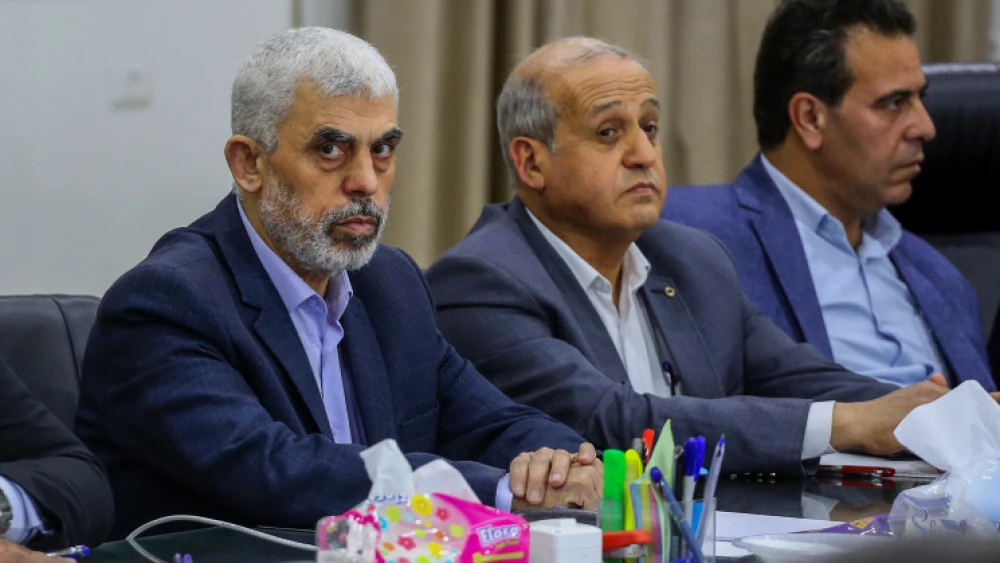
Hamas terror chief Yahya Sinwar, who was killed last week by IDF forces, rejected an offer by Arab negotiators early in the war to flee Gaza in exchange for allowing Egypt to negotiate a hostage deal with Israel on Hamas’s behalf, according to The Wall Street Journal.
“Sinwar clung to the hope that the conflict he ignited might draw in Iran and its proxy in Lebanon, Hezbollah, setting off a regional war against Israel,” the Journal reported on Saturday.
Sinwar survived in Gaza for more than a year until he was eliminated by Israeli forces last Wednesday. He was able to evade Israel’s military thanks to an elaborate tunnel system Hamas constructed under the Gaza Strip that extended between 350 to 450 miles, remarkable given that the entire Strip has an area of only 141 square miles.
After Saleh Arouri, deputy head of Hamas’s political bureau, was killed on Jan. 2 in an Israeli strike in Beirut, Sinwar also dumbed down his communications system to make it more difficult for Israeli forces to track him.
But moving its forces in tandem below ground and above ground, an operational maneuver never before tried in military history, according to IDF Brig. Gen. Dan Goldfus, Israel began to squeeze Sinwar, eventually driving him from his underground lair.
When in early September Israeli soldiers found six dead hostages in a tunnel in the Tel al-Sultan neighborhood of Rafah in southern Gaza, they also found traces of Sinwar’s DNA.
Sinwar apparently realized that the noose was tightening.
After Israel killed Hezbollah leader Hassan Nasrallah in late September, Sinwar sent a message to Hamas leaders outside Gaza, telling them the group would now be under greater pressure to compromise and instructing them to resist, according to Arab mediators.
He also told Hamas members that Israel would offer concessions after he was gone, and that the terrorist group would be in a stronger negotiating position.
He also recommended that Hamas appoint a council of leaders to govern and manage the transition after his death, the mediators said.
The IDF killed Sinwar in a firefight in the southern Gaza city of Rafah on Wednesday. The military announced the positive identification of his remains on Thursday night.