


The U.S. State Department has amended its website after a critical omission on its page defining anti-Semitism.
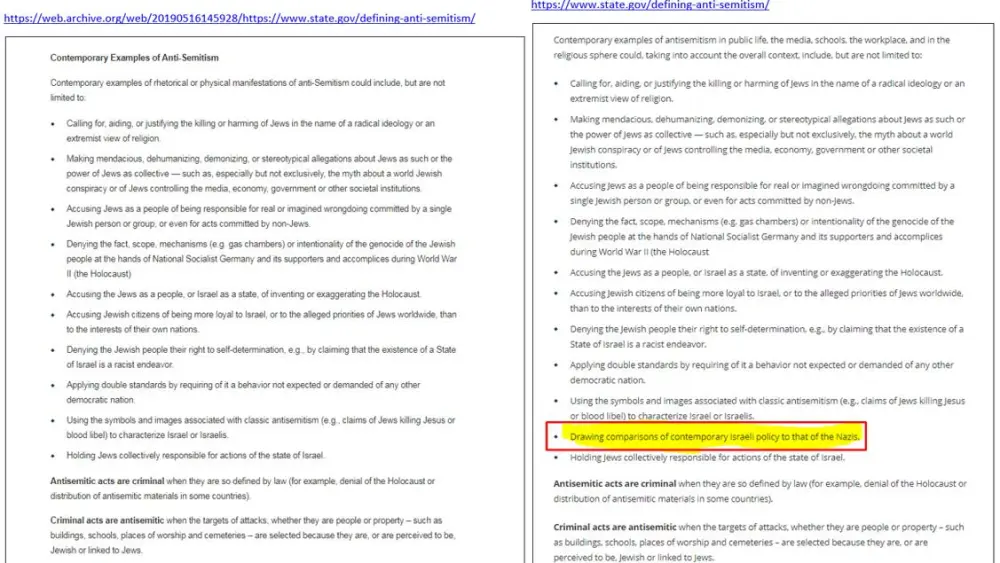
The State Department’s website “Defining Anti-Semitism,” which is based on the International Holocaust Remembrance Alliance’s (IHRA) definition of anti-Semitism that was adopted in 2016, originally omitted the line, “Drawing comparisons of contemporary Israeli policy to that of the Nazis.”
While an earlier version of the State Department’s website, in use until 2017, did include the line, it appears that at some point the critical wording was omitted.
However, after some pro-Israel activists noticed the omission, it appears that the State Department has updated the site to include it.
Comparing Israel’s policies to that of Nazis is a familiar anti-Israel trope often used by BDS supporters and other critics of Israel.
“This can be an important tool against those who make a cynical and horrific use of the Jewish holocaust for the purpose of delegitimizing the Jewish state and promote anti-Semitic sentiments in the general public,” Yifa Segal, director of the International Legal Fund, said in a statement. “Unfortunately, many studies show that this rhetoric is widely used in the U.S. today, and including this legal definition will make clear that this type of comparison originates in anti-Semitism and is not a legitimate discourse.”
Anti-Israel politicians, not only in the United States but elsewhere, have been using this comparison quite regularly.
In July, Rep. Ilhan Omar (D-Minn.) drew criticism for comparing the anti-Israel BDS movement to previous boycotts of Nazi Germany and the Soviet Union. In Canada, a political candidate from the New Democratic Party in Nova Scotia was also recently ousted for this comparison, and British Labour Party leader Jeremy Corbyn was criticized for speaking at a 2009 protest likening Israel to Nazi Germany.


