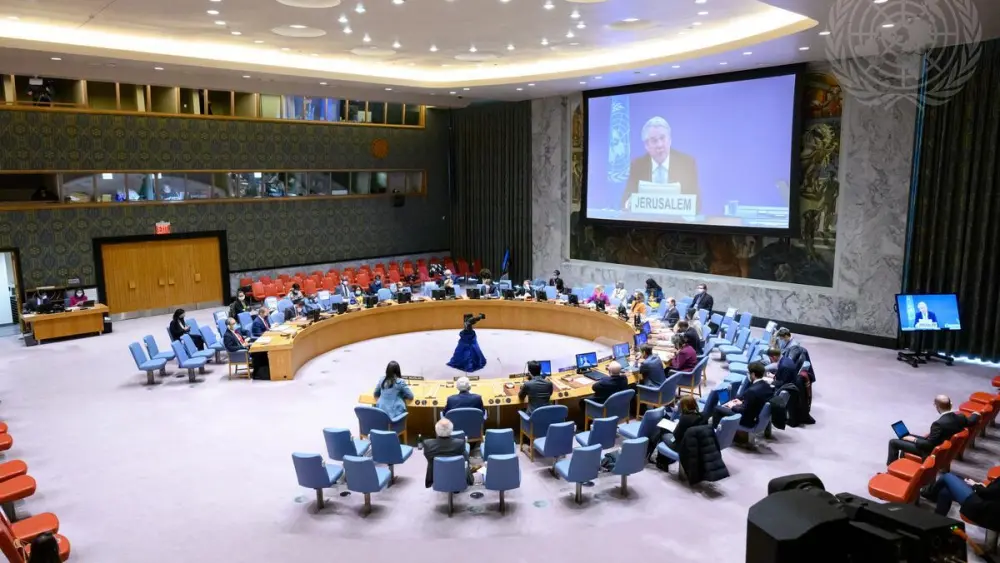
The United Nations Security Council held an emergency meeting on Monday to discuss the security situation in the Middle East.
Called at the behest of Russia, which blasted U.S.-led strikes against Iranian-backed targets in Iraq, Syria and Yemen, the council discussed the consequences for the region, and who is to blame.
Robert Wood, deputy U.S. ambassador to the United Nations, told the council that the deaths of three servicemembers and injury of 40 others in a Jan. 28 attack on an American base in Jordan had been “devastating.”
“This is unacceptable, and attacks like it cannot continue,” he said. “We also repeatedly stated in previous letters to this council that the U.S. would take further action to respond to future attacks or threats of attacks against U.S. nationals or U.S. personnel and facilities,” he added.
The drone attack by Iran-backed militants led to 85 retaliatory airstrikes against Iran’s Islamic Revolutionary Guards Corps (IRGC) Quds Forces and other affiliated groups.
Rosemary DiCarlo, the U.N’s chief political affairs official, warned that escalating attacks were increasing the chances of devastating miscalculation.
“The tensions that have engulfed multiple countries in the Middle East continue to rise,” she told the council. “I reiterate the secretary-general’s call on all parties to step back from the brink and to consider the unbearable human and economic cost of a potential regional conflict.”
DiCarlo sounded alarm about tensions and aggression along the so-called Blue Line marking the border between Israel and Lebanon, Israeli strikes in Syria against Iranian targets and Houthi drone and missile attacks against ships in the Red Sea, leading to retaliatory strikes by the United States and United Kingdom.
Barbara Woodward, the United Kingdom’s U.N. envoy, chastised Iran over its destabilizing influence in the region.
“We call on the regime to reign in these groups and to act now to prevent further attacks by its proxies and partners in Iraq, Syria and Yemen,” she said.
Amir Saeid Iravani, Iran’s U.N. ambassador, said the United States and United Kingdom counterstrikes were a “desperate attempt” to “distract attention” away from what he said was the root cause of the current situation in the Middle East: Israel.