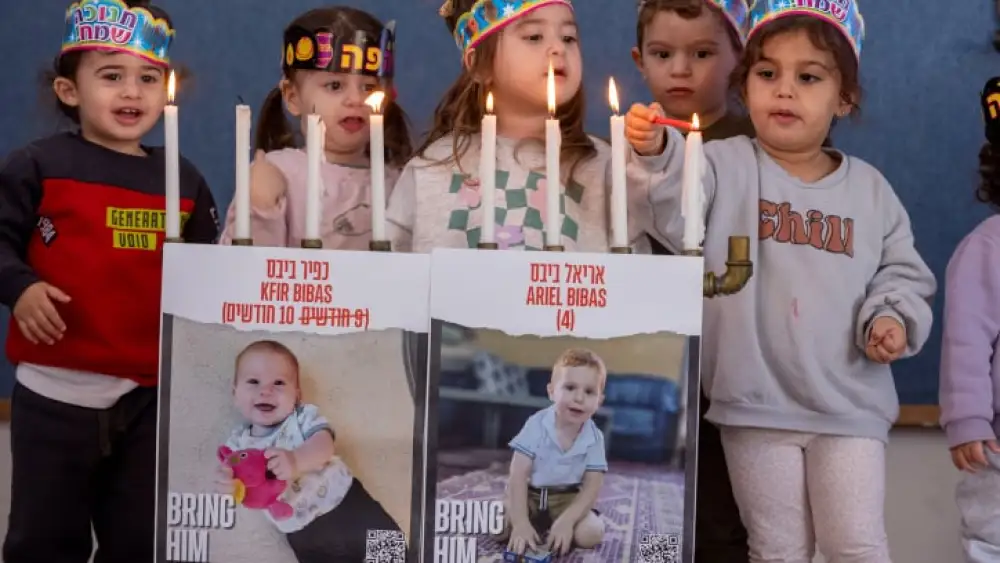

On Aug. 5, Ariel Bibas should have celebrated his sixth birthday.
Instead, Ariel, his baby brother Kfir, and their 32-year-old mother, Shiri, were murdered by the same Hamas terrorists who held them hostage for months and then extinguished their lives in cold blood.
It’s been almost two years since Hamas launched its genocidal assault on Israeli civilians. For nearly 700 days, Israel has fought a war not of conquest, but of rescue. A war to bring its sons and daughters home. A war to uphold the sanctity of life against an enemy that worships death.
And still, 20 live hostages remain in Hamas captivity. Another 30 are believed to be dead.
This war has cost Israel dearly: Some 800 soldiers have fallen. It has tested the nation’s resolve, challenged its leadership and forced the Israel Defense Forces to fight with one hand tied behind its back—to preserve the lives of those still in the terrorists’ clutches.
This war was never about occupying Gaza. The world may indulge in that fantasy, but Israel never wanted it back. In 2005, Israeli Prime Minister Ariel Sharon withdrew unilaterally, evacuating thousands of Israeli families in the hope of peace. Instead, Gaza became a jihadist stronghold—a launching pad for rockets, tunnels and terror.
And yet, even now, Israel continues to weigh every military option through one lens: how to bring the hostages home alive.
Hamas, meanwhile, continues to act with barbaric cynicism. It has rejected every reasonable deal. It has used food and medicine as tools of extortion. It has hidden its leadership and captives inside hospitals, schools and U.N.-run shelters. It starves its own people, then blames the Jewish state. And shamefully, much of the international community still enables this grotesque theater.
The IDF has identified new areas in Gaza, particularly in the Mawasi region, where intelligence suggests the hostages may be held. These areas are densely packed with displaced civilians, whom Hamas deliberately uses as shields. Any potential incursion would require surgical precision.
Chief of Staff Lt. Gen. Eyal Zamir is reportedly wary of the risks such operations pose to the remaining captives. Israeli Prime Minister Benjamin Netanyahu and Defense Minister Israel Katz are pressing for more assertive action.
The Israeli war cabinet remains divided on the exact path forward. What is not in question is the goal: to bring the hostages home. Alive if possible. Dead if necessary, for their families deserve the dignity of a grave, not the limbo of uncertainty.
In private, some officials concede what few dare say aloud: Hamas understands only force. It sees negotiation as weakness. For Hamas, territorial control is sacred. Death is not a price; it is the currency of their jihad. And yet, even after almost 700 days of Hamas atrocities, Western voices still moralize, lecture and equate the hostage-takers with those trying to rescue them.
Why? The West claims to cherish life. Israel actually does. That’s why, unlike any other nation, the Jewish state is still fighting—day after day, week after week—to recover its citizens.
This war will end when the hostages come home. Until then, Israel will not relent. Not for the United Nations. Not for the headlines. Not for the applause of a hypocritical world.
Because Ariel, Kfir and Shiri Bibas weren’t statistics. They were human beings. And 20 others still languish in hell.
Israel will not abandon them. Ever. But to free the hostages, there is only one way—defeat Hamas completely.