… An equation between Israel and Nazism could only be made by “someone who is only totally ignorant of what Nazism was, or was indifferent to it.” – Israeli Foreign Minister Golda Meir in a rebuttal of the Saudi Ambassador, Ahmed Shukeiry, at the United Nations, Oct. 18,1961.1
The war of lies against Israel: the problem in historical perspective
Since the era of World War I, inversion of truth and reality has become a favored method of public persuasion. One of its most frequent expressions has been the accusation that the Jewish people have become the new Nazis, aggressors and oppressors. Contemporary observers have described this method as the “inversion of reality,” an “intellectual confidence trick” and “reversal of moral responsibility,” and these accusations have not been refuted; they have gradually gained credence.
Since inversion of reality constitutes the basic principle of current anti-Israel propaganda, it is important to understand how it works. This propaganda method is a product of totalitarian regimes, particularly of Nazi Germany. It is totalitarian both in its methods and in the absolute solution it advocates. It emphatically denies Israel’s legitimacy, sovereignty and right to self-defense. It strives to dominate public spaces (which now include social media) and, through constant social and political intimidation, creates a condition of groupthink supported by the madness of zombies on the streets.
The purpose of this essay is to describe the origins of the Big Lie, its enablers and, to the extent possible, identify its cultural consequences.
The big lie as a propaganda method: its original source
If one studies the Big Lie as a weapon of political warfare, it becomes clear that Nazi ideologues perfected it. They openly took pride in this accomplishment and credited the British for showing the way. During the Great War, British propaganda successfully encouraged the desertion of the Central Powers’ troops from the front and demoralized the public at home. Hitler, for his part, emphasized the British use of atrocity propaganda and complained that Imperial Germany never understood the importance of propaganda and those who dealt with it were incompetent.
One tool that the British employed was atrocity propaganda. Their most remarkable accusation was that Imperial Germany created a “cadaver exploitation establishment,” the so-called Kadaververwerkungsanstalt, for the production of soap. British atrocity propaganda had been effective, but after the war, the public felt duped. It left a residue of distrust, betrayal and a mood of nihilism. This approach worked in the short term but opened a Pandora’s Box.
On the eve of World War II, the memory of atrocity propaganda provided a compelling argument against American intervention on the side of Britain and contributed to the denial of sympathy for Jews in their moment of dire need. In the United States, where isolationist sentiment ran strong, influential politicians accused the British of having “tricked America into war.” Furthermore, in the 1930s, when Nazi Germany began to perpetrate real atrocities, many refused to believe the reports.
For example, historian Robert Jan van Pelt reported in The Case for Auschwitz, that:
Adolf Hitler advocates the big lie
During World War I, the British disseminated propaganda over a limited period but stopped at the conclusion of hostilities. Fearing that Britain’s wartime propaganda machinery would be turned against him, Lloyd George quickly dismantled it.4 Nevertheless, World War I paved the way for the rise of totalitarian dictatorship. The wartime experience not only undermined the traditional order in Russia, Austria-Hungary, Germany and Italy, but also “hastened the development of the industrial arts, weapons, communications and management which facilitated the totalitarian thrust.”5
According to Hitler, British propaganda experts produced the original “Big Lie.” In his view, they spread the paranoiac myth that Imperial Germany was the innocent victim of British mendacity. A few citations from Vol. 1, Ch. 6, “War Propaganda,” of Mein Kampf, published in 1925 and 1926, reveal Hitler’s grasp of the method. According to Hitler, the British spread certain lies, particularly the accusation of atrocities, and that “the German enemy” was “the sole guilty party for the outbreak of war.” Later in the same chapter, he commented on its cost-effectiveness and the need for scale. He explained that it was more desirable to tell big lies rather than small ones.
All advertising, whether in business or politics, achieves success through the continuity and sustained uniformity of its application.
Here, too, the example of enemy war propaganda was typical; limited to a few points, devised exclusively for the masses, carried on with indefatigable persistence. Once the basic ideas and methods of execution were recognized as correct, they were applied throughout the whole war without the slightest change. At first, the propaganda’s claims were so impudent that people thought it insane; later, they got on people’s nerves, and in the end, they were believed.
After four and a half years, a revolution broke out in Germany, and its slogans originated in the enemy’s war propaganda.
And in England, they understood one more thing: that this spiritual weapon can succeed only if applied on a tremendous scale, and that success amply covers all costs.6
In 1939, Harold Nicolson, a former British diplomat who had once been posted in Germany, wrote a penetrating analysis, Why Britain is at War. In this brief study, he emphasized Hitler’s methods, drawing on passages from Mein Kampf:
It is noteworthy that Hitler recommended sticking to an argument even if one knows it is not true rather than to provoke discussion. That is, one must add the element of stubborn one-sidedness in order to spread a big lie. A dangerous cultural consequence is its cumulative impact, which results in the creation of a totalitarian reality based on a state-sponsored myth.
The creation of a “fictional world of untruth” as a totalitarian tool
Having the means to control the total environment, block competing information through the use of terror and coercion, and project their messages both domestically and abroad, the new totalitarian regimes could bend the truth as long as their power held out. Thus, they were able to transform what originally had been a finite moment of untruth into a sustained artificial reality.
Indeed, the Bolsheviks were the first to adopt propaganda in peacetime. Shortly thereafter, Hitler emulated them. E. H. Carr explained: “The Bolsheviks, when they seized power in Russia, found themselves desperately weak in the ordinary military and economic weapons of international conflict. Their principal strength lay in their influence over opinion in other countries; and it was therefore natural and necessary that they should exploit this weapon to the utmost.” 8
Hannah Arendt explained how totalitarian propaganda constructs a competing fictional world of untruth, possessing its own internal logic. Herein, one may identify the big jump from the inversion of the truth to the inversion of reality. Totalitarian propagandists took the idea of the Big Lie and prolonged its duration to create an alternative new reality:
The mere prevalence of certain ideas can spread a kind of poison that makes one subject after another impossible for literary purposes.”10 He developed this discussion by describing how the totalitarian structure inhibits literary creativity:
Thus, the writer or influencer in the service of a totalitarian regime cannot function without compromising his (or her) integrity.
Some Palestinian lies and their cultural consequences
In a discussion of the Big Lie as part of the Palestinian war against the Jewish state and Jews in general, we have described the method of the Big Lie as a propaganda tool. Following this approach, it is too easy to attach disproportionate weight to the world of untruth and big lies. It is a serious mistake to regard the basic historical facts as the antithesis of a fraudulent narrative. A verifiable fact should be the first premise and baseline. One should begin with the truth and refuse to be ensnared in a web of competing propaganda lies.
We may give two examples: a documented historical fact on the one hand and the calculated use of a Big Lie on the other. For the sake of historical perspective, one would do well to consider Ben Gurion’s first premise, which he described on Jan. 7, 1937, to the Peel Commission:I say on behalf of the Jews that the Bible is our Mandate, the Bible which was written by us, in our own language, in Hebrew in this very country. That is our Mandate. It is only recognition of this right which was expressed in the Balfour Declaration.12
“A bovine figure with silver hair and a diamond-dripping Syrian wife, Alia, Mohsen was an armchair revolutionary if there ever was one. He was known in Beirut as Mr. Carpet, because of all the Persian carpets he and his men had stolen during the Lebanese civil war. When the rigors of the revolution became too much for him, Mohsen would split to an apartment he kept on the famous La Croisette Promenade in Cannes, probably the most expensive stretch of real estate on the French Riviera.”14
The falsification of history as part of the big lie
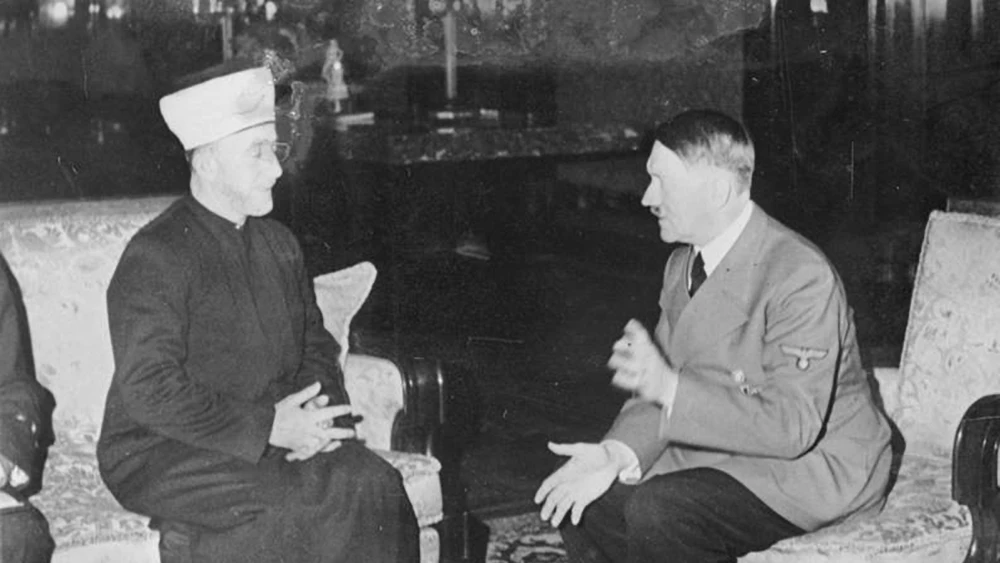
The Palestinian story has several layers, and one of the most important, which has usually been suppressed, is the collaboration of the Mufti of Jerusalem, Haj Amin al Husseini, with the Third Reich. Recent scholarship by the Swiss historian, Werner Rings, “names four different forms of collaboration, according to the degree of identification with the ideology of Nazism: tactical, neutral, conditional and unconditional collaboration.”16
There can be no doubt that Amin al-Husseini was an “unconditional collaborator” on the ideological level and an unequivocal supporter of the Final Solution.
Accordingly, it is important to present the Mufti in his own words. The message of these primary sources is relevant in the light of accusations that the Israelis have become the new Nazis and carry out genocide. For his part, Haj Amin consistently declared that Jews were the common enemy of Islam and of Nazi Germany.17 He frequently went on tour to encourage the Balkan SS Muslim units, and the Axis radio stations faithfully covered these visits. During his broadcast of January 21, 1944, he proclaimed:
The following are the Mufti’s words at an official protest rally held in Berlin on November 2, 1943, the anniversary of the Balfour Declaration:
While the misdeeds of the Third Reich have been formally documented, and a representation of war criminals was held accountable in Nuremberg. This did not include Haj Amin. One of the reasons that he escaped accountability was explained in the Interactive Encyclopedia of the Palestine Question:
Thus, a major aspect of the history of the Palestinian Arab movement is the fact that they have refused to come to terms with their own Nazi past. In contrast, a good number of German historians and industrialists has in good faith, engaged in this confrontation with the past.
Ahmed Shukairy, ideologue of the Palestine-Arab movement
The ideological continuation of the Mufti’s positions may be found in the wisdom of Achmad Shukairy, author of the Palestine Covenant and the first Chairman of the Palestine Liberation Organization. When discussing the characteristics of this movement, one must include the Covenant’s different versions from 1964 onward. It provides a codified statement that embodies its myths and goals. At first, it had little impact, but over time it became the PLO’s credo. The former chief of the Romanian secret service who came over to the West, Ion Mihai Pacepa, disclosed that:
Ahmad Shukairy (1908-1980) was known for his rhetorical skills, but on the eve of the Six-Day War, on May 22, 1967, went too far when he called on the Arabs “to throw the Jews into the sea.” This outburst discredited the cause of the Palestinian Arabs.
A scholarly reader of the Middle East Forum, using the pen name “Gloria,” wrote that, “After the Six-Day War, realizing the great damage it had done to Arabs, Arab propagandists, including Shukairy himself, tried, somehow to “transform” his statement from the meaning of annihilation (or ‘ethnic cleansing’), but it was too late, the clarity of his authentic genocide message was already publicized.”
“Gloria” referred to Shukairy as the “Arab-Nazi mastermind” of “Arab Palestine” by accusing Israel of the crime of the Arabs, that of Nazism. Although Shukairy was the first head of the Palestine Liberation Organization and had drafted the Covenant, he was removed from office because of the embarrassment he had caused. It is also possible to make a reasonable guess as to the identity of “Gloria.” He was, most likely, the late Prof. Barry Rubin, founder and director of the Global Research in International Affairs Center (GLORIA) at Reichman University in Herzliya. Daniel Pipes, who published the Gloria contribution, described Shukeiry as the “Genocidal pro-Nazi Arab Leader,” and “father of the apartheid slander.”22
There has been a tendency to underestimate the importance of Shukairy and the pervasiveness of his thought. He was more than an “Arab-Nazi mastermind.” It would be more accurate to view him as the ideologue of the Palestinian Arab cause. Under the British Mandate, Shukairy had been a member of the Arab Higher Committee, which the Mufti of Jerusalem founded in 1936 for the purpose of opposing the compromise of partition that the Peel Commission proposed. His outlook is reflected in the text of the Palestinian Covenant, in his participation in U.N. debates as Saudi Arabia’s ambassador and in his general writings.
Once more, we face the Big Lie. The problem here is that Shukairy, who delivered an “authentic genocidal message,” really meant what he said, and the main task of subsequent Palestinian messaging became to cover up their real goal, politicide, the destruction of the State of Israel and its people, and to create a veneer of respectability that would permit the PLO to pass in polite society.
When we examine the basic premise of the Palestinian-Arab movement, we should consider the contributions of its leading proponents: Haj Amin al-Husseini, Ahmed Shuqairy and Yasser Arafat. According to Shukairy, the only way to solve the problem of Israel would be to destroy the Jewish state and drive the Jews out through uncompromising armed struggle.23
Prof. Yehoshafat Harkabi, head of Israeli military intelligence from 1955-1959, recognized the importance of the Covenant and carefully analyzed its content. He considered the absoluteness of its message was inherently totalitarian:
The following statement by Arafat in 1974 during a visit to Venezuela confirms the continuity of the main goal described above:
In retrospect, we may be certain that Arafat’s Venezuela statement was intentional. Again, Hannah Arendt contributed an insight with regard to this type of statement: “In order not to overestimate the instances of the propaganda lies one should recall the much more numerous instances in which Hitler was completely sincere and brutally unequivocal in the definition of the movement’s true aims, but they were simply not acknowledged by a public unprepared for such consistency.”26
The first premise of the Palestinian-Arab movement as expressed in primary sources
Shukairy serves as the link between Nazi thought and the present. We can learn from his speeches at the United Nations, where he served as the Saudi Ambassador from 1957 to 1962. There, he expressed himself in language that was contemptuous and uncouth.
On Oct. 3, 1961, he declared that “Israel’s emergence to independence was not the legitimate establishment of a legitimate state, since Israel was ‘the embodiment of imperialism, the symbol of colonialism, the fruition of capitalism and the author … of anti-Semitism.’”
He concluded by denouncing what he termed the United States’ “support for this flagrant injustice called Israel and its treatment as if it were ‘the fiftieth state of the United States.’”27 In the production of propaganda, the technique of ganging epithets together is called “amalgamation,” a method consistent with his accusations of “racism,” “Nazism,” “genocide” and “apartheid.”28 Generally, we get only one side of the story, but on this occasion, the representative of Israel at the U.N., Foreign Minister Golda Meir, was present and answered Shukairy. [She] pointed out that the Arab-Israel conflict was only one source of tension in the area, hostility to Israel being ‘largely a means used by Arab leaders to divert the attention of their peoples from their own unsolved problems and hardships.’ Meir observed that she ‘could not help wondering why he did not worry less about other countries, and worry more about the state of affairs in his own [which at the time was Saudi Arabia].’ 29
During the same year, the Eichmann trial began on April 11, 1961. The issue of accountability for war crimes was a sensitive matter, and we can understand Shukairy’s accusation against Israel as a form of projection, accusing the “Zionist entity” of Nazi crimes, many of which the Palestinian-Arab leadership of the Mandatory era had enthusiastically supported.
The unstated motive for his accusations was to divert attention from this collaboration with the Third Reich and to revive their use with renewed emphasis. On Oct. 17, 1961, Shukairy “denied Israel’s right to try Eichmann since Israel was ‘another Eichmann in a State.’”30 Imagine a self-identified Palestinian-Nazi sympathizer accusing the Jewish State of Nazism!
On the following day, Oct. 18, Foreign Minister Meir delivered a vigorous counterattack.“In reply to Shukairy, the Israeli FM expressed surprise that ‘this vicious speech with its racial incitement … and its outright falsehoods,’ had been allowed to continue unchecked.” She then added that ‘…. An equation between Israel and Nazism could only be made by “someone who is only totally ignorant of what Nazism was, or was indifferent to it.”’
Indeed, she added, Shukairy had once been a member of the Arab Higher Committee [The central political organ of the Palestinian Arabs in Mandatory Palestine] whose leader [Haj Amin al-Husseini] had spent the war years in Germany. As for the suggestion for a commission to investigate the conditions of the Israeli Arabs, Mrs. Meir declared that she believed ‘that a rather more urgent investigation would be more appropriate in regard to the question of slavery in Saudi Arabia.’”31
At present, we live with the direct legacy of the Nazi past of the Palestinian Arabs and their sympathizers in the form of a massive antisemitic propaganda attack, particularly the accusation of genocide against Israel that followed the Hamas attack of Oct. 7, 2023. The time has come to expose such big lies and challenge “the masses” who “will fall victims to a big lie more readily than to a small one, for they themselves only tell small lies, being ashamed to tell big ones [Mein Kampf].”
Originally published by the Jerusalem Center for Security and Foreign Affairs.
* * *
Notes
- Middle East Record (Vol 2, 1961), 188.↩︎
- The Christian Century, as quoted by Robert Jan van Pelt, The Case for Auschwitz: Evidence from the Irving Trial (Bloomington: Indiana University Press, 2002), 133-34.↩︎
- Ibid., 133.↩︎
- Taylor, British Propaganda, 231.↩︎
- Carl J. Friedrich, “The Rise of Totalitarian Dictatorship,” in Jack J. Roth, ed., World War I: A Turning Point in History (New York: Knopf, 1968), 53-54.↩︎
- “Hitler on War Propaganda from Mein Kampf, Volume One: A Reckoning,
Chapter VI: ‘War Propaganda,’”↩︎ - Harold Nicolson, Why Britain is at War (Harmondsworth: Penguin, Reprint 1940), 30. The original German of this passage may be found in Book 1, early in Ch, 10, under the rubric #252: “Moralische Entwaffnung des gefährlichen Anklägers.”↩︎
- E. H. Carr, Propaganda in International Politics (Oxford: Clarendon Press, 1939), 13.↩︎
- Hannah Arendt, The Origins of Totalitarianism, 2nd ed. (New York: Meridian, 1958), 361.↩︎
- George Orwell, “The Prevention of Literature,” (1946), in The Collected Essays Journalism and Letters of George Orwell, Vol. 4. In Front of Your Nose, 1945-1950 (Harmondsworth, Penguin, 1970), 90.↩︎
- Ibid., 95.↩︎
- Coner Cruise O’Brien, The Siege (New York: Simon & Schuster, 1986), 225.↩︎
- James Dorsey, “Zoehair Mohsen vertrouwt alleen op Syrie; ‘Wij zijn alleen Palestijn om politieke reden’”, Trouw, March 31, 1977, 7. [Dutch]↩︎
- Thomas L. Friedman, From Beirut to Jerusalem (New York: Anchor Books, 1989), 118, and 107/108.↩︎
- Mein Kampf, as cited by Harold Nicolson, Why Britain is at War, 23.↩︎
- Werner Rings, Life with the Enemy: Collaboration and Resistance in Hitler’s Europe, 1939-1945 (Garden City, N. Y.: Doubleday, 1982), as referred to by Johannes Houwink ten Cate, Jewish Political Studies Review, 26, 3-4 (Fall 2014), 96.↩︎
- Gerald Fleming, Hitler and the Final Solution (Berkeley: University of California Press, 1984), 101-05. This chapter describes the ex-Mufti’s visit to Hitler on 21 November 1941 and contains the protocol of their discussion.↩︎
- Maurice Pearlman, Mufti of Jerusalem: The Story of Haj Amin el Husseini (London: Gollancz, 1947), 64.↩︎
- “Rede zum Jahrestag der Balfour Erklȁrung, 2. 11. 1943, Gerhard Höpp, ed. Mufti-Papiere (Berlin: Klaus Schwarz, 2002), 197, 198. As quoted by Joel Fishman, “The Recent Discovery of Heinrich Himmler’s Telegram of November 2, 1943, the Anniversary of the Balfour Declaration, to Amin al Husseini. Mufti of Jerusalem.” Jewish Political Studies Review, Vol. 27, Nos. 3 -4 (Fall 2016): 77-87. https://jcfa.org/article/heinrich-himmlers-telegram-balfour-declaration-amin-al-husseini-mufti-jerusalem/↩︎
- Interactive Encyclopedia of the Palestine Question, Muhammad Amin al-Husseini, https://www.palquest.org/en/biography/6563/muhammad-amin-al-husseini↩︎
- “From Russia with Terror,” interview of Ion Mihai Pacepa by Jamie Glazov, 1 March 2004, www.frontpagemag.com/Articles/Printable.asp?ID=12387.↩︎
- Daniel Pipes, “1961: Genocidal pro-Nazi Arab leader: Ahmad Shukairy, ‘father’ of ‘Apartheid’ slander,” Middle East Forum, https://www.danielpipes.org/comments/186160.↩︎
- Ahmad Shukairy, Liberation – Not Negotiation (Beirut: Research Centre – PLO, 1966); Robert Wistrich, Between Redemption and Perdition: Modern Antisemitism and Jewish Identity (London and New York: Routledge, 1990), 218.↩︎
- Y. Harkabi, The Palestine Covenant and its Meaning (London: Vallentine, Mitchell, 1979), 12, 13.↩︎
- Robert S. Wistrich, A Lethal Obsession; Anti-Semitism from Antiquity to the Global Jihad (New York: Random House, 2009), 703.↩︎
- The Origins of Totalitarianism, 343.↩︎
- “Arab-Israel Conflict of General Debate in the UN General Assembly, Sixteenth Session” (September-October) Middle East Record (Vol 2, 1961), 188.↩︎
- Bernard Lewis, “The Anti-Zionist Resolution,” Foreign Affairs (October 1976): 54-64. Here he gave examples of the similarity of language in early anti-Zionist propaganda.↩︎
- Middle East Record (Vol 2, 1961), 188.↩︎
- Ibid.↩︎
- Ibid., 189.↩︎