Newsletter
Newsletter Support JNS

Biden warns he will veto Israel funding bill proposed by House

The Office of Management and Budget said the legislation was “bad for Israel, for the Middle East region and for our own national security.”

White House
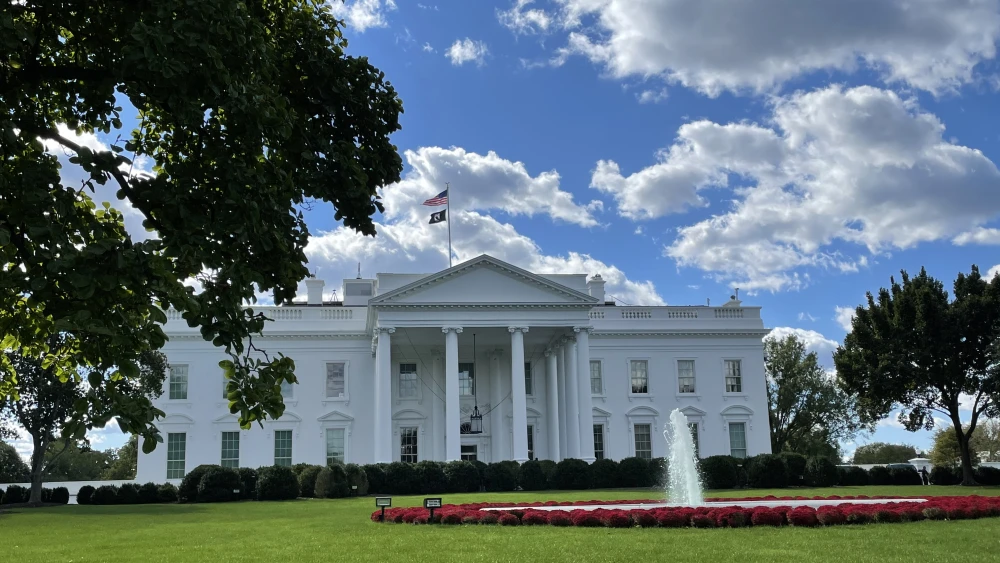
The White House in Washington, D.C. Photo by Menachem Wecker.

Congressional Republicans’ efforts to decouple U.S. President Joe Biden’s proposed aid for Israel and Ukraine have met with opposition from the White House.

Proposed legislation in the U.S. House of Representatives for $14.3 billion for Israel would draw money from cutting the budget of the Internal Revenue Service. It would also remove proposed humanitarian aid to Palestinians.

House Speaker Mike Johnson (R-La.) has insisted that “Israel is a separate matter” from Ukraine and that he seeks to bifurcate the two wars.

The proposal is “bad for Israel, for the Middle East region and for our own national security,” said the White House’s Office of Management and Budget (OMB). “The bill fails to meet the urgency of the moment by deepening our divides and severely eroding historic bipartisan support of Israel’s security.”

OMB added that the legislation “inserts partisanship into support for Israel, making our ally a pawn in our politics at a moment we must stand together.”

The Senate also opposes the House’s standalone Israel funding bill.

Senate Majority Leader Chuck Schumer (D-N.Y.) responded by saying: “The bottom line is, it’s not a serious proposal.”

The U.S. president ordered a third consecutive night of strikes against the Islamic Republic.
“I knew I was gonna be fighting antisemitism,” Inna Vernikov, a Republican, told JNS. “I didn’t see politicians doing that on a big scale. I just saw a lot of pandering on both sides.”
Prosecutors said that fingerprint, surveillance footage and key-card records link the suspect to more than 20 threatening campus messages.
U.S. Secretary of State Marco Rubio says Washington will press allies to withdraw from the Hague-based court while weighing sanctions, visa bans and other measures against its officials.
Dinaw Mengestu wrote on Instagram that he left because of an “ongoing failure to defend free expression fairly and equitably.”
“Whoever ends up getting this seat, they’re not going to have as much foreign policy experience as Lindsey Graham,” Christopher Cooper, a political science professor at Western Carolina University, told JNS.