


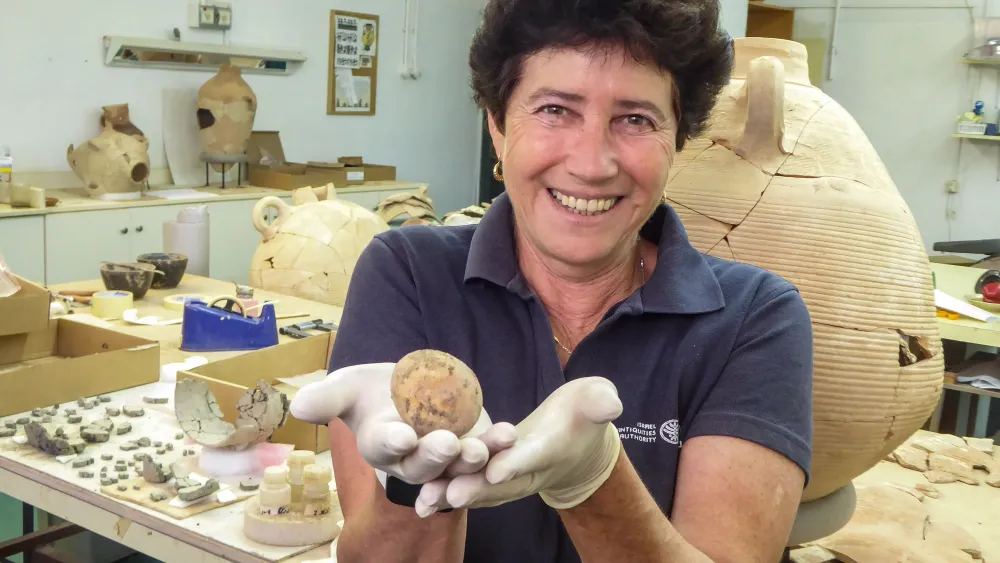
An intact chicken egg dating back to the Islamic period 1,000 years ago was discovered in Yavne, the Israel Antiquities Authority announced on Wednesday.
IAA archaeologists came upon the unbroken egg in an ancient cesspit during large-scale excavations at a site in the central Israeli city that revealed an extensive industrial area from the Byzantine period.
“Eggshell fragments are known from earlier periods, for example in the City of David and at Caesarea and Apollonia,” said the IAA’s Lee Perry Gal, a leading expert on poultry in the ancient world. “But due to the eggs’ fragile shells, hardly any whole chicken eggs have been preserved.”
“Even at the global level, this is an extremely rare find,” added Gal, pointing out that archeological digs occasionally uncover ancient ostrich eggs, whose thick shells preserved them.
“Even today, eggs rarely survive for long in supermarket cartons,” said IAA archaeologist Alla Nagorsky, excavation director at the site where the egg was found. “It’s amazing to think this is a 1,000-year-old find!”
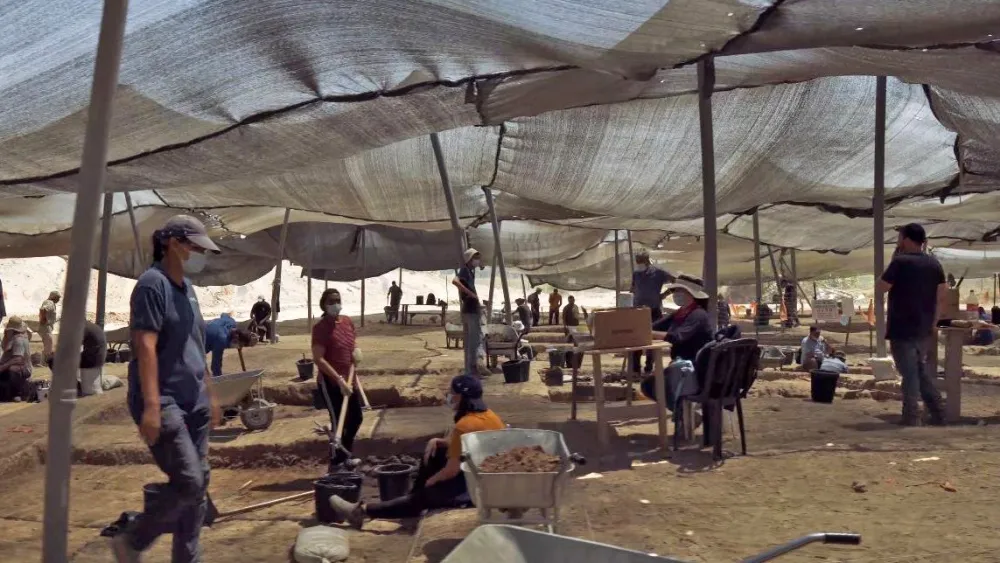
Nagorsky attributes its “unique preservation” to the “conditions in which it lay for centuries, nestled in a cesspit containing soft human waste.”
Nevertheless, said the IAA, “Despite the extreme caution with which the egg was removed, under the experienced supervision of a conservationist, its shell—preserved whole by the unusual anaerobic conditions—was cracked.”
It was restored to the state in which it was found, however, at the IAA organics laboratory by conservationist Ilan Naor.
The IAA said that it’s unclear how the egg ended up in the cesspit, but other “exciting finds were retrieved from the same pit, including three typical Islamic-period bone dolls used as playthings some 1,000 years ago.”
According to the IAA, poultry farming was introduced in Israel 2,300 years ago, during the Hellenistic and Early Roman periods. During the Islamic period, from the seventh century C.E. onwards, there was a marked decrease in the percentage of pig bones at sites in the region, reflecting the prohibition on eating pork.
“Families needed a ready protein substitute that didn’t require cooling and preservation, and they found it in eggs and chicken meat,” explained Gal. “Unfortunately, the egg [unearthed in Yavne] had a small crack in the bottom, so most of the contents had leaked out of it. Only some of the yolk remained, which is being preserved for future DNA analysis.”



