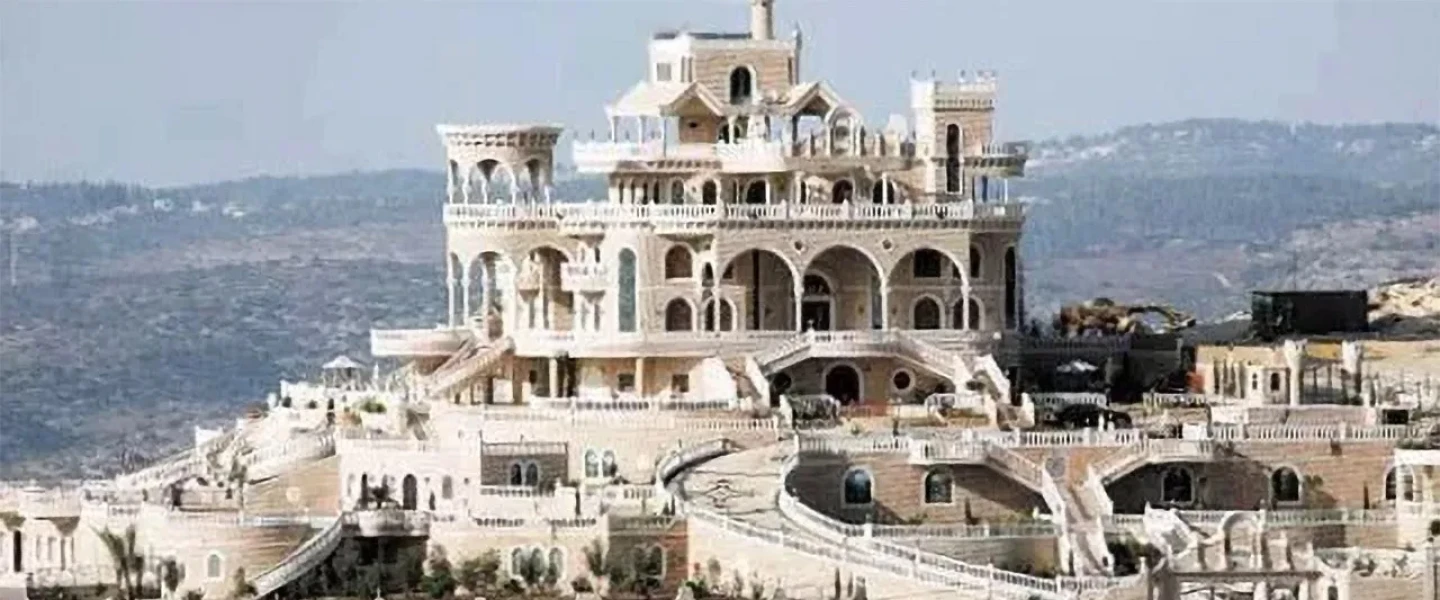
A surprising degree of luxury exists alongside poverty in Palestinian Authority-controlled areas of Judea and Samaria, according to a study by the Jerusalem Center for Security and Foreign Affairs.
The report presents what its authors describe as an often overlooked picture of Palestinian living standards, documenting villas, hotels, shopping centers, universities and other signs of prosperity alongside longstanding refugee camps.
“Alongside the slums of the old refugee camps … a parallel Palestinian society is emerging,” the report states.
Palestinian refugees
The U.N. Relief and Works Agency defines Palestine refugees as people whose normal place of residence was Palestine between June 1, 1946, and May 15, 1948, and who lost both their homes and livelihoods as a result of the 1948 war. Descendants of male Palestine refugees are also eligible for registration with the agency.
The Jerusalem Center report argues that this definition has perpetuated refugee status across generations and contrasts it with the definition used by the U.N. High Commissioner for Refugees.
According to figures cited in the study, 762,288 registered Palestine refugees lived in 19 camps in Judea and Samaria. The report also cited The Economist as reporting that almost 70% of Palestinian refugees in the territory lived outside refugee camps.
The report argues that the Palestinian leadership and Arab states historically opposed permanent resettlement because doing so could undermine Palestinian claims to a “right of return” to Israel.
Another side of Palestinian life
The study says that decades of Western aid and economic development have produced visible improvements in living standards in parts of Judea and Samaria, including newly constructed homes and commercial buildings, late-model cars and luxury goods.
Marwan Asmar, a Jordan-based journalist who returned to the area after 30 years, described a transformation in the village of Huwara.
“One can see a buzz of activity at the shops, restaurants, offices and cafes,” he wrote. “Buildings, villas, mosques and rest areas have been constructed everywhere. There is even a swimming pool.”
The report argues that such scenes complicate a picture of Palestinian life focused exclusively on poverty, unemployment and refugee camps.
Indicators of quality of life
The study compiled a series of economic and social indicators. It cited a poverty rate in Judea and Samaria of 18%, life expectancy of 76 years and a literacy rate of 96.5% among those aged 15 and older.
It also cited an infant mortality rate of 13 per 1,000 live births in Judea and Samaria and the Gaza Strip.
The report noted that Palestinians have received billions of dollars in international assistance since the establishment of Palestinian self-rule in the 1990s, making them among the world’s largest per-capita recipients of foreign aid.
Palestinian employment in Israel
The study also highlighted the role of Palestinian employment in Israel.
It cited an article in the Palestinian Authority’s official Al-Hayat Al-Jadida newspaper describing higher salaries and better employment benefits for Palestinians working for Israeli employers than for Palestinian ones.
“The [Israeli] work conditions are very good, and include transportation, medical insurance and pensions,” the Palestinian newspaper was quoted as saying.
According to Palestinian human-rights activist Bassem Eid, some 92,000 Palestinians from Judea and Samaria were working in Israel each day at the time the study was prepared.
Signs of prosperity
A substantial portion of the study consists of photographs documenting affluent homes and commercial development across Judea and Samaria, including in Ramallah, Nablus, Bethlehem, Hebron, Jenin, Tulkarem, Jericho and other communities.
In Ramallah, the report documented multi-story villas, banks, office buildings, hotels and shopping centers. It noted the opening of the city’s first five-star hotel, a 172-room property that reportedly cost $40 million.
In Nablus, it described busy restaurants and shops, luxury cars, a shopping mall and large private homes.
Similar examples included villas around Bethlehem and Hebron, university facilities in Jenin and Birzeit, resorts near Jericho and the development of Rawabi, the first planned Palestinian city.
“This may not sound like the familiar description of the West Bank (Judea and Samaria)—the impoverished Palestinian village or the overcrowded refugee camp,” the report states.
The study concludes that poverty and refugee camps represent one part of Palestinian life in Judea and Samaria, while growing wealth, development and a prosperous segment of Palestinian society represent another.
Yael Kaplan, Ryan Hartney, and Andrew Felsenthal conducted the study for the Jerusalem Center for Security and Foreign Affairs (JCFA).